Property Communication Task Center
Sidewalk Closed — Use Alternate Route 🛡️ 2026 OSHA/FHA Compliant
Properly notify pedestrians of sidewalk closure due to active construction, establish ADA-compliant alternate routes, deploy OSHA-mandated barricades and overhead protection, and eliminate premises liability exposure for both the contractor and property owner.
Not just a template.
A reality execution tool.
Don't risk tenant disputes with messy Word docs. Generate a print-ready, OSHA-compliant physical notice in exactly 30 seconds.
- 1Bilingual Architecture English & Spanish integrated into a single US Letter design. Crucial for legal compliance in 14+ states.
- 2Toner-Friendly Print Engineered for black-and-white office printers. High contrast hierarchy ensures readability from 10 feet away.
- 3Locked Formatting Zero layout breakage. Type your details, and the engine physicalizes it without overflowing the page.
SIDEWALK CLOSED — USE ALTERNATE ROUTE
ACERA CERRADA — USE LA RUTA ALTERNATIVA
Why use this template?
- ✓ Bilingual output (English/Spanish) prevents FHA liability
- ✓ Formatted strictly for US Letter B&W physical printing
- ✓ Zero JS bloat, generates instantly in your browser
Print Output Preview
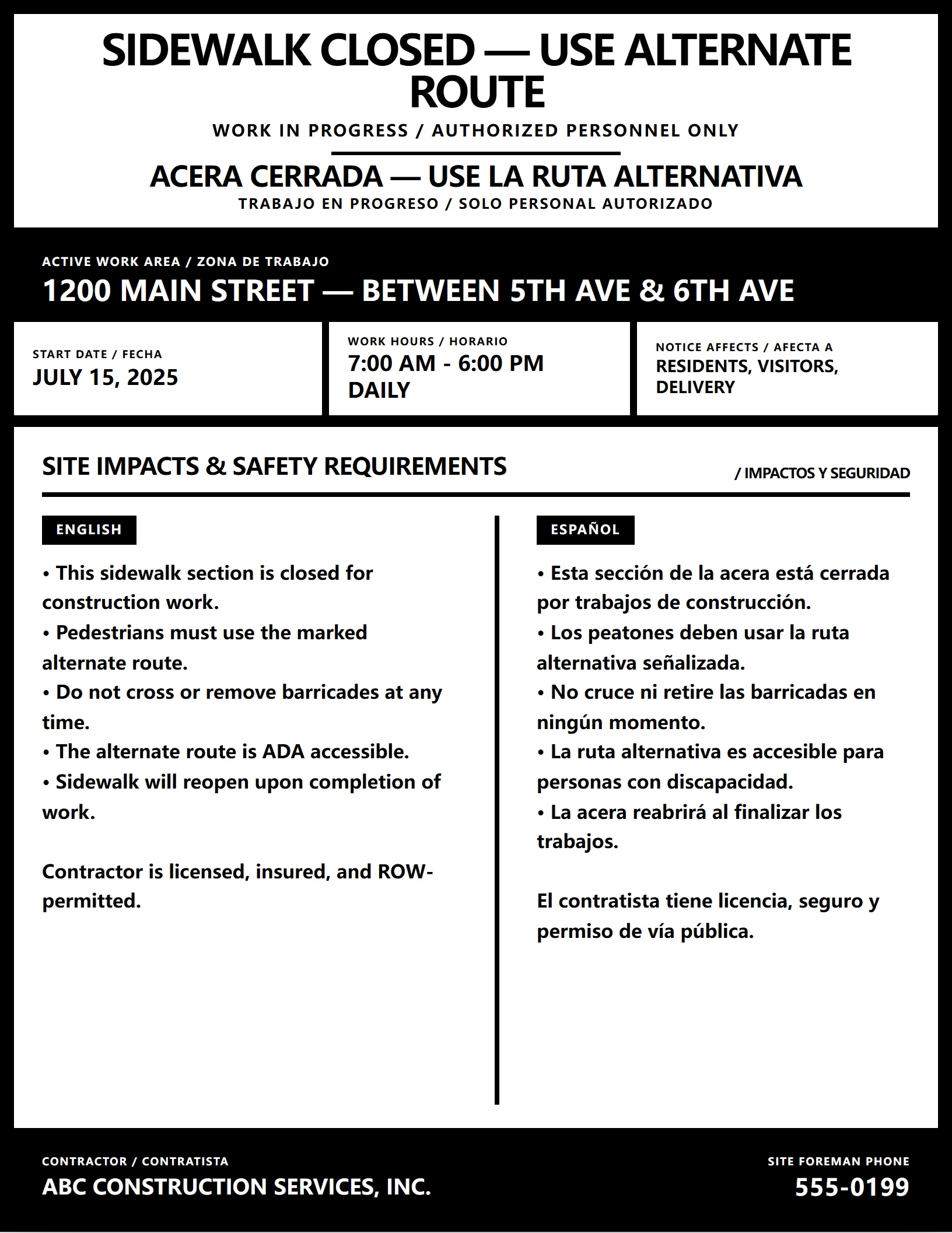
📋 Field Execution Asset
Download the OSHA-compliant manager checklist to ensure zero liability on-site.
🏠 Tenant Distribution Asset
Attach this prep-guide to your notice to reduce tenant front-desk calls by 60%.
Notice Editor & Preview
Edit Notice
Live Print Preview
US Letter • 8.5" x 11"
Legal Deadline Calculator
Powered by US Office of Personnel Management (OPM) rules.
Verify ROW Permit & Insurance
Post Advance Closure Notices
Deploy Barricades & Channelizing Devices
Establish ADA-Compliant Pedestrian Detour
Daily Barricade & Detour Inspection
Compliance & Legal Disclaimer: Calculations are strictly based on U.S. Office of Personnel Management (OPM) observed federal holiday rules and standard weekend exclusions. While this tool is designed for enterprise-grade accuracy regarding FLSA and standard property management protocols (e.g., CA Civil Code §1950.5), local municipal codes may vary. NoticeMint is a workflow software, not a law firm. Always verify critical statutory deadlines with your legal counsel.
Execution Protocol
Operational Timeline & Compliance Checklist
- 72 Hours Before Responsible: contractor
Verify ROW Permit & Insurance
⚠️Liability Alert
Operating without a valid ROW permit can result in stop-work orders, daily fines ($500–$5,000/day depending on jurisdiction), and automatic void of municipal indemnification protections.
💡Pro Strategy
Most municipalities require a Right-of-Way (ROW) or Street Activity permit before closing any public sidewalk. Verify the permit is approved, current, and posted on-site. Confirm general liability insurance ($1M minimum) covers sidewalk closure operations — many standard CGL policies exclude public ROW work.
- 48 Hours Before Responsible: contractor
Post Advance Closure Notices at Both ends of closure zone, Building lobby, Adjacent business entrances
💡Pro Strategy
Post bilingual notices at every pedestrian approach point — not just the closure itself. ADA Title II and local human rights ordinances in many jurisdictions require signage in the dominant language of the surrounding community.
- Start of Work Responsible: contractor
Deploy Barricades & Channelizing Devices
⚠️Liability Alert
Caution tape alone is NOT an acceptable barricade under OSHA 1926.200 or any major municipal code. Tape-only closures have resulted in multi-million dollar judgments when pedestrians — especially children — bypassed them and were injured.
💡Pro Strategy
Use Type III barricades (minimum 4 ft tall) at each closure endpoint. Fill the entire closure length with continuous channelizing devices (cones, drums, or jersey barriers) — gaps in the barrier line create "attractive nuisance" liability, especially near schools. Add detectable edge treatments (tapping rails at 27" and 80" height) for visually impaired pedestrians per ADA §4.4.
- Start of Work Responsible: contractor
Establish ADA-Compliant Pedestrian Detour
⚠️Liability Alert
Redirecting pedestrians across a busy street without a marked crosswalk or traffic signal creates catastrophic liability. If the only alternate route requires a mid-block crossing, you must deploy a flagger or temporary signal — not just a sign.
💡Pro Strategy
The alternate route must be comparable in length, surface quality, and accessibility to the closed sidewalk. Key requirements: minimum 48" clear width, firm/stable/slip-resistant surface, max 1:20 running slope (1:12 for ramps), and overhead clearance of 80" minimum. Use MUTCD-compliant "Sidewalk Closed — Use Other Side" (R11-2) or "Pedestrian Detour" signs with high-visibility retroreflective sheeting.
- Each Workday Start Responsible: contractor
Daily Barricade & Detour Inspection
⚠️Liability Alert
Nighttime and weekend periods without active workers still require full barricade maintenance. 47% of pedestrian construction-zone injuries occur during non-work hours when barriers have degraded or been vandalized.
💡Pro Strategy
Inspect all barricades, signs, and detour markers at the start of each workday. Document with timestamped photos. Replace any knocked-over signs, reposition displaced cones, and verify detectable edge treatments are intact. This daily log is your #1 defense against "inadequate maintenance" negligence claims.
- Upon Completion Responsible: contractor
Remove Barricades & Reopen Sidewalk
⚠️Liability Alert
Do NOT remove barricades until all overhead work is 100% complete. Premature reopening while crane or scaffolding operations continue above is an OSHA willful violation (up to $161,323 per instance in 2024).
💡Pro Strategy
Before reopening, sweep the entire sidewalk surface for debris, nails, wet concrete residue, and tripping hazards. Verify the surface is level and free of any temporary patches or ramps that were part of the detour. The sidewalk must be returned to its pre-construction condition or better.
- Within 4 Hours After Reopening Responsible: contractor
Remove Notices & File Documentation at Both ends of closure zone, Building lobby, Adjacent business entrances
⚠️Liability Alert
Failure to remove "Sidewalk Closed" signs after reopening trains pedestrians to ignore future signage (sign fatigue) and may constitute a code violation in some jurisdictions.
💡Pro Strategy
Remove all posted notices and retain copies in the project compliance file. Compile daily inspection photo logs, ROW permit copy, insurance certificate, and any incident reports. This documentation package is your litigation shield — retain for minimum 6 years (statute of repose for premises liability in most states).
Required Posting Locations
Physical Distribution Checklist
- Both ends of closure zone
- Building lobby
- Adjacent business entrances
Liability Defense Rule
Always take a timestamped wide-angle photo of the posted notice in its physical location. If a tenant claims they were not notified, this photo is your primary legal defense.
Tenant Communication Brief
Anticipated Questions & Official Responses
-
Q
How long will the sidewalk be closed?
- "The closure dates and hours are printed on the posted notice. Typical closures run 7 AM – 6 PM on workdays. The sidewalk will reopen each evening unless a 24-hour closure was specifically permitted.
-
Q
Is there an accessible alternate route?
- "Yes. An ADA-compliant pedestrian detour must be maintained at all times during the closure. Detour route signs with directional arrows are posted at each end of the closure zone.
Manager's Note
Providing these answers in your initial notice can reduce management office phone volume by up to 60% during service interruptions.
Operational Guidance
Industry Best Practices & Field-Tested Strategies
Verify the municipal Right-of-Way (ROW) permit is approved and posted on-site before deploying any barricades. Most cities impose $500–$5,000/day fines for unpermitted sidewalk closures.
Deploy Type III barricades (minimum 4 ft tall) at each closure endpoint with continuous channelizing devices along the full closure length. Caution tape alone is not an acceptable barricade under OSHA 1926.200.
Establish an ADA-compliant alternate pedestrian route before closing the sidewalk. The detour must meet minimum 48" clear width, firm/stable/slip-resistant surface, max 1:20 running slope, and 80" overhead clearance requirements.
Post bilingual (English/Spanish) notices at every pedestrian approach point — not just at the closure itself. Include clear directional arrows to the alternate route.
Conduct and photo-document daily barricade and detour inspections at the start of each workday. This log is your primary defense against "inadequate maintenance" negligence claims.
Install detectable edge treatments (tapping rails at 27" and 80" height) along the barricade line for visually impaired pedestrians per ADA §4.4 and PROWAG guidelines.
Remove all barricades, notices, and detour signage within 4 hours of sidewalk reopening. Retain the full compliance documentation package for minimum 6 years.
Manager Checklist
- Confirm contractor has valid municipal Right-of-Way (ROW) or Street Activity permit for the specific closure location and dates
- Verify contractor general liability insurance ($1M minimum) explicitly covers public ROW and sidewalk closure operations
- Review contractor's pedestrian protection plan — must include barricade layout, detour route map, and daily inspection schedule
- Confirm ADA-compliant alternate route has been surveyed — minimum 48" width, firm surface, proper slopes, and 80" overhead clearance
- Ensure bilingual (English/Spanish) advance notices are posted 48 hours before at all pedestrian approach points
- Notify adjacent businesses in writing — their customers and delivery access will be affected
- Verify MUTCD-compliant signage is on hand: "Sidewalk Closed — Use Other Side" (R11-2) or "Pedestrian Detour" signs with retroreflective sheeting
- Confirm detectable edge treatments (tapping rails) are included in the barricade setup for visually impaired pedestrians
- Establish daily barricade inspection photo documentation protocol with contractor
- Brief all on-site staff on the alternate route location so they can direct pedestrians who ask
- Verify contractor understands sidewalk must be returned to pre-construction condition or better before barricade removal
- File copies of ROW permit, insurance certificate, contractor license, and all posted notices in the project compliance folder
Common Costly Mistakes
- ✗ Using caution tape, rope, or orange netting as the sole barricade — these create "attractive nuisance" liability and have resulted in multi-million dollar judgments when children bypassed them.
- ✗ Failing to provide an ADA-compliant alternate route — redirecting wheelchair users or visually impaired pedestrians through inaccessible terrain is an ADA Title II/III violation with fines up to $75,000 for first offense.
- ✗ Posting closure notices only at one end of the closure zone — pedestrians approaching from the other end receive zero warning and are funneled directly into the hazard.
- ✗ Skipping daily barricade inspections — 47% of pedestrian construction-zone injuries occur during non-work hours when barriers have degraded, shifted, or been vandalized.
- ✗ Redirecting pedestrians across a busy street at a mid-block location without a marked crosswalk, flagger, or temporary signal — this creates catastrophic liability exposure.
- ✗ Leaving "Sidewalk Closed" signs posted after the sidewalk has reopened — sign fatigue trains the public to ignore all future construction signage, undermining community-wide safety.
- ✗ Not verifying contractor's insurance covers public Right-of-Way work — many standard CGL policies exclude ROW operations, leaving the property owner as the deep pocket in any injury lawsuit.
Resident Preparation Checklist
Include this checklist in your notice to reduce tenant calls by up to 60%
- ☐ Read the posted notice for exact closure dates and daily work hours
- ☐ Follow the marked alternate route — do not cross or remove any barricades
- ☐ If you use a wheelchair, walker, or stroller, verify the detour route is accessible before proceeding
- ☐ Report any missing, damaged, or knocked-over barricades to the management office or contractor immediately
- ☐ Keep children away from the barricaded construction zone at all times — barricades are not playground boundaries
- ☐ If the alternate route requires crossing a street, use only marked crosswalks and obey traffic signals
- ☐ After the sidewalk reopens, watch for uneven surfaces, fresh patches, or debris during the first few days
Frequently Asked Questions
Does a contractor need a permit to close a public sidewalk?
What are the ADA requirements for a sidewalk closure alternate route?
Can caution tape be used as a sidewalk barricade?
Who is liable if a pedestrian is injured in a sidewalk closure zone?
Are bilingual sidewalk closure notices legally required?
Disclaimer
- • A valid municipal Right-of-Way (ROW) permit is required before closing any public sidewalk — verify with your local DOT or Public Works department.
- • OSHA 1926.200 (Accident Prevention Signs and Tags) governs all construction-zone barricade and signage requirements for pedestrian protection.
- • ADA Title II and Title III, along with PROWAG (Public Rights-of-Way Accessibility Guidelines), govern alternate route accessibility standards.
- • MUTCD (Manual on Uniform Traffic Control Devices) Part 6 sets the national standard for pedestrian detour signage and channelizing devices in temporary traffic control zones.
- • General liability insurance must explicitly cover public ROW operations — standard CGL policies often exclude sidewalk closure work.
- • This template provides formatting and operational guidance only and does not constitute legal advice. Consult your construction attorney and insurance broker for jurisdiction-specific compliance.
- • Retain all compliance documentation (permits, insurance, daily inspection logs, posted notice copies) for minimum 6 years — the statute of repose for premises liability in most states.
Related Operational Tasks
Complete your communication workflow with these related notices