Property Communication Task Center
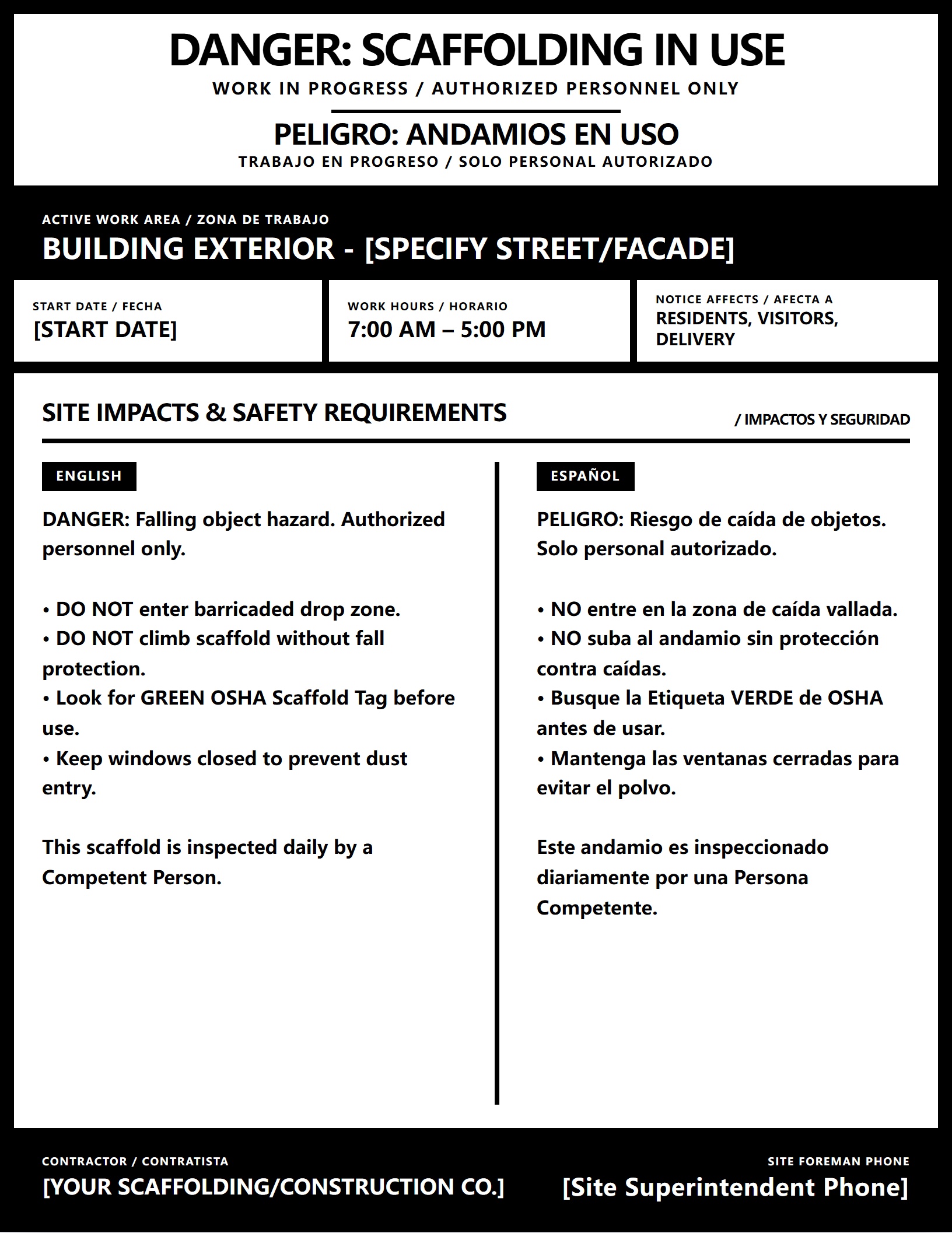
DANGER: SCAFFOLDING IN USE 🛡️ 2026 OSHA/FHA Compliant
Establish a legally compliant scaffold exclusion zone, warn pedestrians of overhead falling object hazards, enforce the OSHA Scaffold Tagging system, and prevent unauthorized climbing (Attractive Nuisance liability).
Not just a template.
A reality execution tool.
Don't risk tenant disputes with messy Word docs. Generate a print-ready, OSHA-compliant physical notice in exactly 30 seconds.
- 1Bilingual Architecture English & Spanish integrated into a single US Letter design. Crucial for legal compliance in 14+ states.
- 2Toner-Friendly Print Engineered for black-and-white office printers. High contrast hierarchy ensures readability from 10 feet away.
- 3Locked Formatting Zero layout breakage. Type your details, and the engine physicalizes it without overflowing the page.
DANGER: SCAFFOLDING IN USE
PELIGRO: ANDAMIOS EN USO
Why use this template?
- ✓ Bilingual output (English/Spanish) prevents FHA liability
- ✓ Formatted strictly for US Letter B&W physical printing
- ✓ Zero JS bloat, generates instantly in your browser
Print Output Preview
📋 Field Execution Asset
Download the OSHA-compliant manager checklist to ensure zero liability on-site.
🏠 Tenant Distribution Asset
Attach this prep-guide to your notice to reduce tenant front-desk calls by 60%.
Notice Editor & Preview
Edit Notice
Live Print Preview
US Letter • 8.5" x 11"
Legal Deadline Calculator
Powered by US Office of Personnel Management (OPM) rules.
Notify tenants of exterior scaffolding erection
Install toe boards, debris netting, and canopy walkways
Compliance & Legal Disclaimer: Calculations are strictly based on U.S. Office of Personnel Management (OPM) observed federal holiday rules and standard weekend exclusions. While this tool is designed for enterprise-grade accuracy regarding FLSA and standard property management protocols (e.g., CA Civil Code §1950.5), local municipal codes may vary. NoticeMint is a workflow software, not a law firm. Always verify critical statutory deadlines with your legal counsel.
Execution Protocol
Operational Timeline & Compliance Checklist
- 48 hours before scaffolding delivery Responsible: property manager
Notify tenants of exterior scaffolding erection
💡Pro Strategy
Scaffolding will block natural light to lower-floor units and may cause metallic clanking noises at 7:00 AM. Proactively warn tenants to keep windows closed and locked to prevent dust intrusion and unauthorized access from scaffold platforms.
- During scaffold erection, before work begins Responsible: contractor
Install toe boards, debris netting, and canopy walkways
⚠️Liability Alert
Never allow workers to leave loose bolts, wrenches, or bricks on scaffold planks without tying them off. A 2lb wrench dropped from 30ft is lethal.
💡Pro Strategy
OSHA 1926.451(h) mandates toe boards and debris nets if tools/materials are used overhead. If the scaffold crosses a public sidewalk, a heavy timber canopy (sidewalk shed) is legally required to protect pedestrians.
- Start of every shift (Repeat Daily) Responsible: contractor
Daily inspection and sign-off by Competent Person
💡Pro Strategy
OSHA requires a designated "Competent Person" to inspect the scaffold daily before each shift and after any weather event (high winds, rain). They must physically sign and date the Scaffold Tag. No signature = no work.
- End of daily shift (Repeat Daily) Responsible: contractor
Remove or lock bottom access ladders at end of shift
💡Pro Strategy
Attractive Nuisance Liability: Scaffold ladders are highly tempting to children and teenagers. You MUST remove the bottom 8 feet of the access ladder, or lock a physical ladder guard over the rungs every night to prevent unauthorized climbing.
- During scaffold teardown Responsible: contractor
Establish strict drop zone during dismantling
💡Pro Strategy
Dismantling is more dangerous than erection. Expand the red danger tape perimeter by 50% during teardown. Station a dedicated ground spotter with a radio to halt pedestrian traffic while tubes and planks are lowered.
- After all scaffold materials are trucked off-site Responsible: contractor AUTOMATABLE
Remove all tags, signs, and ground barriers
💡Pro Strategy
Ensure no scaffold base plates, ties, or anchor bolts are left protruding from the building facade or sidewalk, which could cause trip hazards or facade water leaks.
Required Posting Locations
Physical Distribution Checklist
- scaffold_ladders
- stair_towers
- pedestrian_pathways
Liability Defense Rule
Always take a timestamped wide-angle photo of the posted notice in its physical location. If a tenant claims they were not notified, this photo is your primary legal defense.
Operational Guidance
Industry Best Practices & Field-Tested Strategies
Strictly enforce the OSHA Scaffold Tagging System at every access point. GREEN means fully compliant and safe for use. YELLOW means safe but requires specific modifications or personal fall arrest systems (PFAS). RED means "DO NOT USE" (incomplete or structurally compromised). A missing tag defaults to RED.
Mandate daily sign-offs by a designated "Competent Person." OSHA requires a specific, trained individual to inspect the scaffold and physically sign/date the tag before EVERY work shift, and immediately after any weather event (high winds, heavy rain, snow). No signature = no work.
Implement a 100% Tool Lanyard and Toe Board policy. A 2lb wrench dropped from 30ft is lethal. All hand tools must be tied off to the worker's harness or wrist. Scaffold platforms must have 4-inch toe boards and debris netting to prevent loose bolts, bricks, or materials from kicking off the edge.
Defeat "Attractive Nuisance" climbing liability every night. Scaffold ladders are highly tempting to children and teenagers. You MUST remove the bottom 8 feet of the access ladder, or lock a physical steel ladder guard over the rungs at the end of every shift to prevent unauthorized climbing.
Treat dismantling as the highest-risk phase. Dismantling a scaffold is statistically more dangerous than erecting it. Expand the red danger tape "Drop Zone" perimeter by 50% during teardown and station a dedicated ground spotter with a two-way radio to halt pedestrian traffic while tubes and planks are lowered.
Manager Checklist
- Verify the scaffolding contractor's specific "Scaffold Erector" certifications and ensure their General Liability insurance explicitly covers exterior facade work and third-party falling object damage.
- Confirm that the municipality (DOT or Department of Buildings) has issued the required permits for the scaffold footprint, especially if it encroaches on public sidewalks or requires a pedestrian canopy (sidewalk shed).
- Distribute bilingual "Scaffolding Work" alerts to all tenants 48 hours prior, specifically warning lower-floor residents about blocked natural light, 7:00 AM metallic clanking noises, and the critical need to keep windows closed and locked.
- Conduct a Day 1 site walkthrough to verify that RED tags are hung on all incomplete sections, and that physical ladder guards are installed to prevent unauthorized public access.
- Monitor the site daily to ensure the GREEN tag is physically signed and dated by the Competent Person before any workers are allowed on the platform.
- Verify that the contractor has installed heavy timber canopies or debris netting over all pedestrian walkways and building entry/exit points.
- Retain all daily Competent Person inspection logs, municipal permits, and tenant notification receipts in the property compliance file for liability defense.
Common Costly Mistakes
- ✗ Using a YELLOW tag without specifying the exact hazard or required modification. A yellow tag is not a "caution" sign; it is a strict operational directive (e.g., "Harness required due to missing guardrail on North side"). Failing to detail the restriction renders the tag legally useless.
- ✗ Allowing workers to leave loose materials (bricks, buckets, un-tied tools) on the scaffold planks overnight. High winds can easily sweep these items off the platform, turning them into lethal projectiles that strike pedestrians or parked cars below.
- ✗ Failing to re-inspect the scaffold after a severe weather event. Even if the Competent Person signed the tag at 7:00 AM, a sudden 40 MPH wind gust at 2:00 PM legally voids that inspection. Work must halt until a new inspection is performed and signed.
- ✗ Erecting scaffolding on un-compacted soil without proper Base Plates and Mud Sills. Placing scaffold legs directly on asphalt, dirt, or uneven concrete will cause catastrophic sinking and structural collapse once the full weight of workers and materials is applied.
- ✗ Ignoring municipal DOT/DOB permits for sidewalk sheds (canopies). If the scaffold crosses a public sidewalk, a heavy timber canopy is legally required to protect pedestrians. Erecting scaffold poles directly on a public right-of-way without a permit will result in an immediate municipal Stop Work Order.
Resident Preparation Checklist
Include this checklist in your notice to reduce tenant calls by up to 60%
- ☐ Keep all windows and balcony doors facing the scaffolding CLOSED and LOCKED. This prevents construction dust from entering your unit and eliminates the security risk of unauthorized access from the scaffold platforms.
- ☐ NEVER allow children to play near, under, or on the scaffolding. The area directly beneath the scaffold is a high-risk "Drop Zone" for falling tools and materials.
- ☐ Always use the designated pedestrian walkways or heavy timber canopies (sidewalk sheds) when entering and exiting the building. Do not duck under red danger tape.
- ☐ Look for the GREEN OSHA Scaffold Tag at the base of the access ladders. If you do not see a green tag, or if the tag is missing/torn, report it to management immediately.
- ☐ Do not attempt to climb the scaffolding under any circumstances, even to retrieve a lost item or look at the building exterior. It is a restricted construction zone.
- ☐ Report any loose scaffold tubes, damaged debris netting, or missing base plates to the property management office immediately.
- ☐ Be aware that scaffolding may block natural light to lower-floor apartments and cause loud metallic noises during early morning erection or dismantling phases.
Frequently Asked Questions
What is the OSHA Scaffold Tagging System (Green, Yellow, Red)?
Who is the "Competent Person" required for scaffold inspections?
What are the OSHA requirements for preventing falling objects from scaffolding?
How should property managers handle scaffolding near tenant windows for security?
Disclaimer
- • OSHA 29 CFR 1926 Subpart L (Scaffolds) strictly governs the design, erection, use, and dismantling of all scaffolding systems. This template provides operational guidance and does not replace a certified engineer's scaffold design or a Site Safety and Health Plan (SSHP).
- • Municipal Departments of Buildings (DOB) or Transportation (DOT) often require specific permits, engineered drawings, and heavy timber sidewalk sheds (canopies) for scaffolding erected over public rights-of-way. Always verify local municipal codes.
- • The "Competent Person" designation requires formal, documented training specific to the type of scaffold being used (e.g., frame, tube-and-coupler, suspended). A general construction safety card (like OSHA 10 or 30) is insufficient on its own.
- • Properties must ensure that scaffolding does not block fire escapes, emergency egress routes, or fire department access points (FDNY connections). Blocking egress is an immediate life-safety violation.
- • Always retain all municipal permits, daily Competent Person inspection logs, and tenant security notifications for a minimum of 5 years, or as required by your state's statute of repose for construction-related liability claims.
Related Operational Tasks
Complete your communication workflow with these related notices