Property Communication Task Center
DANGER: ROOF WORK 🛡️ 2026 OSHA/FHA Compliant
Generate an OSHA-compliant, high-visibility warning sign that establishes a hard hat zone, prevents injury from falling debris, and legally documents neighbor/tenant notification to mitigate liability and damage claims.
Not just a template.
A reality execution tool.
Don't risk tenant disputes with messy Word docs. Generate a print-ready, OSHA-compliant physical notice in exactly 30 seconds.
- 1Bilingual Architecture English & Spanish integrated into a single US Letter design. Crucial for legal compliance in 14+ states.
- 2Toner-Friendly Print Engineered for black-and-white office printers. High contrast hierarchy ensures readability from 10 feet away.
- 3Locked Formatting Zero layout breakage. Type your details, and the engine physicalizes it without overflowing the page.
DANGER: ROOF WORK
PELIGRO: TRABAJO EN TECHO
Why use this template?
- ✓ Bilingual output (English/Spanish) prevents FHA liability
- ✓ Formatted strictly for US Letter B&W physical printing
- ✓ Zero JS bloat, generates instantly in your browser
Print Output Preview
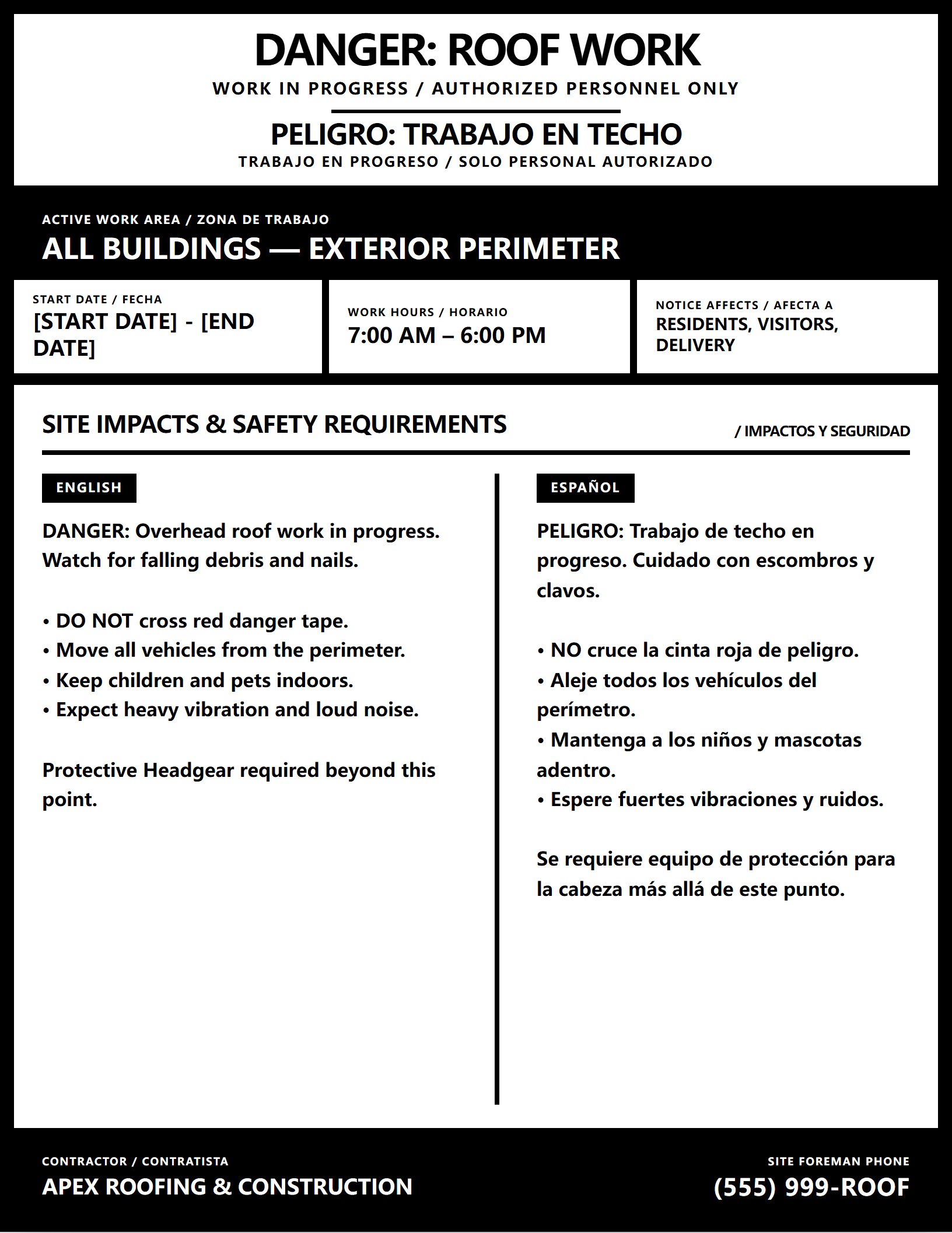
📋 Field Execution Asset
Download the OSHA-compliant manager checklist to ensure zero liability on-site.
🏠 Tenant Distribution Asset
Attach this prep-guide to your notice to reduce tenant front-desk calls by 60%.
Notice Editor & Preview
Edit Notice
Live Print Preview
US Letter • 8.5" x 11"
Legal Deadline Calculator
Powered by US Office of Personnel Management (OPM) rules.
Deliver notice to affected units and adjacent neighbors
Tarp landscaping and cover HVAC units
Establish OSHA Drop Zone and post warning signs
Compliance & Legal Disclaimer: Calculations are strictly based on U.S. Office of Personnel Management (OPM) observed federal holiday rules and standard weekend exclusions. While this tool is designed for enterprise-grade accuracy regarding FLSA and standard property management protocols (e.g., CA Civil Code §1950.5), local municipal codes may vary. NoticeMint is a workflow software, not a law firm. Always verify critical statutory deadlines with your legal counsel.
Execution Protocol
Operational Timeline & Compliance Checklist
- 48-72 hours before tear-off Responsible: property manager
Deliver notice to affected units and adjacent neighbors
💡Pro Strategy
A proactive notice prevents 90% of noise complaints. Advise top-floor tenants that vibration may cause unsecured items on walls to fall. Advise neighbors to move vehicles away from the drop zone to prevent paint/windshield damage from flying shingles.
- Morning of project start Responsible: contractor
Tarp landscaping and cover HVAC units
💡Pro Strategy
Nails and roofing debris falling into HVAC condenser unit fans will destroy the motor. ALWAYS strap plywood or heavy tarps over AC units. Tarp all bushes and flowerbeds to catch falling nails.
- Before tear-off begins Responsible: contractor
Establish OSHA Drop Zone and post warning signs at dumpster_perimeter, walkways_under_work_area, scaffolding_base
⚠️Liability Alert
DO NOT use yellow caution tape for overhead falling hazards. OSHA requires RED "Danger" tape for immediate life-safety hazards like falling debris.
💡Pro Strategy
OSHA standard 1926.250 requires a barricaded drop zone if debris is dropped without a chute. Tape off the area with RED "Danger" tape. Mount this NoticeMint sign on A-frames at all approach angles.
- End of daily shift (Repeat Daily) Responsible: contractor
Secure and remove ladders at the end of each shift
💡Pro Strategy
Attractive Nuisance Liability: If a child climbs your unattended ladder after hours and falls, the contractor is 100% liable. Always lower, lock, and remove ladders from the building edge when leaving the site.
- After tear-off and at project completion Responsible: contractor
Perform intensive magnetic sweep for nails
💡Pro Strategy
Flat tires are the #1 source of lawsuits and negative reviews for roofing contractors. Perform a rolling magnetic sweep of the entire driveway, parking lot, and lawn at least THREE times in different grid patterns.
- Before leaving site Responsible: contractor
Inspect gutters and uncover HVAC units
💡Pro Strategy
Remove protective tarps from HVAC units BEFORE residents return home and turn on their AC (prevents overheating the unit). Blow out all gutters to ensure no loose shingles or nails block downspouts.
- After final inspection passes Responsible: contractor AUTOMATABLE
Remove all safety barricades, tape, and warning signs
💡Pro Strategy
Once the area is completely free of debris and equipment, remove all red danger tape and signs to fully restore tenant/pedestrian access.
Required Posting Locations
Physical Distribution Checklist
- dumpster_perimeter
- walkways_under_work_area
- scaffolding_base
Liability Defense Rule
Always take a timestamped wide-angle photo of the posted notice in its physical location. If a tenant claims they were not notified, this photo is your primary legal defense.
Tenant Communication Brief
Anticipated Questions & Official Responses
-
Q
Should I move my car during the roof work?
- "YES. Please move all vehicles from driveways and parking spots immediately adjacent to the building. Falling shingles, nails, and debris can cause severe vehicle damage during the tear-off phase.
-
Q
¿Debo mover mi auto durante el trabajo del techo?
- "SÍ. Por favor mueva todos los vehículos de las entradas y lugares de estacionamiento inmediatamente adyacentes al edificio. Las tejas, clavos y escombros que caen pueden causar daños graves a los vehículos.
Manager's Note
Providing these answers in your initial notice can reduce management office phone volume by up to 60% during service interruptions.
Operational Guidance
Industry Best Practices & Field-Tested Strategies
Strictly enforce OSHA color codes for barricades: Use RED "Danger" tape for overhead falling debris drop zones (immediate life-safety hazard), and YELLOW "Caution" tape only for general trip hazards or equipment staging areas. Using yellow tape for falling debris is an OSHA citable offense.
Implement the "Three-Pass Magnetic Sweep" protocol. Flat tires from stray roofing nails are the #1 source of lawsuits against roofing contractors. Sweep the entire driveway, parking lot, and lawn at least three times in intersecting grid patterns before demobilizing equipment.
Mandate daily ladder lockdowns to defeat "Attractive Nuisance" liability. If a child climbs an unattended, unsecured ladder after work hours and falls, the contractor and property owner face catastrophic joint liability. Ladders must be lowered, locked, or removed from the building edge at the end of every shift.
Protect HVAC condenser units with heavy tarps or plywood caps. Roofing nails and asphalt shingle granules falling into the condenser fan will destroy the motor and void the manufacturer warranty. Uncover units before residents return home and turn on their AC.
Issue proactive vibration warnings to top-floor tenants. The heavy impact of tearing off old shingles can cause unsecured mirrors, heavy picture frames, and wall-mounted TVs to fall and shatter. Advise tenants to remove or secure heavy wall hangings before day one.
Manager Checklist
- Verify the roofing contractor's Certificate of Insurance (COI), ensuring it includes active Workers' Compensation and a minimum of $2M in General Liability coverage naming the property as an Additional Insured.
- Distribute bilingual "Roof Work in Progress" notices to all affected units and adjacent neighbors 48-72 hours before the scheduled tear-off.
- Coordinate with the contractor to map out the dumpster placement, material staging area, and the OSHA-mandated Red Tape Drop Zone.
- Send a specific "Vibration & Wall Hanging" warning to all top-floor tenants, advising them to secure heavy mirrors and electronics.
- Inspect the site on Day 1 to verify that all ground-level HVAC condenser units, landscaping, and exterior light fixtures are heavily tarped or protected by plywood.
- Conduct daily end-of-shift walkthroughs to verify that all ladders are secured/removed and the Red Tape barricades are fully intact.
- Monitor the contractor's cleanup process, specifically demanding visual confirmation of the three-pass magnetic nail sweep before releasing the final payment.
- Retain all signed delivery receipts, site photos, and the contractor's daily safety logs in the property compliance file for future liability defense.
Common Costly Mistakes
- ✗ Failing to notify adjacent neighbors who are not on the primary tenant roster. Flying shingles and nails can easily cross property lines, damaging neighboring vehicles or siding. Always deliver physical notices to adjacent property owners 48 hours prior.
- ✗ Allowing tenants to park in the "Drop Zone" to save them a walk. Even with a signed liability waiver, property owners can still be held negligent if a vehicle is crushed by falling plywood or scaffolding. Enforce a strict, zero-tolerance towing policy for the red-taped perimeter.
- ✗ Leaving the dumpster area unsecured at night. Open roofing dumpsters attract illegal dumping by third parties and pose a severe climbing hazard to children. The dumpster perimeter must be part of the daily lockdown and barricade check.
- ✗ Using English-only warning signs on sites with a high percentage of Spanish-speaking workers or tenants. OSHA requires that safety training and critical hazard warnings be communicated in a language the workers understand, and Fair Housing guidelines strongly recommend bilingual tenant signage.
- ✗ Skipping the pre-inspection of gutters and downspouts. If old gutters are left full of roofing debris, the first heavy rain will cause massive water backups, leading to interior ceiling leaks and mold claims that far exceed the cost of the roof itself.
Resident Preparation Checklist
Include this checklist in your notice to reduce tenant calls by up to 60%
- ☐ Move ALL vehicles, motorcycles, and bicycles out of the driveways and parking spots immediately adjacent to the building perimeter. Falling debris will cause severe damage.
- ☐ Keep all windows and sliding glass doors closed during the work day to prevent loud noise, dust, and stray nails from entering your apartment.
- ☐ Remove or securely anchor heavy items mounted on walls (large mirrors, heavy picture frames, wall-mounted TVs), especially if you live on the top floor. Roof tear-off vibrations can cause them to fall.
- ☐ Keep children and pets strictly indoors and away from the red-taped "Drop Zone" and the dumpster area at all times.
- ☐ Do not attempt to cross the red danger tape or walk under scaffolding, even if you do not see workers directly above you. Debris can bounce or roll off the roof edge unexpectedly.
- ☐ Report any damage to your vehicle, windows, or exterior property to the management office IMMEDIATELY with timestamped photos. Do not wait until the project is finished.
- ☐ Expect intermittent loud noise (nail guns, compressors, tearing) between 7:00 AM and 6:00 PM. Plan work-from-home schedules or childcare accordingly.
Frequently Asked Questions
What are the OSHA requirements for roof work warning signs and barricades?
What is the "Attractive Nuisance" doctrine regarding roofing ladders?
Who is liable if a roofing nail pops a tenant's tire?
Can roof tear-off vibrations cause damage inside top-floor apartments?
Disclaimer
- • OSHA regulations (29 CFR 1926 Subpart M for Fall Protection and Subpart J for Welding/Cutting/Heating) strictly govern roofing operations. This template provides operational guidance and does not replace a certified Site Safety and Health Plan (SSHP).
- • The "Attractive Nuisance" doctrine varies significantly by state jurisdiction. Always consult your local property attorney regarding specific fencing, signage, and equipment lockdown requirements.
- • Properties receiving federal funding (HUD/Section 8) must ensure that exterior construction projects comply with Section 3 resident employment and notification requirements, in addition to standard safety protocols.
- • Always verify the contractor's OSHA EMR (Experience Modification Rate) and TRIR (Total Recordable Incident Rate) before awarding the contract. An EMR above 1.0 indicates a poor safety history and significantly increases the property's vicarious liability risk.
- • Retain all site safety logs, magnetic sweep certifications, and daily barricade inspection photos for a minimum of 5 years, or as required by your state's statute of repose for construction defects.
Related Operational Tasks
Complete your communication workflow with these related notices