Property Communication Task Center
NOISE POLICY & QUIET HOURS WARNING 🛡️ 2026 OSHA/FHA Compliant
Generate a legally sound, bilingual noise policy warning that enforces community quiet hours, documents violations, and establishes a clear escalation path while strictly maintaining Fair Housing compliance.
Not just a template.
A reality execution tool.
Don't risk tenant disputes with messy Word docs. Generate a print-ready, OSHA-compliant physical notice in exactly 30 seconds.
- 1Bilingual Architecture English & Spanish integrated into a single US Letter design. Crucial for legal compliance in 14+ states.
- 2Toner-Friendly Print Engineered for black-and-white office printers. High contrast hierarchy ensures readability from 10 feet away.
- 3Locked Formatting Zero layout breakage. Type your details, and the engine physicalizes it without overflowing the page.
NOISE POLICY & QUIET HOURS WARNING
ADVERTENCIA SOBRE POLÍTICA DE RUIDO Y HORAS DE SILENCIO
Why use this template?
- ✓ Bilingual output (English/Spanish) prevents FHA liability
- ✓ Formatted strictly for US Letter B&W physical printing
- ✓ Zero JS bloat, generates instantly in your browser
Print Output Preview
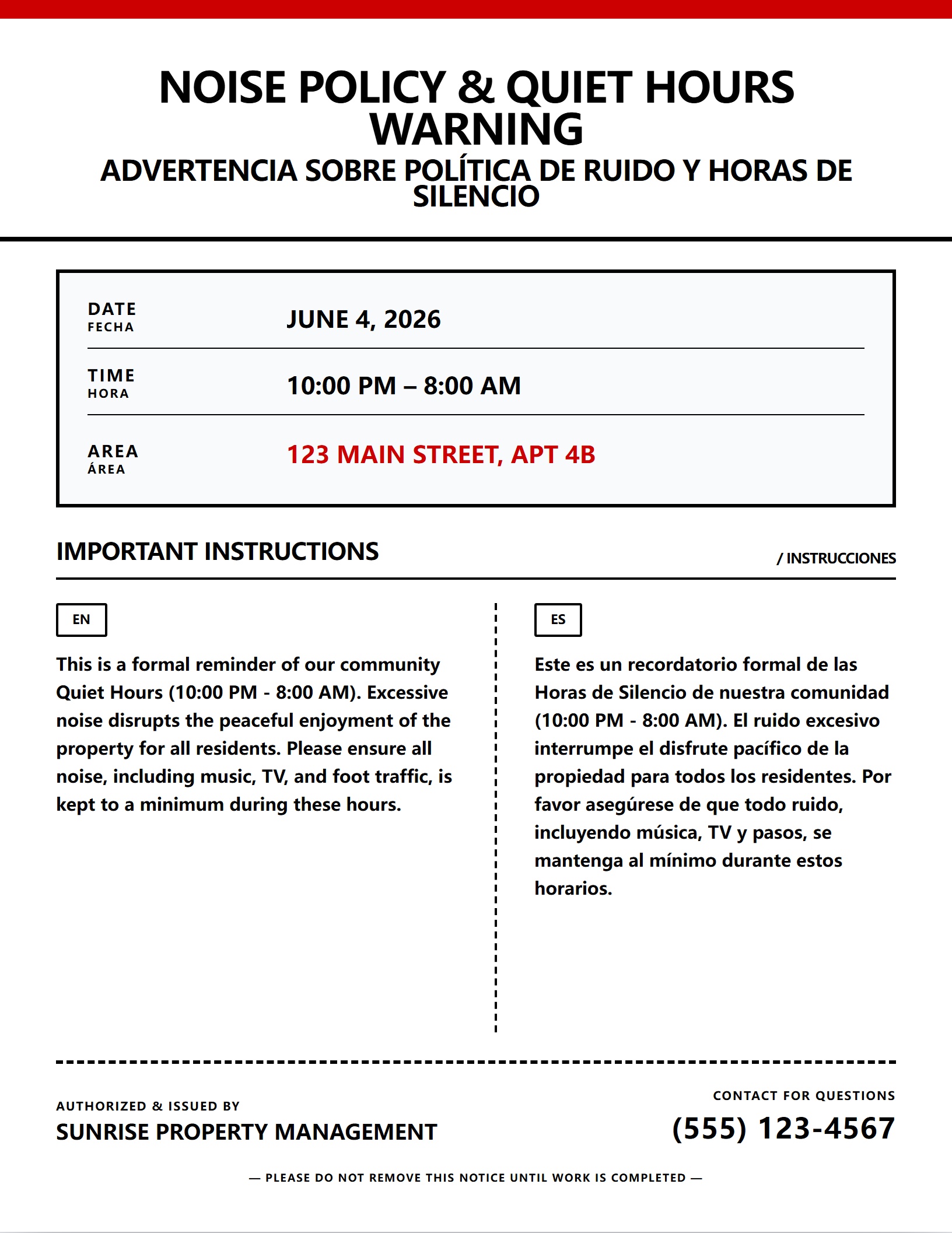
📋 Field Execution Asset
Download the OSHA-compliant manager checklist to ensure zero liability on-site.
🏠 Tenant Distribution Asset
Attach this prep-guide to your notice to reduce tenant front-desk calls by 60%.
Notice Editor & Preview
Edit Notice
Live Print Preview
US Letter • 8.5" x 11"
Execution Protocol
Operational Timeline & Compliance Checklist
- Upon receiving complaints or as seasonal reminder Responsible: property manager
Send community-wide quiet hours reminder or targeted violation warning
💡Pro Strategy
Under the Fair Housing Act (FHA), noise policies MUST be enforced consistently across all demographics. Selective enforcement is the #1 cause of discrimination lawsuits. Always use standardized templates and document every complaint.
- Before issuing formal written warning Responsible: property manager
Log noise complaints with timestamps and decibel readings (if applicable)
⚠️Liability Alert
Never issue a formal noise violation notice based on a single anonymous complaint without independent verification by property staff. This protects against malicious neighbor disputes.
💡Pro Strategy
Many local Noise Ordinances define violations by decibel levels (e.g., >65 dBA at property line). If using a decibel meter, calibrate it and log the exact reading, time, and location. If relying on staff testimony, have two staff members verify.
- Within 24 hours of verified violation Responsible: property manager
Deliver formal written warning to tenant door or via certified mail
💡Pro Strategy
For targeted violations, deliver via the method specified in the lease (usually email + physical door drop). For community-wide reminders, post in common areas (clubhouse, elevators) and send via the resident portal.
- During the next quiet hours window Responsible: maintenance
Monitor the unit/area during next quiet hours period
💡Pro Strategy
Have maintenance or security staff patrol the specific area during the next quiet hours. Document the noise level (or lack thereof) to close the loop on the complaint.
- After monitoring period Responsible: system AUTOMATABLE
Archive warning and outcome in tenant file for legal compliance
💡Pro Strategy
All noise warnings must be permanently archived in the tenant's digital file. If eviction becomes necessary, judges require a documented paper trail of progressive discipline. The system will automatically log this action.
Tenant Communication Brief
Anticipated Questions & Official Responses
-
Q
What are the standard quiet hours in our community?
- "Standard quiet hours are typically from 10:00 PM to 8:00 AM on weekdays, and 11:00 PM to 9:00 AM on weekends. During these times, loud music, TV, vacuuming, and heavy footsteps must be minimized.
-
Q
¿Cuáles son las horas de silencio estándar en nuestra comunidad?
- "Las horas de silencio estándar suelen ser de 10:00 PM a 8:00 AM entre semana, y de 11:00 PM a 9:00 AM los fines de semana. Durante estos horarios, se debe minimizar la música alta, TV, aspiradoras y pasos fuertes.
-
Q
What happens if the noise continues after this warning?
- "Noise violations follow a strict escalation policy: 1st offense is a written warning, 2nd offense may incur a lease-specified fine, and 3rd or subsequent offenses can lead to lease termination and eviction proceedings for violating the "Quiet Enjoyment" clause.
-
Q
¿Qué pasa si el ruido continúa después de esta advertencia?
- "Las violaciones de ruido siguen una política de escalamiento estricta: 1ra ofensa es advertencia escrita, 2da ofensa puede generar multa, y 3ra o más ofensas pueden llevar a la terminación del contrato y desalojo por violar la cláusula de "Disfrute Tranquilo".
Manager's Note
Providing these answers in your initial notice can reduce management office phone volume by up to 60% during service interruptions.
Operational Guidance
Industry Best Practices & Field-Tested Strategies
Use calibrated decibel meters (Type 2 or better per ANSI S1.4) when documenting noise violations. Subjective "too loud" assessments are easily challenged in eviction hearings, while objective decibel readings with timestamps and calibration certificates are legally defensible. Most local ordinances define violations at 65-75 dBA at the property line during quiet hours.
Document noise complaints using the "3-Strike Rule" within a rolling 12-month period. First strike: written warning with policy education. Second strike: formal violation notice with lease-specified fine ($50-$200 typical). Third strike: lease termination notice citing breach of "Quiet Enjoyment" covenant. Judges expect this progressive discipline pattern and often reject eviction cases without it.
Send noise policy reminders seasonally (May/September) rather than only reactively after complaints. Proactive community-wide education reduces noise complaints by 40-60% compared to reactive-only enforcement. Include quiet hours, common noise sources, and complaint procedures in seasonal reminders.
For noise complaints involving children (crying, running, playing), exercise extreme caution under Fair Housing Act familial status protections. Normal childhood noise is NOT a lease violation — only excessive, unreasonable noise that would disturb a "reasonable person" qualifies. Document specific behaviors, times, and durations rather than general "children are too loud" complaints.
When noise originates from hard surface flooring (footsteps, dropped objects, furniture dragging) in units above, investigate whether the tenant has installed area rugs covering 80% of floor area as required by most apartment leases. Flooring impact noise (Impact Insulation Class/IIC rating) is the #1 source of multi-family noise complaints and is often a lease compliance issue, not a noise ordinance issue.
Manager Checklist
- Review lease agreement noise clauses and quiet hours definitions — ensure they match your community policies
- Obtain calibrated decibel meter (Type 2 or better per ANSI S1.4) and calibration certificate
- Research local noise ordinance — identify decibel limits, quiet hours, and enforcement procedures
- Create standardized noise complaint form — include fields for: complainant name/unit, date/time, noise source description, duration, decibel reading (if available)
- Train all staff on Fair Housing Act requirements — noise policies must be enforced consistently across all demographics
- Establish progressive discipline policy: 1st offense = warning, 2nd = fine, 3rd = lease termination
- Document every noise complaint with: date/time, complainant information, specific noise description, staff verification, decibel reading (if applicable)
- For targeted violations: deliver written notice via lease-specified method (email + door drop) within 24 hours
- For community-wide reminders: post in common areas and send via resident portal seasonally (May/September)
- When complaints involve children: document specific behaviors, times, and durations — not general "children are too loud" statements
- When complaints involve hard flooring: verify tenant has installed area rugs covering 80% of floor area per lease requirements
- When complaints involve disability-related sensitivity: engage in interactive process to discuss reasonable accommodations
- Schedule follow-up patrol during next quiet hours window to verify compliance
- Archive all noise warnings and outcomes permanently in tenant digital file — judges require documented paper trail
- Audit enforcement records quarterly for demographic patterns — ensure consistent treatment across all protected classes
- If eviction becomes necessary: compile complete documentation package including all warnings, fines, staff verifications, and decibel readings
Common Costly Mistakes
- ✗ Enforcing noise policies inconsistently across demographics — this is the #1 cause of Fair Housing discrimination lawsuits. If you warn a Hispanic family for loud music but ignore identical behavior from a white family, you face FHA liability regardless of intent. Use standardized templates, document every complaint identically, and audit your enforcement records quarterly for demographic patterns.
- ✗ Issuing formal violations based solely on anonymous neighbor complaints without independent staff verification — this creates "he said/she said" situations that judges routinely dismiss. Always have property staff personally witness and document the noise (decibel reading, timestamp, location, description) before issuing formal notices.
- ✗ Failing to document the specific noise source, duration, and time — vague complaints like "loud noise" or "disturbing the peace" are legally insufficient. Document: "Loud bass music from Unit 4B, 75 dBA measured at Unit 3B ceiling, 11:45 PM, lasting 45 minutes, staff member John Smith verified." Specificity wins eviction cases.
- ✗ Ignoring noise complaints from residents with disabilities who may have heightened sensitivity — while you cannot enforce different noise standards, you should engage in the interactive process to discuss reasonable accommodations (white noise machines, unit transfers, soundproofing assistance) under Fair Housing Act disability protections.
- ✗ Threatening eviction for first or second offenses without following progressive discipline — judges expect to see documented warnings, fines, and opportunities to cure before granting eviction. Skipping steps creates the appearance of retaliation or discrimination and results in case dismissal.
Resident Preparation Checklist
Include this checklist in your notice to reduce tenant calls by up to 60%
- ☐ Review your lease agreement for specific quiet hours (typically 10 PM - 8 AM weekdays, 11 PM - 9 AM weekends) and noise policy clauses
- ☐ Install area rugs covering at least 80% of hard surface flooring — this is required by most apartment leases and reduces impact noise complaints by 70-80%
- ☐ Use area rugs with sound-absorbing padding (IIC rating 50+) for maximum noise reduction
- ☐ Place felt pads under all furniture legs to prevent dragging sounds on hard floors
- ☐ Keep TV, music, and gaming volume at levels that cannot be heard through walls or floors — use headphones for late-night entertainment
- ☐ If you have children: establish quiet play activities during quiet hours (books, puzzles, tablets with headphones) and avoid running, jumping, or throwing toys
- ☐ If you work night shifts or have unusual schedules: use white noise machines, fans, or sound conditioners to mask unavoidable noise
- ☐ If you receive a noise warning: respond in writing acknowledging receipt and describing corrective actions you will take
- ☐ If you believe a noise complaint is unfair or retaliatory: document your position in writing to management with specific facts and evidence
- ☐ If you have a disability that affects noise sensitivity: contact management to discuss reasonable accommodations under Fair Housing Act
- ☐ Report noise violations to management with specific details: date/time, noise source, duration, and how it affected you — vague complaints are less effective
Frequently Asked Questions
What decibel level constitutes a noise violation?
What if the noise is coming from normal daily activities (footsteps, cooking, children playing)?
Can I be evicted for noise complaints?
What if I work night shifts and need to be active during quiet hours?
What if my neighbor is filing false or retaliatory noise complaints against me?
Can I call the police for noise violations instead of going through management?
What reasonable accommodations are available for tenants with noise sensitivity disabilities?
What soundproofing solutions can I install in my apartment?
Disclaimer
- • Fair Housing Act (FHA) requires consistent enforcement of noise policies across all protected classes (race, color, national origin, religion, sex, familial status, disability). Selective enforcement is the #1 cause of discrimination lawsuits.
- • Familial status protections under FHA mean normal childhood noise (crying, playing, running) is NOT a lease violation. Only excessive, unreasonable noise qualifies. Document specific behaviors, times, and durations.
- • Disability protections under FHA require engagement in the interactive process when tenants request reasonable accommodations for noise sensitivity. Accommodations may include unit transfers, soundproofing permissions, or policy modifications.
- • Most local noise ordinances define violations at 65-75 dBA during quiet hours, measured at property line or inside complaining tenant's unit. Some use "plainly audible" standards instead of specific decibel limits.
- • Progressive discipline is legally expected before eviction: 1st offense = warning, 2nd = fine, 3rd = lease termination. Judges routinely dismiss eviction cases without documented progressive discipline.
- • Decibel meters used for enforcement should be Type 2 or better per ANSI S1.4 standard, with current calibration certificates. Subjective assessments are easily challenged in eviction hearings.
- • Impact noise from hard surface flooring (footsteps, furniture dragging) is the #1 source of multi-family complaints. Most leases require area rugs covering 80% of hard floor surfaces.
- • Anonymous complaints without independent staff verification are legally insufficient for formal violations. Always have property staff personally witness and document noise before issuing notices.
- • All noise warnings and outcomes must be permanently archived in tenant files. Eviction cases require documented paper trail of progressive discipline, staff verifications, and decibel readings.
- • Retaliatory or malicious complaints can result in disciplinary action against the complaining tenant. Property management has a duty to protect tenants from harassment that interferes with quiet enjoyment.
- • This template provides formatting and operational guidance only and does not constitute legal advice. Consult your property attorney and local authorities for jurisdiction-specific compliance.
Related Operational Tasks
Complete your communication workflow with these related notices