Property Communication Task Center
Parking Enforcement & Towing Notice 🛡️ 2026 OSHA/FHA Compliant
Enforce community parking rules through a legally compliant escalation process — from warning notice to authorized tow — while satisfying state private-property towing statutes, minimizing wrongful-tow lawsuits, and ensuring all signage and authorization protocols are defensible in court.
Not just a template.
A reality execution tool.
Don't risk tenant disputes with messy Word docs. Generate a print-ready, OSHA-compliant physical notice in exactly 30 seconds.
- 1Bilingual Architecture English & Spanish integrated into a single US Letter design. Crucial for legal compliance in 14+ states.
- 2Toner-Friendly Print Engineered for black-and-white office printers. High contrast hierarchy ensures readability from 10 feet away.
- 3Locked Formatting Zero layout breakage. Type your details, and the engine physicalizes it without overflowing the page.
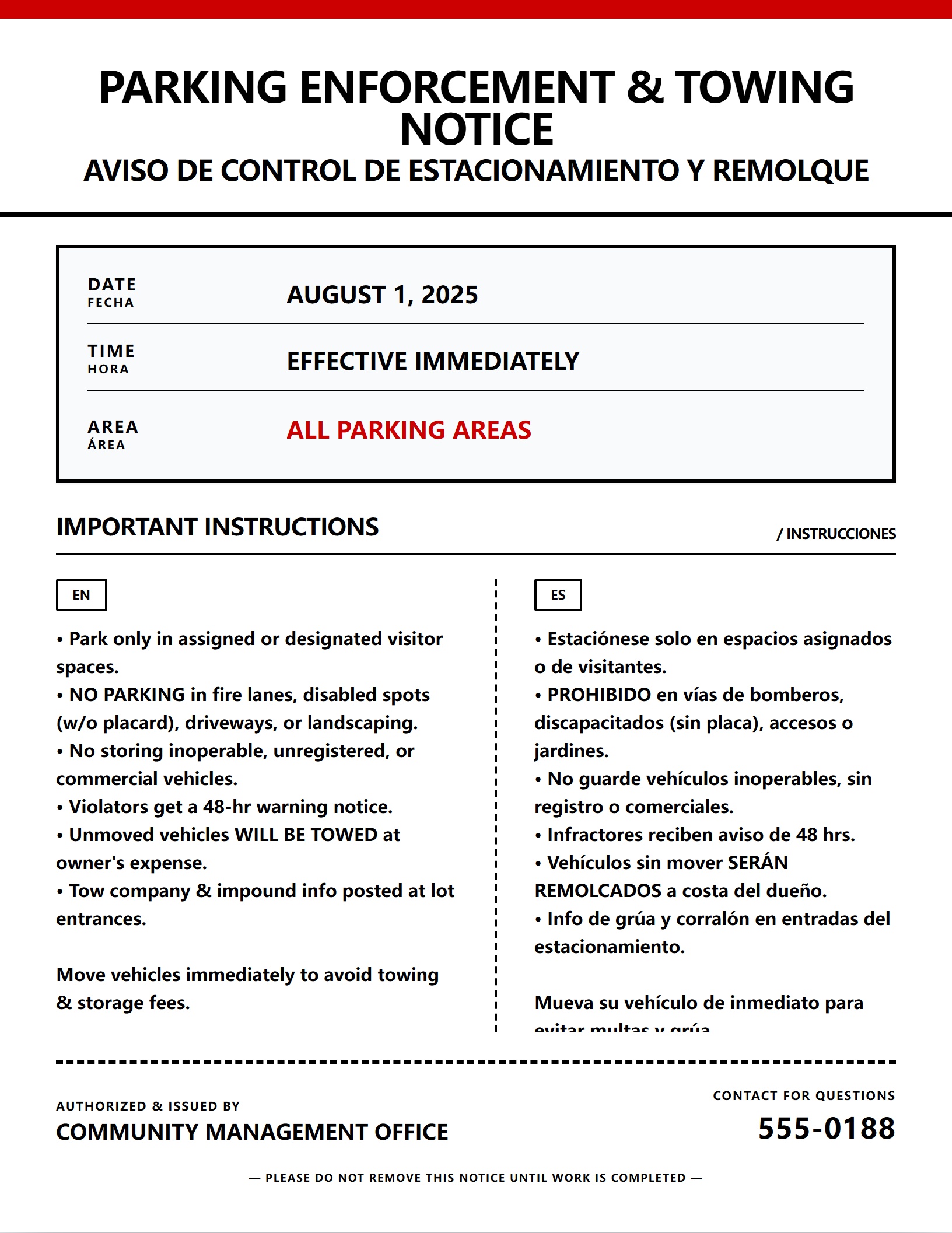
PARKING ENFORCEMENT & TOWING NOTICE
AVISO DE CONTROL DE ESTACIONAMIENTO Y REMOLQUE
Why use this template?
- ✓ Bilingual output (English/Spanish) prevents FHA liability
- ✓ Formatted strictly for US Letter B&W physical printing
- ✓ Zero JS bloat, generates instantly in your browser
Print Output Preview
📋 Field Execution Asset
Download the OSHA-compliant manager checklist to ensure zero liability on-site.
🏠 Tenant Distribution Asset
Attach this prep-guide to your notice to reduce tenant front-desk calls by 60%.
Notice Editor & Preview
Edit Notice
Live Print Preview
US Letter • 8.5" x 11"
Legal Deadline Calculator
Powered by US Office of Personnel Management (OPM) rules.
Review State Towing Statute & Signage Compliance
Verify Licensed Towing Company Contract
Send Community-Wide Parking Policy Reminder
Post & Verify Towing Authorization Signs
Issue Windshield Warning Notice (First Violation)
Compliance & Legal Disclaimer: Calculations are strictly based on U.S. Office of Personnel Management (OPM) observed federal holiday rules and standard weekend exclusions. While this tool is designed for enterprise-grade accuracy regarding FLSA and standard property management protocols (e.g., CA Civil Code §1950.5), local municipal codes may vary. NoticeMint is a workflow software, not a law firm. Always verify critical statutory deadlines with your legal counsel.
Execution Protocol
Operational Timeline & Compliance Checklist
- 30 Days Before Enforcement Responsible: property manager
Review State Towing Statute & Signage Compliance
⚠️Liability Alert
Do NOT authorize a single tow until all entrance signage has been photographed, measured, and documented as compliant with your state statute. Improper towing is the #1 source of HOA lawsuits in North America.
💡Pro Strategy
Before ANY towing occurs, verify your state's private-property towing statute is fully satisfied. California (CVC §22658) requires signs at every entrance (min 17"×22", letters ≥1"), Texas (Ch. 684) requires written parking facility agreement, Florida (§715.07) requires conspicuous posting. Missing even one sign invalidates every tow and exposes the HOA to $2,000+ statutory damages per wrongful tow.
- 21 Days Before Enforcement Responsible: property manager
Verify Licensed Towing Company Contract
⚠️Liability Alert
Never use an unlicensed or "fly-by-night" towing operator. If the towing company damages a vehicle or operates without proper licensing, the HOA/property management is jointly liable.
💡Pro Strategy
Confirm your towing company holds a valid state/local license, carries minimum $1M liability insurance, and operates a secure impound lot within reasonable distance (under 10 miles is best practice). The towing contract must specify: response time, fee schedule, accepted payment methods, and impound lot address/phone. Many states require the towing company name and phone number to appear on your posted signage.
- 14 Days Before Enforcement Responsible: hoa board AUTOMATABLE
Send Community-Wide Parking Policy Reminder
⚠️Liability Alert
Apply parking rules uniformly to ALL residents. Selective enforcement (e.g., towing only one resident's guests while ignoring others) is the most common basis for Fair Housing Act complaints and breach-of-fiduciary-duty claims against HOA boards.
💡Pro Strategy
Frame this as a "parking policy reminder," not a threat. Tone matters — aggressive language increases complaint volume and Fair Housing scrutiny. Include: permitted parking areas, prohibited zones (fire lanes, visitor spots without permit, disabled spaces without placard), guest parking rules, and the escalation timeline (warning → fine → tow).
- 7 Days Before Enforcement Responsible: property manager
Post & Verify Towing Authorization Signs at All Parking Lot Entrances, Fire Lanes, Visitor Parking Areas, Disabled Spaces, Garage Entry Points
⚠️Liability Alert
Do NOT post signs on public right-of-way, utility poles, or city property — only on private property within the community boundaries. Signs on public property may be removed by the city and do not satisfy statutory posting requirements.
💡Pro Strategy
Every sign must include: (1) "Unauthorized vehicles will be towed at owner's expense," (2) Towing company name and 24-hour phone number, (3) Impound lot address, (4) Applicable state statute reference. In California, signs must be at least 17"×22" with letters no smaller than 1" in height. Photograph every sign with a date-stamped camera — this is your primary legal defense.
- At Time of Violation Responsible: property manager
Issue Windshield Warning Notice (First Violation)
⚠️Liability Alert
Never place a notice on a vehicle that is actively being loaded/unloaded or has a person inside — wait until the vehicle is unattended. Never damage a vehicle while placing the notice (e.g., scratching paint, bending wipers).
💡Pro Strategy
Place a bright-colored (orange or yellow) windshield notice on the FIRST violation. The notice must include: date/time of violation, specific rule violated, cure deadline (typically 24-48 hours), and a clear statement that the vehicle WILL be towed if not moved by the deadline. Photograph the violation AND the placed notice with timestamp — this creates the "reasonable notice" paper trail courts require.
- Within 24 Hours After Tow Responsible: property manager
Notify Vehicle Owner of Tow & Impound Details
⚠️Liability Alert
Do NOT disclose the vehicle owner's personal information to the towing company beyond what is necessary for the tow. Maintain privacy compliance under your state's data protection laws.
💡Pro Strategy
Send a written notice to the vehicle owner (if identifiable from community records) including: towing company name and phone, impound lot address and hours, fee schedule, and the specific rule violation that triggered the tow. This is legally required in some states and demonstrates good faith in all jurisdictions.
- Within 7 Days After Tow Responsible: property manager
Document Enforcement Action & Close Case
⚠️Liability Alert
Never destroy or alter enforcement documentation. If a vehicle owner files a wrongful-tow claim, spoliation of evidence (destroying records) can result in adverse inference rulings that guarantee the HOA loses the case.
💡Pro Strategy
Create a complete enforcement file for each tow: (1) Photos of compliant signage, (2) Digital policy notice proof, (3) Windshield warning notice photo, (4) Final violation photo before tow, (5) Written towing authorization, (6) Vehicle owner notification proof. Retain for minimum 5 years — this is your defense package if the vehicle owner sues.
Required Posting Locations
Physical Distribution Checklist
- All Parking Lot Entrances
- Fire Lanes
- Visitor Parking Areas
- Disabled Spaces
- Garage Entry Points
Liability Defense Rule
Always take a timestamped wide-angle photo of the posted notice in its physical location. If a tenant claims they were not notified, this photo is your primary legal defense.
Tenant Communication Brief
Anticipated Questions & Official Responses
-
Q
Can the HOA tow my car from my own assigned spot?
- "Generally no — unless your vehicle violates specific CC&R provisions (e.g., inoperable vehicles, commercial vehicles in residential spots, expired registration). The HOA must follow the same warning-and-cure process for assigned spots as for common areas.
-
Q
What if my guest gets towed?
- "Guests are subject to the same parking rules as residents. Ensure guests park only in designated visitor areas and display any required temporary permits. The vehicle owner (not the HOA) is responsible for towing and storage fees.
-
Q
How do I get my car back from the impound lot?
- "Contact the towing company listed on the parking signs. You will need: valid driver's license, proof of ownership/registration, and payment for towing + daily storage fees. Fees typically range from $150-$350 for towing plus $30-$75 per day storage.
-
Q
Can I sue the HOA for wrongful towing?
- "Yes. If proper signage, warning notice, and written authorization were not provided, you may recover statutory damages (up to $2,000 in California under CVC §22658) plus actual damages. Consult a consumer protection attorney.
Manager's Note
Providing these answers in your initial notice can reduce management office phone volume by up to 60% during service interruptions.
Operational Guidance
Industry Best Practices & Field-Tested Strategies
Audit ALL parking signage at every entrance before authorizing any tow. California requires minimum 17"×22" signs with 1" lettering stating "Unauthorized vehicles will be towed at owner's expense" plus towing company name, phone, and impound address. One non-compliant sign can invalidate every tow and expose the HOA to $2,000+ statutory damages per vehicle.
Always issue a windshield warning notice (bright orange/yellow) before towing — even if your state statute doesn't explicitly require it. Courts consistently rule that "reasonable notice" before tow-away demonstrates good faith and dramatically reduces wrongful-tow lawsuit success rates.
Require the property manager to sign a written Towing Authorization Form for EACH individual vehicle — never use blanket "tow all violators" authorizations. California, Texas, Florida, Arizona, and Nevada all require per-vehicle written authorization; blanket authorizations are illegal.
Photograph EVERY step: the violation, the windshield notice placement, the final pre-tow condition, and the towing company's arrival. Timestamped photo documentation is the single most important evidence package for defending against wrongful-tow claims.
Enforce parking rules uniformly across ALL residents and guests. Selective enforcement (e.g., towing only one resident's guests) is the #1 basis for Fair Housing Act complaints and breach-of-fiduciary-duty claims against HOA boards. Document equal application of rules.
Maintain a current, licensed towing company contract with a written fee schedule, response-time SLA (under 2 hours), $1M+ liability insurance, and a secure impound lot within 10 miles. An unlicensed towing operator makes the HOA jointly liable for any vehicle damage.
Provide bilingual parking notices in communities with >30% Spanish-speaking households. Fair Housing Act communication requirements apply to enforcement actions — English-only towing notices in diverse communities create discrimination liability.
Manager Checklist
- Audit all parking lot entrance signs for state statute compliance (size, content, visibility) — photograph each sign with date stamp
- Verify towing company holds current state/local license, $1M+ liability insurance, and operates a secure impound lot within 10 miles
- Review and update written towing contract — confirm fee schedule, response time SLA, and per-vehicle authorization requirement
- Send bilingual community-wide parking policy reminder 14 days before enforcement begins
- Post bilingual towing authorization signs at all entrances 7 days before enforcement (if signs need updating)
- Prepare windshield warning notice templates (bilingual, bright-colored, pre-printed with cure period language)
- Brief all on-site staff on uniform enforcement protocol — no exceptions, no selective targeting
- For each violation: photograph vehicle + license plate, place windshield notice, photograph notice on vehicle, log date/time
- After 48-hour cure period: take final photo, sign per-vehicle written Towing Authorization, call towing company
- Be physically present (or designate staff) when tow occurs — some states require authorizing person on-site
- Notify vehicle owner within 24 hours of tow with impound lot details and fee schedule
- Create complete enforcement file per tow: all photos, notices, authorization, and correspondence
- Retain all enforcement documentation for minimum 5 years
Common Costly Mistakes
- ✗ Towing a vehicle without compliant entrance signage — this is an automatic wrongful tow in California (CVC §22658), Texas (Ch. 684), and Florida (§715.07), with statutory damages of $2,000+ per vehicle plus attorney's fees.
- ✗ Using blanket towing authorizations instead of per-vehicle written authorization — this is illegal in most states and voids the tow, requiring the HOA to reimburse all towing and storage fees.
- ✗ Failing to photograph the windshield warning notice before calling the towing company — without proof of reasonable notice, the tow is presumed wrongful and the burden of proof shifts to the HOA.
- ✗ Towing vehicles from assigned/owned parking spaces without following the same warning-and-cure process used for common areas — owners have stronger property rights in assigned spaces, and summary towing triggers conversion (theft) claims.
- ✗ Towing a vehicle with a valid disabled placard from a disabled space — this triggers ADA and state disability discrimination penalties that can exceed $10,000 per violation. Always verify placard status before authorizing tow from accessible spaces.
- ✗ Allowing the towing company to charge fees above the posted rate or the contracted rate — price-gouging at impound lots creates class-action liability for the HOA as the authorizing party.
- ✗ Destroying or failing to retain enforcement documentation after the tow — spoliation of evidence results in adverse inference rulings that guarantee the HOA loses any subsequent lawsuit.
Resident Preparation Checklist
Include this checklist in your notice to reduce tenant calls by up to 60%
- ☐ Review the community parking rules in your CC&Rs, lease agreement, or most recent policy notice
- ☐ Park ONLY in your assigned space or designated visitor areas — never in fire lanes, disabled spots (without valid placard), or landscaped areas
- ☐ Ensure your vehicle has current registration and is in operable condition — inoperable/unregistered vehicles are towable on sight in most communities
- ☐ If you have guests, direct them to designated visitor parking and provide any required temporary permits
- ☐ Remove commercial vehicles, trailers, RVs, and boats from community parking unless specifically permitted by CC&Rs
- ☐ If you find a warning notice on your windshield, move your vehicle IMMEDIATELY — the cure period is typically 48 hours
- ☐ If your vehicle is towed: call the towing company listed on the parking signs, bring valid ID + registration + payment
- ☐ If you believe your vehicle was wrongfully towed: document everything, do NOT damage the impound lot or towing equipment, and consult a consumer protection attorney
- ☐ Report any damaged, missing, or faded parking signs to the management office immediately — missing signs can invalidate future tows
- ☐ Keep a copy of your lease or CC&R parking provisions in your vehicle glove box for quick reference
Frequently Asked Questions
What signage is required before vehicles can be towed from private property?
Can the HOA tow a vehicle without a warning notice first?
What can I do if my vehicle was wrongfully towed?
How much does a private-property tow typically cost?
Can the HOA tow my car if I have a valid disabled parking placard?
Disclaimer
- • Private-property towing statutes vary significantly by state — always verify your specific state law (CA CVC §22658, TX Transportation Code Ch. 684, FL §715.07, AZ §12-981, NV §487.038) before establishing a towing enforcement program.
- • This template provides formatting and operational guidance only and does not constitute legal advice. Consult your property attorney for jurisdiction-specific towing compliance.
- • Fair Housing Act obligations apply to parking enforcement — rules must be applied uniformly regardless of race, color, national origin, religion, sex, familial status, or disability.
- • ADA requirements prohibit towing vehicles with valid disabled placards from accessible parking spaces — violations carry federal penalties up to $10,000+ per incident.
- • Some states require the property owner or authorized agent to be physically present at the time of tow — verify this requirement in your jurisdiction before authorizing remote towing.
- • Retain all enforcement documentation (photos, authorization forms, notices, correspondence) for a minimum of 5 years to defend against potential wrongful-tow claims.
- • Municipal ordinances may impose additional requirements beyond state law — always check local city/county towing regulations.
Related Operational Tasks
Complete your communication workflow with these related notices