Property Communication Task Center
Asphalt Paving In Progress — Lot Closed 🛡️ 2026 OSHA/FHA Compliant
Safely execute hot mix asphalt (HMA) paving operations by enforcing strict no-parking zones, isolating heavy equipment blind spots, managing toxic asphalt fume exposure, and protecting the curing surface from premature pedestrian and vehicular traffic to prevent permanent ruts and burn injuries.
Not just a template.
A reality execution tool.
Don't risk tenant disputes with messy Word docs. Generate a print-ready, OSHA-compliant physical notice in exactly 30 seconds.
- 1Bilingual Architecture English & Spanish integrated into a single US Letter design. Crucial for legal compliance in 14+ states.
- 2Toner-Friendly Print Engineered for black-and-white office printers. High contrast hierarchy ensures readability from 10 feet away.
- 3Locked Formatting Zero layout breakage. Type your details, and the engine physicalizes it without overflowing the page.
ASPHALT PAVING IN PROGRESS — LOT CLOSED
PAVIMENTACIÓN EN PROGRESO — ESTACIONAMIENTO CERRADO
Why use this template?
- ✓ Bilingual output (English/Spanish) prevents FHA liability
- ✓ Formatted strictly for US Letter B&W physical printing
- ✓ Zero JS bloat, generates instantly in your browser
Print Output Preview
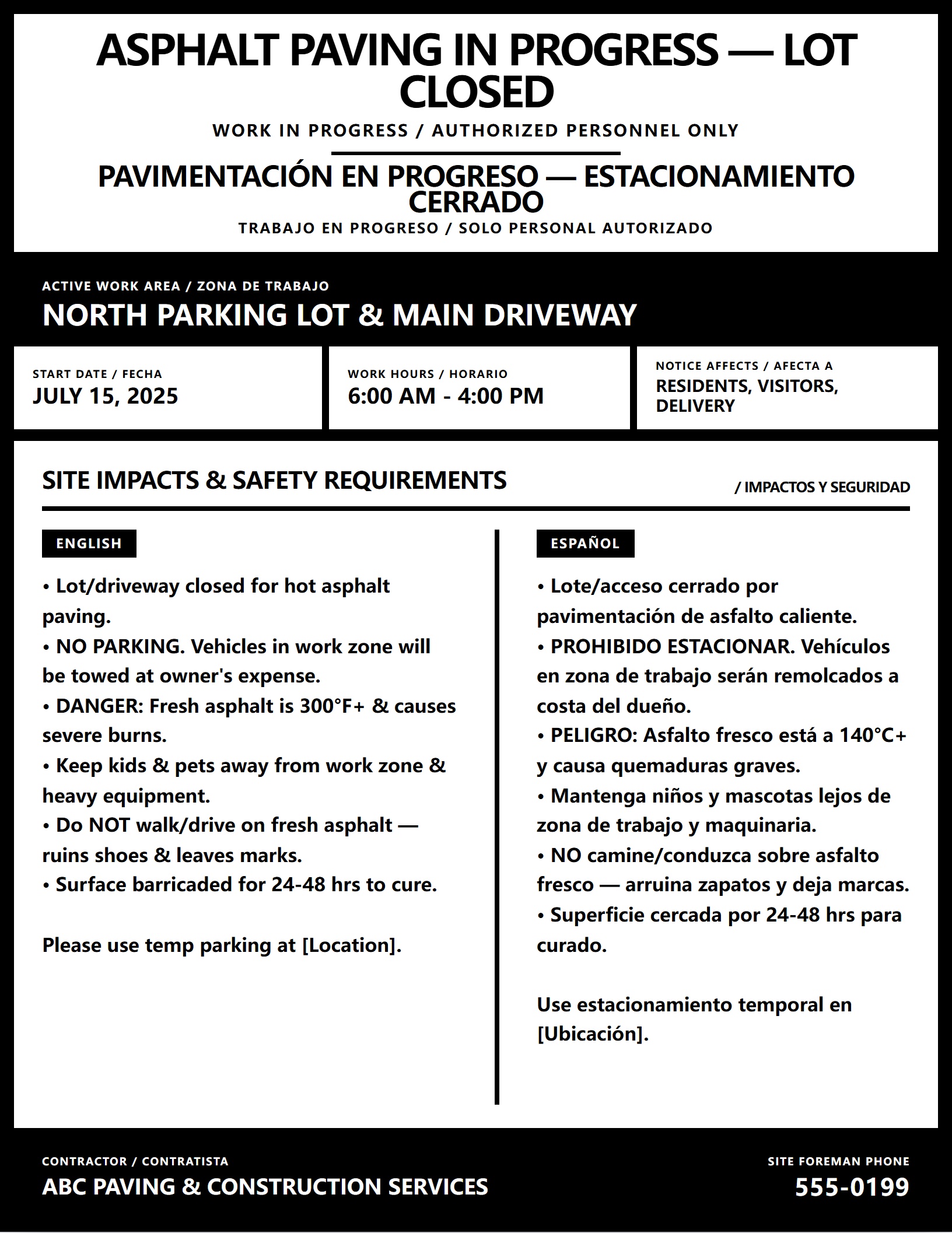
📋 Field Execution Asset
Download the OSHA-compliant manager checklist to ensure zero liability on-site.
🏠 Tenant Distribution Asset
Attach this prep-guide to your notice to reduce tenant front-desk calls by 60%.
Notice Editor & Preview
Edit Notice
Live Print Preview
US Letter • 8.5" x 11"
Legal Deadline Calculator
Powered by US Office of Personnel Management (OPM) rules.
Plan Traffic Control & Temporary Parking
Post Advance No-Parking & Closure Notices
Deploy MUTCD Traffic Control & Equipment Barricades
Execute Hot Lay & Manage Fume Exposure
Compliance & Legal Disclaimer: Calculations are strictly based on U.S. Office of Personnel Management (OPM) observed federal holiday rules and standard weekend exclusions. While this tool is designed for enterprise-grade accuracy regarding FLSA and standard property management protocols (e.g., CA Civil Code §1950.5), local municipal codes may vary. NoticeMint is a workflow software, not a law firm. Always verify critical statutory deadlines with your legal counsel.
Execution Protocol
Operational Timeline & Compliance Checklist
- 72 Hours Before Responsible: property manager
Plan Traffic Control & Temporary Parking
⚠️Liability Alert
Failing to provide alternate parking or clear fire lanes during a multi-day paving project will result in mass tenant complaints, unauthorized parking on grass/landscaping, and potential emergency vehicle access violations.
💡Pro Strategy
Map out the exact paving sequence and identify temporary parking alternatives for displaced residents. If paving blocks fire lanes or dumpster access, coordinate with the local fire marshal and waste hauler in advance. Ensure the contractor submits a MUTCD-compliant Temporary Traffic Control (TTC) plan.
- 48 Hours Before Responsible: property manager
Post Advance No-Parking & Closure Notices at Parking Lot Entrances, Building Lobbies, Elevator Cabs, Windshields of parked cars
💡Pro Strategy
Place physical "No Parking - Tow Away Zone" flyers directly on the windshields of all vehicles in the paving zone 48 hours in advance. Digital emails are easily missed. Clearly state the exact date, time, and the towing company's phone number.
- Start of Work Responsible: contractor
Deploy MUTCD Traffic Control & Equipment Barricades
⚠️Liability Alert
Backing up a vibratory roller without a spotter or backup alarm is a fatal hazard. "Struck-by" incidents involving heavy paving equipment in residential complexes are among the most severe contractor liability claims.
💡Pro Strategy
Use MUTCD-compliant channelizing devices (cones, drums, barricades) to seal off the work zone. Heavy equipment like rollers and pavers have massive blind spots. A dedicated flagperson or spotter in a high-visibility vest MUST be present whenever equipment is reversing or operating near pedestrian walkways.
- Active Paving Period Responsible: contractor
Execute Hot Lay & Manage Fume Exposure
⚠️Liability Alert
Contact with hot asphalt causes instant, severe 3rd-degree burns because the material sticks to the skin and continues to transfer heat. First aid requires immediate cooling with cold water — NEVER attempt to peel or wipe hot asphalt off the skin.
💡Pro Strategy
Hot Mix Asphalt (HMA) is delivered and laid at 275°F–325°F (135°C–163°C). Workers must wear heavy-duty insulated gloves and long sleeves. Monitor wind direction to ensure asphalt fumes (which contain VOCs and PAHs) are not blowing directly into open tenant windows or building HVAC fresh-air intakes.
- Immediately After Paving Responsible: contractor
Protect Curing Surface (24-48 Hours)
⚠️Liability Alert
Allowing residents to drive or walk on the asphalt before it has fully cured will result in permanent tire ruts, footprints, and scuff marks. The property owner will likely refuse to sign off on the final payment until the contractor mills and repaves the damaged sections at their own cost.
💡Pro Strategy
Maintain all barricades for a minimum of 24 hours (or up to 48 hours in hot/humid weather) to allow the asphalt to cool and cure. Vehicles turning their steering wheels while stationary on fresh asphalt will tear the surface ("power steering tears").
- After Curing Period Responsible: contractor
Reopen Traffic & Final Sweep
⚠️Liability Alert
Leaving raised utility covers or depressed drainage grates creates immediate vehicle damage liability and bicycle/pedestrian tripping hazards.
💡Pro Strategy
Before removing barricades, sweep the newly paved surface for loose gravel, discarded nails, or construction debris that could cause tire punctures. Verify that all manhole covers and utility valve boxes are flush with the new asphalt grade.
- Within 4 Hours After Reopening Responsible: property manager
Remove Notices & Schedule Striping at Parking Lot Entrances, Building Lobbies, Elevator Cabs
💡Pro Strategy
Remove all "No Parking" and closure notices. Note that parking lot striping (painting lines) typically requires an additional 24-48 hours of curing before paint can be applied without blistering. Communicate the striping schedule separately if required.
Required Posting Locations
Physical Distribution Checklist
- Parking Lot Entrances
- Building Lobbies
- Elevator Cabs
- Windshields of parked cars
Liability Defense Rule
Always take a timestamped wide-angle photo of the posted notice in its physical location. If a tenant claims they were not notified, this photo is your primary legal defense.
Tenant Communication Brief
Anticipated Questions & Official Responses
-
Q
Can I walk on the new asphalt if it looks dry?
- "No. Fresh asphalt may look solid on the surface but remains soft underneath for 24-48 hours. Walking on it will leave permanent footprints, and it can stick to and ruin your shoes.
-
Q
Will the asphalt smell be dangerous?
- "Hot asphalt emits fumes that can cause temporary throat or eye irritation. Keep your windows closed on the side of the building facing the paving work during active hot-lay operations.
Manager's Note
Providing these answers in your initial notice can reduce management office phone volume by up to 60% during service interruptions.
Operational Guidance
Industry Best Practices & Field-Tested Strategies
Place physical "No Parking - Tow Away" flyers directly on the windshields of all parked vehicles 48 hours in advance. Digital emails are frequently ignored, resulting in delayed mobilization and idle paving crews.
Deploy a dedicated flagperson/spotter in a high-visibility vest whenever heavy paving equipment (rollers, pavers) is reversing or operating near pedestrian walkways. Blind spots on vibratory rollers are massive.
Monitor wind direction during hot-lay operations to ensure asphalt fumes are not blowing directly into open tenant windows or building HVAC fresh-air intakes. Adjust the paving direction if possible.
Maintain all barricades for a strict minimum of 24 hours (up to 48 hours in hot/humid weather) after paving. Fresh asphalt may look solid but remains soft underneath; premature traffic causes permanent damage.
Ensure all workers handling hot asphalt wear heavy-duty insulated gloves, long sleeves, and high-top boots. Hot mix is delivered at 275°F–325°F and causes instant 3rd-degree burns upon skin contact.
Conduct a final sweep for loose gravel, discarded nails, and verify that all manhole covers and utility valve boxes are flush with the new asphalt grade before reopening to vehicular traffic.
Manager Checklist
- Approve the contractor's MUTCD-compliant Temporary Traffic Control (TTC) and sequencing plan
- Identify and clearly signpost temporary parking areas for displaced residents and visitors
- Coordinate with local fire marshal if paving operations temporarily block designated fire lanes
- Notify waste hauler and adjust dumpster pickup schedules if access routes are blocked
- Ensure physical "No Parking" windshield flyers are distributed 48 hours before mobilization
- Confirm the towing company's name and phone number are printed on all closure notices
- Advise tenants to close windows facing the work zone to minimize asphalt fume intrusion
- Verify contractor has a dedicated spotter/flagperson for heavy equipment blind-spot management
- Establish the exact curing time (24-48 hours) and communicate this to residents to prevent premature use
- Inspect final surface for flush utility covers, proper drainage slope, and debris before authorizing barricade removal
Common Costly Mistakes
- ✗ Relying solely on email notifications for parking lot closures — residents will leave cars in the paving zone, forcing the contractor to halt work or pay for emergency towing, destroying the day's production schedule.
- ✗ Removing barricades too early because the asphalt "looks dry" — allowing vehicles to turn their steering wheels while stationary on warm asphalt will cause "power steering tears," requiring expensive mill-and-fill repairs.
- ✗ Failing to deploy a spotter for reversing rollers — "struck-by" incidents involving heavy paving equipment in residential complexes are among the most severe and financially devastating contractor liability claims.
- ✗ Ignoring asphalt fume complaints — while standard HMA fumes are primarily an irritant, prolonged exposure in poorly ventilated areas requires OSHA monitoring. Dismissing tenant health complaints can trigger formal OSHA investigations.
- ✗ Allowing pedestrians to walk across the fresh mat to reach their cars — footprints in fresh asphalt are permanent. The property owner will withhold final payment until the contractor cuts out and repaves the damaged sections.
- ✗ Paving over utility covers or drainage grates without adjusting their elevation — this creates immediate vehicle damage liability, bicycle hazards, and requires costly concrete coring to access utilities later.
Resident Preparation Checklist
Include this checklist in your notice to reduce tenant calls by up to 60%
- ☐ Move your vehicle out of the designated paving zone before the posted closure time to avoid towing
- ☐ Use the designated temporary parking area and allow extra time for walking to your unit
- ☐ Keep windows closed on the side of your unit facing the paving work during active hot-lay hours
- ☐ Keep children and pets strictly away from the work zone — heavy equipment has massive blind spots and asphalt is dangerously hot
- ☐ Do NOT walk, bike, or drive on the newly paved surface, even if it looks dry, until all barricades and cones are officially removed
- ☐ Avoid walking on the fresh asphalt in high heels or cleats, which will sink in and ruin both the shoes and the pavement
- ☐ Report any vehicles illegally parked in the barricaded curing zone to management immediately before they damage the new surface
Frequently Asked Questions
Why does the asphalt need to be barricaded for 24-48 hours if it looks dry?
Are asphalt fumes toxic?
What happens if my car is towed from the paving zone?
Will the new asphalt stain my car or shoes?
Why is the paving crew watering the asphalt or rolling it so many times?
Disclaimer
- • MUTCD (Manual on Uniform Traffic Control Devices) Part 6 governs all temporary traffic control, barricading, and signage requirements for paving operations.
- • OSHA 29 CFR 1926.601(b)(4) requires that all heavy equipment with an obstructed rear view must have a reverse signal alarm or a dedicated spotter/flagperson.
- • OSHA 29 CFR 1910.1000 Table Z-1 and NIOSH guidelines set the Permissible Exposure Limits (PEL) for asphalt fumes to protect workers from respiratory irritation.
- • Local municipal codes typically require 24 to 48 hours advance written notice and physical windshield tagging before towing vehicles from private parking lots.
- • This template provides formatting and operational guidance only and does not constitute legal advice. Consult your traffic control engineer and construction attorney for jurisdiction-specific compliance.
Related Operational Tasks
Complete your communication workflow with these related notices