Property Communication Task Center
Utility Shutoff & Repair Notice 🛡️ 2026 OSHA/FHA Compliant
Safely execute critical utility repairs by enforcing OSHA Lockout/Tagout (LOTO) energy isolation, verifying 811 underground utility locates, managing life-support medical device dependencies, preventing cross-contamination (sewer backup/boil water), and restoring services with proper flushing and clearance testing.
Not just a template.
A reality execution tool.
Don't risk tenant disputes with messy Word docs. Generate a print-ready, OSHA-compliant physical notice in exactly 30 seconds.
- 1Bilingual Architecture English & Spanish integrated into a single US Letter design. Crucial for legal compliance in 14+ states.
- 2Toner-Friendly Print Engineered for black-and-white office printers. High contrast hierarchy ensures readability from 10 feet away.
- 3Locked Formatting Zero layout breakage. Type your details, and the engine physicalizes it without overflowing the page.
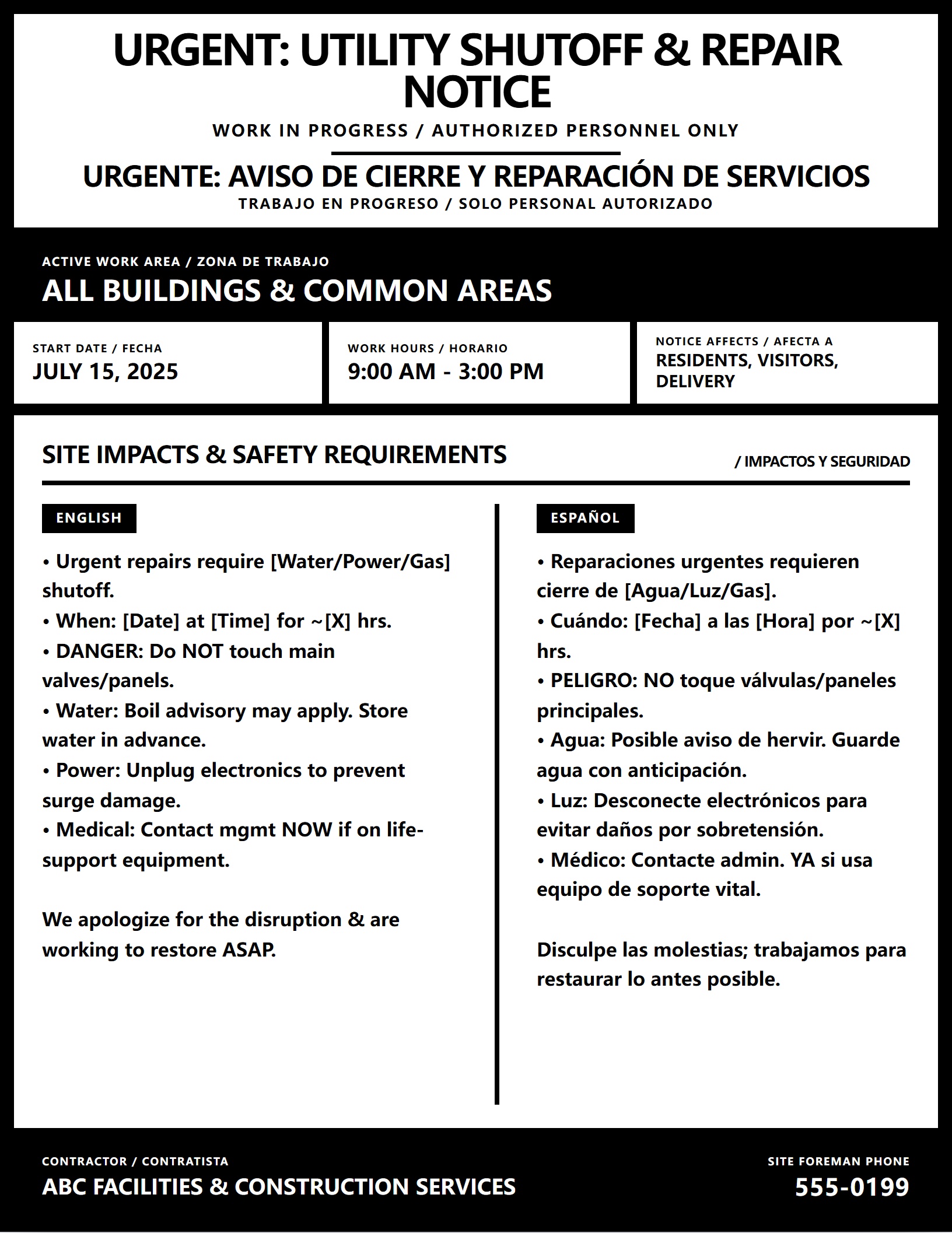
URGENT: UTILITY SHUTOFF & REPAIR NOTICE
URGENTE: AVISO DE CIERRE Y REPARACIÓN DE SERVICIOS
Why use this template?
- ✓ Bilingual output (English/Spanish) prevents FHA liability
- ✓ Formatted strictly for US Letter B&W physical printing
- ✓ Zero JS bloat, generates instantly in your browser
Print Output Preview
📋 Field Execution Asset
Download the OSHA-compliant manager checklist to ensure zero liability on-site.
🏠 Tenant Distribution Asset
Attach this prep-guide to your notice to reduce tenant front-desk calls by 60%.
Notice Editor & Preview
Edit Notice
Live Print Preview
US Letter • 8.5" x 11"
Legal Deadline Calculator
Powered by US Office of Personnel Management (OPM) rules.
Call 811 & Verify Underground Utility Locates
Post Advance Shutoff & Medical Dependency Survey
Execute OSHA LOTO (Lockout/Tagout) Energy Isolation
Execute Repair & Prevent Cross-Contamination
Compliance & Legal Disclaimer: Calculations are strictly based on U.S. Office of Personnel Management (OPM) observed federal holiday rules and standard weekend exclusions. While this tool is designed for enterprise-grade accuracy regarding FLSA and standard property management protocols (e.g., CA Civil Code §1950.5), local municipal codes may vary. NoticeMint is a workflow software, not a law firm. Always verify critical statutory deadlines with your legal counsel.
Execution Protocol
Operational Timeline & Compliance Checklist
- 72+ Hours Before (Statutory Lead Time) Responsible: contractor
Call 811 & Verify Underground Utility Locates
⚠️Liability Alert
Blindly digging or core-drilling without an 811 locate is a severe federal/state violation. Striking an underground high-pressure gas line or fiber-optic trunk can cause fatal explosions or millions of dollars in communication outage liabilities.
💡Pro Strategy
If the repair involves ANY excavation, trenching, or drilling into concrete slabs, you MUST call 811 (Dig Safe) to have all public underground utilities marked with paint/flags. Private lines (e.g., underground electrical to a detached garage, private sewer laterals) are NOT marked by 811 and require a private utility locator.
- 48 Hours Before Responsible: property manager
Post Advance Shutoff & Medical Dependency Survey at Building Lobbies, Elevator Cabs, Unit Doors, Digital Tenant Portal
💡Pro Strategy
Explicitly state the exact start time, expected duration, and which specific utilities (water, power, gas) will be shut off. Crucially, include a prompt for tenants who rely on electricity for life-support medical equipment (CPAP, oxygen concentrators, motorized wheelchairs) to register with management for emergency backup power or relocation assistance.
- Start of Work Responsible: contractor
Execute OSHA LOTO (Lockout/Tagout) Energy Isolation
⚠️Liability Alert
Failing to perform LOTO is a leading cause of fatal electrocution and high-pressure steam/water burns in maintenance. If a second shift worker or property manager accidentally turns a valve back on while a worker is inside a trench or panel, the result is catastrophic.
💡Pro Strategy
Before cutting, un-capping, or opening any utility line, the authorized worker MUST apply a personal padlock and danger tag to the main shutoff valve or electrical breaker (Lockout/Tagout). Verify "Zero Energy" by attempting to start the equipment or testing the line with a calibrated multimeter/pressure gauge before touching it.
- Active Repair Period Responsible: contractor
Execute Repair & Prevent Cross-Contamination
⚠️Liability Alert
A drop in water main pressure can cause "back-siphonage," pulling groundwater, soil, or sewage into the building's drinking water pipes. Cross-connection control is a critical public health mandate.
💡Pro Strategy
For water main repairs, deploy portable pumps to prevent trench flooding. For sewer line repairs, use bypass pumping and strictly enforce confined space entry protocols (gas monitoring, tripods) if entering manholes. Ensure backflow preventers are installed or verified to stop contaminated water from siphoning back into the clean potable water supply.
- Upon Repair Completion Responsible: contractor
Restore Service, Flush Lines & Clearance Testing
⚠️Liability Alert
Turning a water main valve on too quickly sends a massive shockwave through the plumbing system, frequently causing secondary pipe bursts inside occupied units, leading to massive water damage claims.
💡Pro Strategy
When restoring water, open valves SLOWLY to prevent "water hammer" (hydraulic shock) which can blow apart copper joints inside tenant walls. Flush all exterior hose bibbs and common area sinks until the water runs completely clear of rust and sediment. For gas lines, a certified technician must perform a pressure decay test and leak-check all joints with combustible gas detectors or soap solution before re-lighting pilot lights.
- Immediately After Water Restoration Responsible: property manager
Issue Boil Water Advisory (If applicable) at Building Lobbies, Elevator Cabs, Unit Doors, Digital Tenant Portal
⚠️Liability Alert
Failing to issue a Boil Water Advisory after a pressure loss is a severe public health violation. If tenants consume contaminated water and contract gastrointestinal illnesses (e.g., E. coli, Giardia), the property owner faces massive liability.
💡Pro Strategy
If the water system lost positive pressure for more than a few minutes, local health departments typically mandate a "Boil Water Advisory." Instruct tenants to boil all water used for drinking, cooking, and brushing teeth for 1 full minute until management receives passing lab results from water samples (usually takes 24-48 hours).
- After Clearance / Advisory Lifted Responsible: property manager
Remove Shutoff Notices & Final Site Inspection at Building Lobbies, Elevator Cabs, Unit Doors
💡Pro Strategy
Once utility services are fully stabilized, water tests return negative for bacteria, and all gas pilot lights are re-lit, remove all physical notices. Update the digital tenant portal to confirm the "All Clear" and lift any Boil Water Advisories.
Required Posting Locations
Physical Distribution Checklist
- Building Lobbies
- Elevator Cabs
- Unit Doors
- Digital Tenant Portal
Liability Defense Rule
Always take a timestamped wide-angle photo of the posted notice in its physical location. If a tenant claims they were not notified, this photo is your primary legal defense.
Tenant Communication Brief
Anticipated Questions & Official Responses
-
Q
Will my refrigerator food spoil during a power outage?
- "For planned outages under 4 hours, keep your refrigerator and freezer doors completely closed. A closed refrigerator will keep food safely cold for about 4 hours; a full freezer will hold its temperature for about 48 hours.
-
Q
Can I use the toilet during a water shutoff?
- "Standard flush toilets will work exactly ONCE using the water already in the tank. After that, you must manually pour a bucket of water (about 1-2 gallons) quickly into the bowl to force a flush. Do not use the sinks or showers, as drain traps may dry out and allow sewer gases to enter.
Manager's Note
Providing these answers in your initial notice can reduce management office phone volume by up to 60% during service interruptions.
Operational Guidance
Industry Best Practices & Field-Tested Strategies
Call 811 (Dig Safe) at least 72 hours before any excavation or concrete core-drilling. Never assume you know where underground gas, electric, or fiber-optic lines are buried. Private lines require a separate private utility locator.
Strictly enforce OSHA Lockout/Tagout (LOTO) protocols. Every authorized worker must apply their own personal padlock to the main shutoff valve or breaker before opening any line or panel. Verify "Zero Energy" with calibrated testing equipment before touching the system.
Survey the tenant roster for life-support medical dependencies (CPAP machines, oxygen concentrators, dialysis, motorized wheelchairs) 48 hours in advance. Arrange for backup generators, battery packs, or temporary relocation for these vulnerable individuals.
When restoring water service, open the main valve EXTREMELY SLOWLY. Opening it too fast causes "water hammer" (hydraulic shockwave) that can blow apart copper joints and angle stops inside tenant walls, causing massive secondary water damage.
Issue a "Boil Water Advisory" immediately if the potable water system loses positive pressure. Instruct tenants to boil water for 1 minute before drinking or cooking until lab clearance tests return negative for bacteria (typically 24-48 hours).
For gas line repairs, a certified technician must perform a pressure decay test and leak-check all joints with combustible gas detectors before re-lighting pilot lights. Never rely on the "smell test" alone.
Manager Checklist
- Verify contractor has submitted an 811 Dig Safe ticket and all underground utilities are marked with paint/flags before excavation begins
- Identify all tenants with life-support medical equipment and establish emergency backup power or relocation plans
- Ensure bilingual shutoff notices are posted physically and digitally 48 hours in advance, clearly stating the exact start time and expected duration
- Advise tenants to unplug sensitive electronics (computers, TVs) to protect against power surges when electricity is restored
- Verify contractor has a written LOTO (Lockout/Tagout) plan and sufficient personal padlocks for all crew members
- Prepare "Boil Water Advisory" templates in advance so they can be deployed immediately if the water system loses pressure
- Coordinate with the local water authority and health department regarding mandatory flushing and testing protocols
- Ensure contractor has a plan to systematically re-light all gas pilot lights (water heaters, furnaces, stoves) after gas restoration
- Brief front desk and security staff on the shutoff timeline and emergency contact numbers for the contractor
- Verify contractor understands main valves must be opened extremely slowly to prevent water hammer damage
Common Costly Mistakes
- ✗ Skipping the 811 locate because "it's just a small dig" — striking an underground high-pressure gas line or municipal fiber-optic trunk can cause fatal explosions or millions of dollars in outage liabilities.
- ✗ Failing to perform LOTO and relying on someone "standing by the valve" — human error, shift changes, or miscommunication frequently result in valves being turned back on while workers are inside trenches or panels, causing fatal electrocution or scalding.
- ✗ Turning the water main back on too quickly — the resulting water hammer shockwave frequently causes secondary pipe bursts in occupied units, turning a simple exterior repair into a multi-unit flood disaster.
- ✗ Failing to issue a Boil Water Advisory after a pressure loss — if the main loses pressure, groundwater and soil contaminants can back-siphon into the drinking water pipes. Failing to warn tenants is a severe public health violation.
- ✗ Ignoring medical dependency needs during planned power outages — if a tenant on a ventilator or oxygen concentrator suffers a medical emergency due to an unannounced or unmanaged power shutoff, the property owner faces catastrophic wrongful death or negligence liability.
- ✗ Leaving gas pilot lights unlit after restoring gas service — tenants may not realize their water heater or furnace pilot light went out during the shutoff, leading to days without hot water or heat, and generating mass complaint calls.
Resident Preparation Checklist
Include this checklist in your notice to reduce tenant calls by up to 60%
- ☐ Store clean water in advance for drinking, cooking, and flushing toilets if a water shutoff is planned
- ☐ Unplug sensitive electronics (computers, TVs, microwaves) to protect them from power surges when electricity is restored
- ☐ Keep refrigerator and freezer doors completely closed during a power outage to preserve food safety
- ☐ If you rely on electricity for life-support medical equipment (CPAP, oxygen), contact management IMMEDIATELY to arrange backup power
- ☐ After water is restored, run all cold water taps for 5-10 minutes until the water runs completely clear of rust and sediment before using it for laundry
- ☐ If a "Boil Water Advisory" is issued, bring all water used for drinking, cooking, and brushing teeth to a rolling boil for 1 full minute
- ☐ Check your gas appliances (water heater, furnace, stove) after a gas shutoff; if the pilot light is out, contact management or the gas company to have it safely re-lit
Frequently Asked Questions
Why do I need to boil my water after a water main repair?
What is OSHA LOTO and why is it so important?
Will my electronics be damaged when the power comes back on?
How do I flush my toilet if the water is shut off?
Why is my water brown or cloudy after the water is turned back on?
Disclaimer
- • OSHA 29 CFR 1910.147 (The Control of Hazardous Energy / Lockout-Tagout) mandates strict energy isolation procedures for all maintenance and repair work.
- • OSHA 29 CFR 1926.651 covers specific excavation and trenching safety requirements, including underground utility locates and confined space entry for sewer manholes.
- • EPA Safe Drinking Water Act (SDWA) and local municipal health codes dictate mandatory Boil Water Advisory protocols and water quality testing following a loss of positive system pressure.
- • NFPA 54 (National Fuel Gas Code) governs the safe installation, repair, and pressure testing of gas piping systems, including mandatory leak detection before re-energizing.
- • State and local "Dig Safe" or "811" One-Call laws legally require notification to utility companies 48 to 72 hours prior to any mechanical excavation.
- • This template provides formatting and operational guidance only and does not constitute legal advice. Consult your safety director, licensed master plumber/electrician, and legal counsel for jurisdiction-specific compliance.
Related Operational Tasks
Complete your communication workflow with these related notices