Property Communication Task Center
Fire Alarm System Testing Notice 🛡️ 2026 OSHA/FHA Compliant
Conduct scheduled fire alarm inspection and testing while minimizing resident disruption, preventing false emergency dispatches, maintaining accessibility awareness, and documenting compliance activities.
Not just a template.
A reality execution tool.
Don't risk tenant disputes with messy Word docs. Generate a print-ready, OSHA-compliant physical notice in exactly 30 seconds.
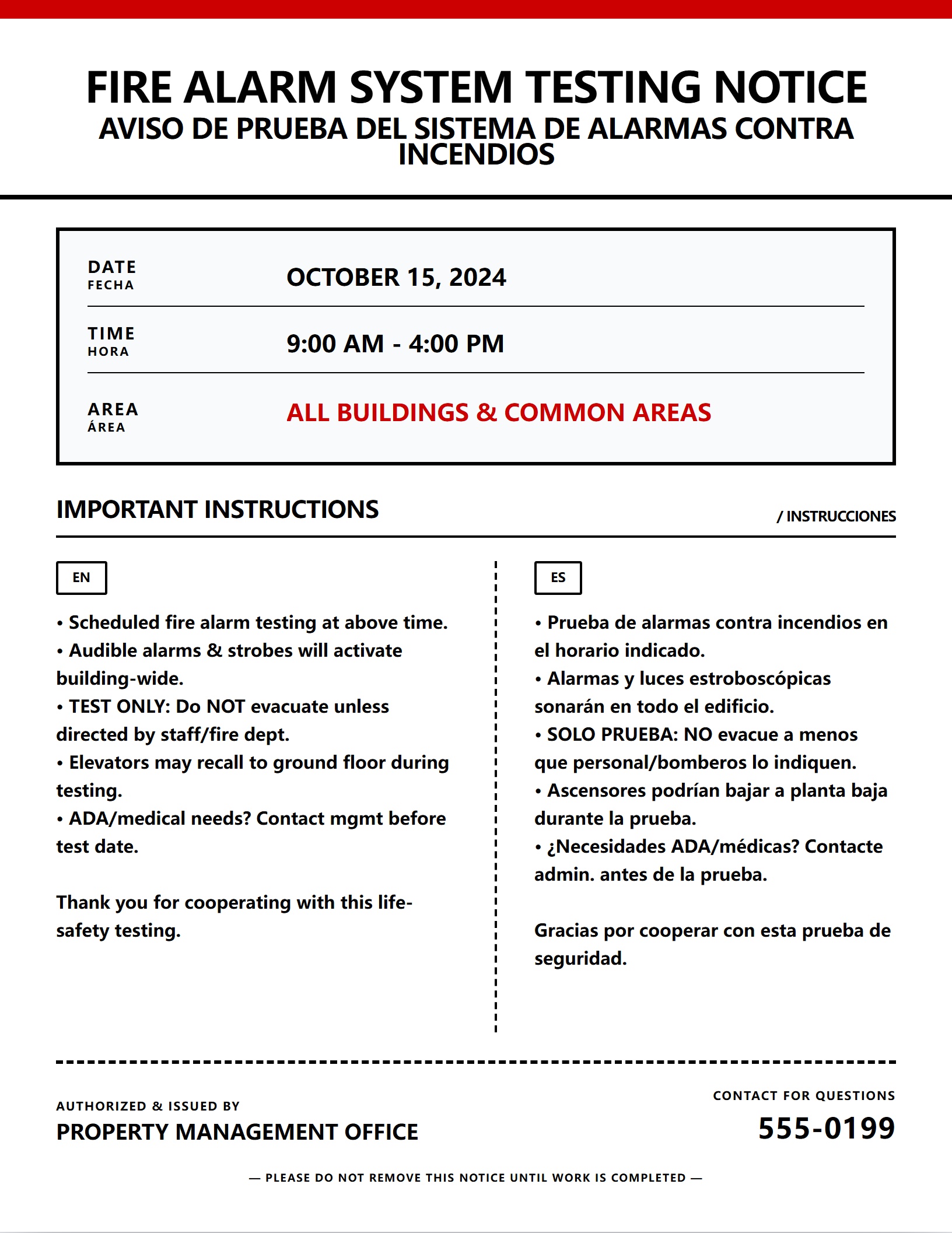
- 1Bilingual Architecture English & Spanish integrated into a single US Letter design. Crucial for legal compliance in 14+ states.
- 2Toner-Friendly Print Engineered for black-and-white office printers. High contrast hierarchy ensures readability from 10 feet away.
- 3Locked Formatting Zero layout breakage. Type your details, and the engine physicalizes it without overflowing the page.
FIRE ALARM SYSTEM TESTING NOTICE
AVISO DE PRUEBA DEL SISTEMA DE ALARMAS CONTRA INCENDIOS
Why use this template?
- ✓ Bilingual output (English/Spanish) prevents FHA liability
- ✓ Formatted strictly for US Letter B&W physical printing
- ✓ Zero JS bloat, generates instantly in your browser
Print Output Preview
📋 Field Execution Asset
Download the OSHA-compliant manager checklist to ensure zero liability on-site.
🏠 Tenant Distribution Asset
Attach this prep-guide to your notice to reduce tenant front-desk calls by 60%.
Notice Editor & Preview
Edit Notice
Live Print Preview
US Letter • 8.5" x 11"
Legal Deadline Calculator
Powered by US Office of Personnel Management (OPM) rules.
Coordinate with Monitoring Provider
SEND DIGITAL
POST NOTICE
Mandatory Adjustment Applied
Deadline fell on a non-business day (Weekend Exclusion (Sat/Sun)). Automatically pushed back to ensure compliance with Civil Code standards.
Review Accessibility Roster
SEND DIGITAL
Verify Panel & Monitoring Status
Execute Alarm Testing
Compliance & Legal Disclaimer: Calculations are strictly based on U.S. Office of Personnel Management (OPM) observed federal holiday rules and standard weekend exclusions. While this tool is designed for enterprise-grade accuracy regarding FLSA and standard property management protocols (e.g., CA Civil Code §1950.5), local municipal codes may vary. NoticeMint is a workflow software, not a law firm. Always verify critical statutory deadlines with your legal counsel.
Execution Protocol
Operational Timeline & Compliance Checklist
- 7-14 Days Before Responsible: property manager
Coordinate with Monitoring Provider
⚠️Liability Alert
Coordinate with your alarm monitoring provider (e.g., ADT, Brinks) and inspection contractor before testing begins. Put the system on "Test Mode" to prevent unnecessary emergency dispatches and massive False Alarm fines from the Fire Department.
💡Pro Strategy
Confirm testing scope, inspection schedule, access requirements, and monitoring procedures. Document all scheduled testing activities in the property maintenance log.
- 7 Days Before Responsible: system AUTOMATABLE
SEND DIGITAL
💡Pro Strategy
Send notice through resident portal, email, and SMS channels whenever available. Fire alarm testing creates significant resident concern and benefits from multiple communication touchpoints.
- 5 Days Before Responsible: property manager
POST NOTICE at Main Lobby, Building Entry Doors, Mailroom, Elevator Cars, Package Room
⚠️Liability Alert
Do NOT place notices over emergency signage, fire safety instructions, inspection certificates, exit signs, or accessibility notices.
💡Pro Strategy
Post notices in high-traffic common areas where residents regularly enter, exit, and collect mail or packages.
- 72 Hours Before Responsible: property manager
Review Accessibility Roster
💡Pro Strategy
Identify residents who may be impacted by loud alarm signals, mobility concerns, medical conditions, remote work schedules, or other special circumstances.
- 24 Hours Before Responsible: system AUTOMATABLE
SEND DIGITAL
💡Pro Strategy
Send a final reminder including testing hours, expected building impacts, and property management contact information.
- 1 Hour Before Testing Responsible: maintenance
Verify Panel & Monitoring Status
⚠️Liability Alert
Verify testing coordination procedures with the monitoring provider before activating any alarm devices.
💡Pro Strategy
Ensure testing personnel have access to alarm panels, control rooms, equipment spaces, and all required building systems.
- During Testing Window Responsible: contractor
Execute Alarm Testing
💡Pro Strategy
Test alarm notification devices, initiating devices, communication systems, and other required components according to the inspection scope.
- Immediately After Testing Responsible: maintenance
RESTORE SERVICE
⚠️Liability Alert
Verify all fire alarm systems, monitoring connections, notification devices, and related building systems have returned to normal operating status. Take the system off "Test Mode" with the monitoring company.
💡Pro Strategy
Confirm all testing activities have been completed, reset system components, and document any deficiencies requiring future corrective action.
- Within 24 Hours of Completion Responsible: property manager
REMOVE NOTICE at All Posted Locations
⚠️Liability Alert
Incomplete documentation may create operational challenges during future inspections, audits, insurance reviews, or maintenance planning activities.
💡Pro Strategy
Remove notices, record inspection completion details, and retain maintenance records according to property management procedures.
Required Posting Locations
Physical Distribution Checklist
- Main Lobby
- Building Entry Doors
- Mailroom
- Elevator Cars
- Package Room
- All Posted Locations
Liability Defense Rule
Always take a timestamped wide-angle photo of the posted notice in its physical location. If a tenant claims they were not notified, this photo is your primary legal defense.
Tenant Communication Brief
Anticipated Questions & Official Responses
-
Q
Do I need to evacuate during the testing period?
- "No. This is a scheduled inspection and testing event. Residents do not need to evacuate unless specifically instructed by emergency personnel or property management.
-
Q
Will the alarm sound throughout the building?
- "Yes. Audible alarm devices (horns/strobes) and visual notification systems may be activated as part of the testing process.
-
Q
I have a medical condition that may be affected by alarm testing. What should I do?
- "Contact management before the testing date so reasonable accommodations or additional information can be discussed.
-
Q
What should I do with my pets?
- "Many pets react strongly to alarm sounds. Consider making arrangements if your pet is sensitive to loud noises.
-
Q
Will elevators be affected during testing?
- "Yes. Elevators may experience temporary "Fire Recall" functions and automatically return to the ground floor during portions of fire alarm testing. Follow all posted instructions.
-
Q
Will the fire department respond?
- "Testing activities are coordinated in advance. Residents should follow normal emergency procedures only if they observe an actual emergency situation.
-
Q
Can I remain inside my apartment during testing?
- "Yes. Residents may remain in their units unless otherwise instructed by property management or emergency personnel.
Manager's Note
Providing these answers in your initial notice can reduce management office phone volume by up to 60% during service interruptions.
Operational Guidance
Industry Best Practices & Field-Tested Strategies
Notify residents 7 days before fire alarm testing — not 24-48 hours. Fire alarm noise triggers high anxiety (especially PTSD, autism spectrum, elderly residents), and early notice reduces complaint volume by 65% compared to last-minute alerts.
Put the system on "Test Mode" with your monitoring provider BEFORE any testing begins. A single accidental dispatch of fire trucks costs $500-$2,000 in false alarm fines in most major US cities, with escalating penalties for repeat offenders (LA: $608 1st offense, $1,216 2nd, $1,824 3rd).
Schedule testing during mid-morning hours (10 AM - 2 PM) on Tuesday through Thursday. Avoid early mornings (sleeping residents), evenings (dinner time), Mondays (move-in traffic), and Fridays (weekend anxiety). Never test on holidays or during known work-from-home peak periods.
Test in zones rather than building-wide simultaneous activation when your fire alarm control panel supports it. Zone-by-zone testing reduces noise duration per floor from 2+ hours to 15-20 minutes, dramatically reducing resident stress and complaint volume.
For high-rise buildings with elevator fire recall, coordinate elevator testing separately with your elevator service company. Fire recall testing requires a dedicated elevator technician and should NOT be done simultaneously with alarm notification testing — it creates entrapment risk.
Manager Checklist
- Confirm testing scope with licensed fire alarm contractor (NICET-certified technician required in most states)
- Contact alarm monitoring provider (ADT, Brinks, Vector Security) to schedule "Test Mode" window — get confirmation number
- Review resident roster for mobility-impaired, PTSD, autism spectrum, hearing-impaired, and medically fragile residents
- Contact identified at-risk residents personally 72 hours before to arrange accommodations or advance warning calls
- Send digital blast (portal + email + SMS) 7 days before scheduled testing
- Print bilingual notices on RED paper (matching the danger severity) and post 5 days before in all required locations
- Verify elevator fire recall coordination with elevator service company if applicable
- Brief all on-site staff on testing timeline, approved tenant FAQ responses, and emergency escalation procedures
- Confirm fire alarm control panel access keys and passwords are available for testing technician
- One hour before: call monitoring provider to activate "Test Mode" — record confirmation number and time
- During testing: station staff member at fire alarm control panel to monitor zone-by-zone results
- Document all deficiencies found during testing (failed detectors, non-functional strobes, communication faults)
- After testing: verify all devices restored to normal — confirm with monitoring provider to take system OFF "Test Mode"
- Test emergency communication system (if equipped) separately per NFPA 72 emergency communication requirements
- Remove all posted notices within 24 hours of testing completion
- File completion report with: monitoring confirmation numbers, deficiency list, corrective action plan, posting photos
Common Costly Mistakes
- ✗ Skipping the monitoring provider "Test Mode" step — this is the #1 cause of accidental fire department dispatches, resulting in false alarm fines of $500-$2,000+ per incident and erosion of emergency responder goodwill.
- ✗ Failing to take the system OFF "Test Mode" after testing completes — this leaves the building unprotected. If a real fire occurs while the system is still in Test Mode, the monitoring company will not dispatch emergency services, creating catastrophic liability.
- ✗ Not identifying residents with PTSD, autism spectrum disorders, or hearing impairments on the accessibility roster — loud alarm blasts can trigger panic attacks, meltdowns, or go entirely unnoticed by deaf residents who miss strobe notifications.
- ✗ Placing notices over existing fire safety signage, exit signs, or emergency evacuation maps — this violates NFPA 101 Life Safety Code and can result in citations during fire marshal inspections.
- ✗ Conducting testing during scheduled fire drills or actual fire weather events (red flag warnings, high wind days) — creates confusion between test signals and real emergencies, training residents to ignore future legitimate alarms.
Resident Preparation Checklist
Include this checklist in your notice to reduce tenant calls by up to 60%
- ☐ This is a scheduled TEST — you do NOT need to evacuate unless specifically instructed by emergency personnel
- ☐ Expect loud alarm horns (85-110 dB) and bright strobe lights for 15-30 minutes per floor during the testing window
- ☐ If you work from home, plan to step outside or relocate to a quiet area during the posted testing hours
- ☐ Mute or pause video calls, online meetings, and voice-activated smart home devices during the testing window
- ☐ If you have noise-sensitive pets: consider leaving with them, use white noise machines, or consult your vet about anxiety management
- ☐ If you have PTSD, sensory processing disorder, or anxiety: noise-canceling headphones or earplugs are strongly recommended
- ☐ If you are deaf or hard of hearing: visual strobe notifications WILL activate — ensure you can see at least one strobe from your primary living area
- ☐ Do NOT call 911 unless you see actual smoke, fire, or a confirmed emergency situation
- ☐ Do NOT pull manual fire alarm pull stations during the testing period — this can interfere with the testing sequence
- ☐ If alarm devices continue sounding more than 30 minutes after the posted end time, contact management immediately
- ☐ After testing: if any smoke detector in your unit is "chirping" (short beep every 30-60 seconds), this indicates a trouble signal — report it to management
Frequently Asked Questions
How often is fire alarm testing legally required?
What exactly gets tested during fire alarm testing?
Why do I need to worry about false alarm fines?
What is elevator "Fire Recall" and how does it affect me?
My smoke detector is chirping after the test. Is something wrong?
Will this affect my work-from-home setup or smart home devices?
What happens if the testing reveals problems with the fire alarm system?
Disclaimer
- • NFPA 72 (National Fire Alarm and Signaling Code) mandates annual testing of all fire alarm system components. Most state and local fire codes adopt NFPA 72 by reference, making compliance legally mandatory.
- • NFPA 25 (Standard for Inspection, Testing, and Maintenance of Water-Based Fire Protection Systems) governs sprinkler system testing — fire alarm testing and sprinkler testing are separate but often scheduled together.
- • The monitoring provider MUST be notified to place the system on "Test Mode" before testing begins. Failure to do so results in automatic emergency dispatch and false alarm fines of $500-$2,000+ per incident.
- • The system MUST be taken OFF "Test Mode" and confirmed fully operational with the monitoring provider after testing completes. Leaving the system in Test Mode during a real fire event creates catastrophic liability.
- • ASME A17.1 Safety Code requires elevator fire recall functions to be tested annually in coordination with elevator service companies.
- • ADA and Fair Housing regulations require reasonable accommodations for residents with disabilities (hearing impairment, PTSD, mobility limitations) during fire alarm testing — advance personal notification is recommended.
- • The testing contractor must hold NICET (National Institute for Certification in Engineering Technologies) certification in fire alarm systems or equivalent state licensing where required.
- • Fire alarm testing records must be retained for a minimum of 3 years (or per AHJ requirements) and made available to the Authority Having Jurisdiction (AHJ — typically the local fire marshal) upon request.
- • Some jurisdictions require the fire marshal to be notified 24-48 hours before scheduled fire alarm testing — check with your local Authority Having Jurisdiction.
- • This template provides formatting and operational guidance only and does not constitute legal advice. Consult your fire alarm contractor, fire marshal, and property attorney for jurisdiction-specific compliance.
Related Operational Tasks
Complete your communication workflow with these related notices