Property Communication Task Center
Pest Control Treatment Notice 🛡️ 2026 OSHA/FHA Compliant
Ensure 100% unit access and proper tenant preparation for chemical pest treatment while strictly mitigating pet toxicity and privacy liabilities.
Not just a template.
A reality execution tool.
Don't risk tenant disputes with messy Word docs. Generate a print-ready, OSHA-compliant physical notice in exactly 30 seconds.
- 1Bilingual Architecture English & Spanish integrated into a single US Letter design. Crucial for legal compliance in 14+ states.
- 2Toner-Friendly Print Engineered for black-and-white office printers. High contrast hierarchy ensures readability from 10 feet away.
- 3Locked Formatting Zero layout breakage. Type your details, and the engine physicalizes it without overflowing the page.
MANDATORY PEST CONTROL TREATMENT
TRATAMIENTO OBLIGATORIO CONTRA PLAGAS
Why use this template?
- ✓ Bilingual output (English/Spanish) prevents FHA liability
- ✓ Formatted strictly for US Letter B&W physical printing
- ✓ Zero JS bloat, generates instantly in your browser
Print Output Preview
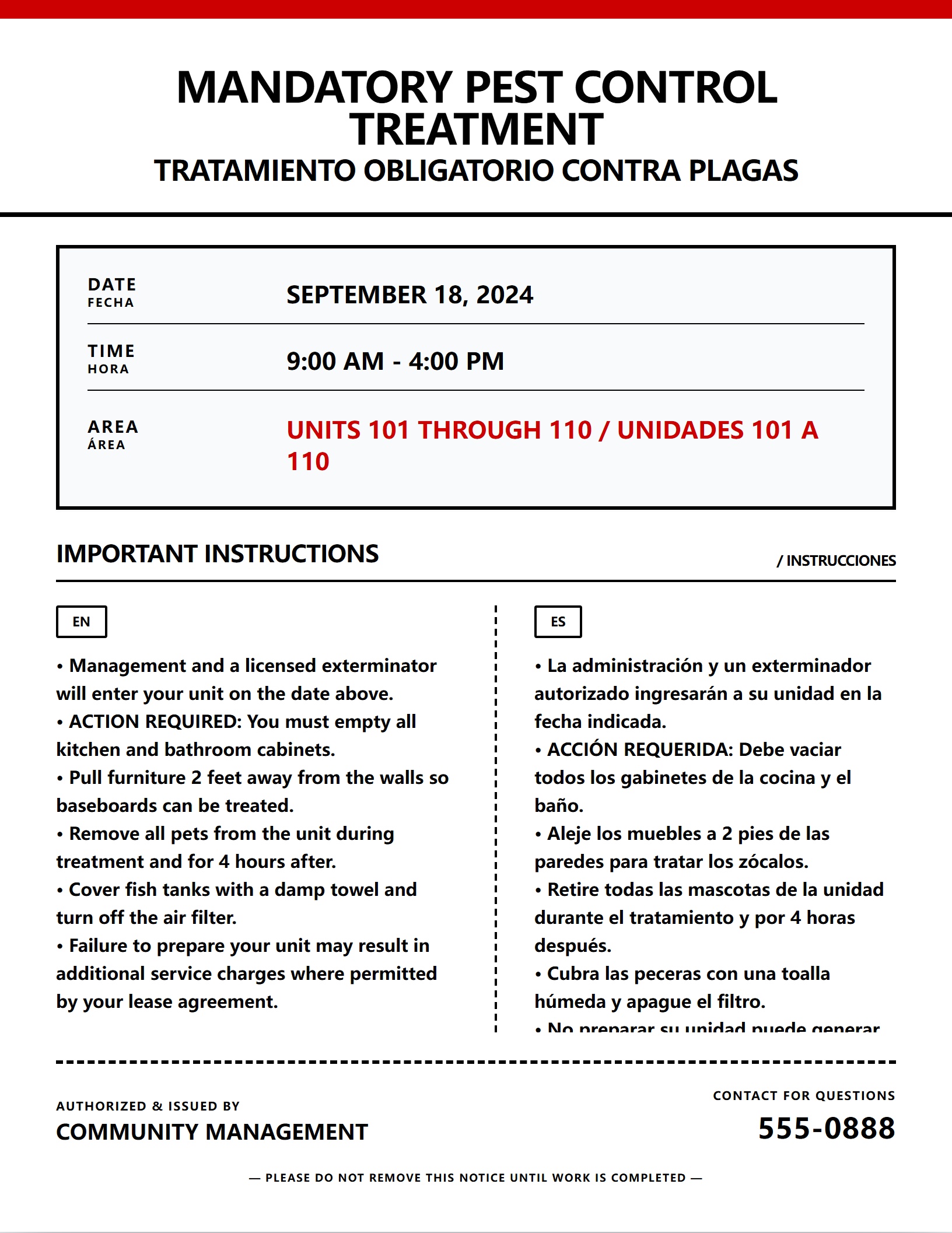
📋 Field Execution Asset
Download the OSHA-compliant manager checklist to ensure zero liability on-site.
🏠 Tenant Distribution Asset
Attach this prep-guide to your notice to reduce tenant front-desk calls by 60%.
Notice Editor & Preview
Edit Notice
Live Print Preview
US Letter • 8.5" x 11"
Legal Deadline Calculator
Powered by US Office of Personnel Management (OPM) rules.
SEND DIGITAL
POST NOTICE
Verify Unit Preparation
Escort Exterminator
Compliance & Legal Disclaimer: Calculations are strictly based on U.S. Office of Personnel Management (OPM) observed federal holiday rules and standard weekend exclusions. While this tool is designed for enterprise-grade accuracy regarding FLSA and standard property management protocols (e.g., CA Civil Code §1950.5), local municipal codes may vary. NoticeMint is a workflow software, not a law firm. Always verify critical statutory deadlines with your legal counsel.
Execution Protocol
Operational Timeline & Compliance Checklist
- 48 Hours Before Responsible: system AUTOMATABLE
SEND DIGITAL
💡Pro Strategy
A standard 24-hour notice is legally sufficient in most states, but 48 hours is the industry standard for pest control because tenants need time to clear cabinets and arrange pet boarding.
- 48 Hours Before Responsible: property manager
POST NOTICE at Individual Unit Doors, Building Entrance, Mailbox Area
⚠️Liability Alert
Keep a master list of all posted doors. If a tenant claims they weren't notified and their pet is exposed to chemicals, you need proof of posting.
💡Pro Strategy
Tape notices directly to the individual unit doors of affected apartments. Do NOT slip them under the door where pets might destroy them.
- Treatment Day (Morning) Responsible: maintenance
Verify Unit Preparation
⚠️Liability Alert
If a fish tank is NOT covered with a damp towel and the filter turned off, DO NOT SPRAY that room. Airborne chemicals are highly toxic to aquatic life.
💡Pro Strategy
Before the exterminator sprays, visually verify that kitchen cabinets are emptied and toothbrushes/towels in bathrooms are put away.
- During Treatment Responsible: property manager
Escort Exterminator
⚠️Liability Alert
Never give master keys to third-party exterminators. A maintenance tech or management staff MUST escort the vendor into every occupied unit to prevent theft liability. Staff should avoid photographing or documenting personal belongings inside occupied units unless required for damage documentation or legal purposes.
💡Pro Strategy
Ensure the vendor provides the SDS (Safety Data Sheet) for all chemicals used on-site, as required by OSHA.
- Upon Exit Responsible: contractor
POST NOTICE at Inside Unit (Kitchen Counter)
💡Pro Strategy
Leave a signed "Service Completed" door hanger or carbon copy inside the unit. This prevents tenants from calling the office to ask if the exterminator showed up.
- 24 Hours After Completion Responsible: property manager
REMOVE NOTICE at Building Entrance, Mailbox Area, Community Bulletin Board
💡Pro Strategy
Remove outdated pest control notices after the treatment cycle is complete to avoid resident confusion and maintain accurate community communications.
Required Posting Locations
Physical Distribution Checklist
- Individual Unit Doors
- Building Entrance
- Mailbox Area
- Inside Unit (Kitchen Counter)
- Community Bulletin Board
Liability Defense Rule
Always take a timestamped wide-angle photo of the posted notice in its physical location. If a tenant claims they were not notified, this photo is your primary legal defense.
Tenant Communication Brief
Anticipated Questions & Official Responses
-
Q
Do I have to be home?
- "No. Management will escort the licensed exterminator into your unit if you are not present.
-
Q
Can I refuse the treatment?
- "In most cases, residents are required to provide access for scheduled pest control services in accordance with the lease agreement and applicable local laws.
-
Q
Is the spray safe for my pets?
- "The treatment is safe ONLY AFTER it has completely dried (usually 2-4 hours). Dogs and cats must be removed from the unit during spraying.
Manager's Note
Providing these answers in your initial notice can reduce management office phone volume by up to 60% during service interruptions.
Operational Guidance
Industry Best Practices & Field-Tested Strategies
Issue notices 48 hours before treatment, not 24 hours. Tenants need time to clear cabinets, move furniture, and arrange pet boarding. Rushed notifications lead to 40% higher refusal rates.
Tape notices directly to unit doors at eye level — never slip under doors where pets destroy them. Use brightly colored paper (yellow/orange) to increase visibility by 3x over standard white.
Require vendors to provide Safety Data Sheets (SDS) for all chemicals used on-site. OSHA mandates SDS availability, and tenants have legal right to request copies.
Maintain a master posting log with timestamps and photos of every posted door. If a tenant claims non-notification after pet exposure to chemicals, documented proof is your only defense.
Brief all front desk and maintenance staff on the 5 most common tenant questions before treatment day. Prepared responses reduce call volume by 60% and prevent inconsistent information.
Manager Checklist
- Confirm treatment scope, chemical types, and estimated duration with licensed exterminator
- Send digital blast (portal + SMS + email) 48 hours before treatment
- Print bilingual notices on colored paper and post 48 hours before at all required locations
- Create master posting log with unit numbers, timestamps, and staff initials
- Take timestamped photos of notices on each unit door for compliance documentation
- Brief all on-site staff on the 5 most common tenant questions and approved responses
- Verify exterminator has current license, insurance certificate, and SDS sheets for all chemicals
- Confirm maintenance staff availability to escort vendor into every occupied unit
- Inspect 3-5 sample units morning-of to verify tenant preparation compliance
- Ensure "Service Completed" door hangers are ready for vendor to leave in each unit
- Monitor post-treatment — check for tenant complaints, pet incidents, or chemical odors
- Remove all posted notices within 24 hours of treatment completion
- File completion report with posting log photos, vendor invoice, and any incident notes
Common Costly Mistakes
- ✗ Giving master keys to third-party exterminators without staff escort — creates theft liability and violates tenant privacy rights in most jurisdictions.
- ✗ Spraying rooms with uncovered fish tanks — airborne pyrethroids are highly toxic to aquatic life and can kill fish within hours, leading to property damage claims.
- ✗ Failing to provide bilingual notices in buildings with >30% Spanish-speaking households — violates fair housing communication standards and creates legal exposure.
- ✗ Not verifying unit preparation before spraying — if cabinets are full or furniture blocks baseboards, treatment effectiveness drops by 70% and pests relocate rather than die.
- ✗ Photographing personal belongings inside occupied units during escort — violates tenant privacy and can lead to harassment claims unless documenting specific damage.
Resident Preparation Checklist
Include this checklist in your notice to reduce tenant calls by up to 60%
- ☐ Empty ALL kitchen and bathroom cabinets — exterminator needs access to spray interior walls and baseboards
- ☐ Pull furniture 2 feet away from walls so baseboards can be treated (beds, dressers, couches, bookshelves)
- ☐ Remove all pets from the unit during treatment and for 4 hours after spraying
- ☐ Cover fish tanks with damp towels and turn off air filters — airborne chemicals are toxic to aquatic life
- ☐ Put away toothbrushes, towels, and personal hygiene items in bathrooms
- ☐ Remove or cover all food, dishes, and cooking utensils from kitchen counters and open shelves
- ☐ Wash all countertops and food preparation surfaces after treatment before using
- ☐ Do not mop or wash treated floors for 48 hours to allow chemical absorption
- ☐ Ventilate unit by opening windows for 2-3 hours after returning (if weather permits)
- ☐ Report any persistent chemical odors, pet illness, or health symptoms to management immediately
Frequently Asked Questions
What chemicals will be used, and are they safe for children and pregnant women?
How long do I need to stay out of my apartment after treatment?
What if pests return within a week after treatment?
Can I hire my own exterminator instead of the building's scheduled treatment?
What about my food, dishes, and kitchen items?
Do I need to clean or vacuum after the treatment?
Disclaimer
- • Notice periods vary by jurisdiction — California requires 24 hours minimum, but industry best practice is 48 hours for pest control due to preparation requirements.
- • All pest control vendors must hold current state licenses and provide proof of liability insurance. Verify credentials before signing contracts.
- • OSHA requires Safety Data Sheets (SDS) for all chemicals used in occupied spaces. Tenants have the right to request copies.
- • The Federal Insecticide, Fungicide, and Rodenticide Act (FIFRA) governs pesticide use. All products must be EPA-registered and applied according to label directions.
- • Some jurisdictions require integrated pest management (IPM) plans that prioritize non-chemical methods before chemical treatment. Consult local regulations.
- • HUD-assisted properties may have additional notice and accessibility requirements under federal fair housing regulations.
- • Always retain copies of all posted notices, digital communications, vendor contracts, and SDS sheets for your compliance file.
- • This template provides formatting and operational guidance only and does not constitute legal advice. Consult your property attorney for jurisdiction-specific compliance.
Related Operational Tasks
Complete your communication workflow with these related notices