Property Communication Task Center
TRASH & RECYCLING PICKUP DELAYED 🛡️ 2026 OSHA/FHA Compliant
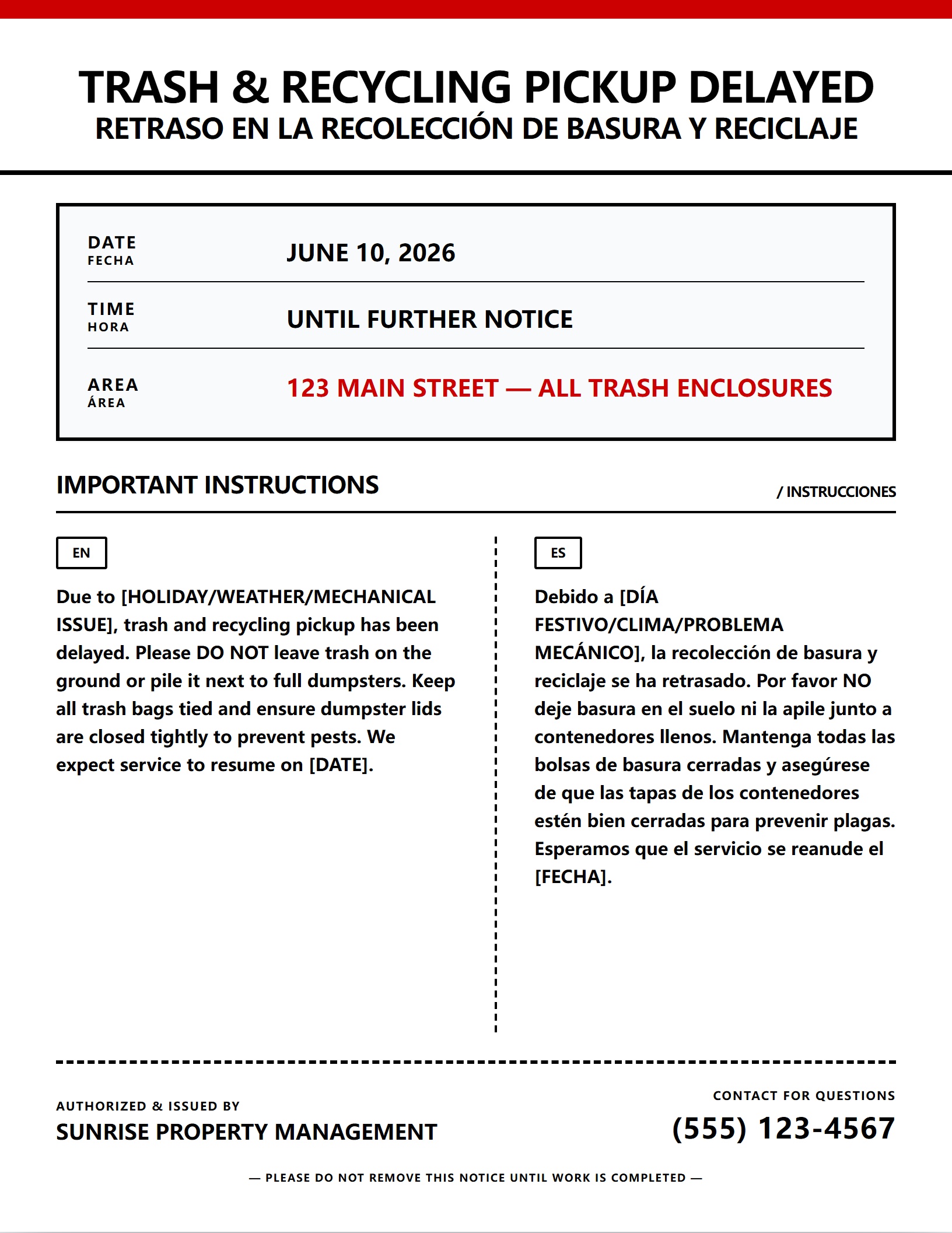
Generate a bilingual trash delay notice that manages tenant expectations, enforces temporary waste storage protocols, prevents illegal dumping, and mitigates pest/odor risks during service interruptions.
Not just a template.
A reality execution tool.
Don't risk tenant disputes with messy Word docs. Generate a print-ready, OSHA-compliant physical notice in exactly 30 seconds.
- 1Bilingual Architecture English & Spanish integrated into a single US Letter design. Crucial for legal compliance in 14+ states.
- 2Toner-Friendly Print Engineered for black-and-white office printers. High contrast hierarchy ensures readability from 10 feet away.
- 3Locked Formatting Zero layout breakage. Type your details, and the engine physicalizes it without overflowing the page.
TRASH & RECYCLING PICKUP DELAYED
RETRASO EN LA RECOLECCIÓN DE BASURA Y RECICLAJE
Why use this template?
- ✓ Bilingual output (English/Spanish) prevents FHA liability
- ✓ Formatted strictly for US Letter B&W physical printing
- ✓ Zero JS bloat, generates instantly in your browser
Print Output Preview
📋 Field Execution Asset
Download the OSHA-compliant manager checklist to ensure zero liability on-site.
🏠 Tenant Distribution Asset
Attach this prep-guide to your notice to reduce tenant front-desk calls by 60%.
Notice Editor & Preview
Edit Notice
Live Print Preview
US Letter • 8.5" x 11"
Legal Deadline Calculator
Powered by US Office of Personnel Management (OPM) rules.
Send digital notice to all residents via email & app
Post bilingual signs on all dumpsters and trash chute doors
Inspect and secure all dumpster lids and animal-proof latches
Monitor dumpster capacity and prevent illegal dumping
Compliance & Legal Disclaimer: Calculations are strictly based on U.S. Office of Personnel Management (OPM) observed federal holiday rules and standard weekend exclusions. While this tool is designed for enterprise-grade accuracy regarding FLSA and standard property management protocols (e.g., CA Civil Code §1950.5), local municipal codes may vary. NoticeMint is a workflow software, not a law firm. Always verify critical statutory deadlines with your legal counsel.
Execution Protocol
Operational Timeline & Compliance Checklist
- As soon as delay is confirmed (typically 12-24 hours before pickup) Responsible: property manager
Send digital notice to all residents via email & app
💡Pro Strategy
Trash delays are commonly caused by holidays, severe weather (snow/ice blocking access), or municipal truck shortages. Notify residents IMMEDIATELY to prevent dumpster overflow and illegal dumping.
- Immediately after digital notice Responsible: maintenance
Post bilingual signs on all dumpsters and trash chute doors at trash_chute_doors, dumpster_enclosures, mail_kiosk
⚠️Liability Alert
If dumpsters are already overflowing, DO NOT allow residents to pile trash on the ground. This violates Municipal Health Codes and attracts rodents. Open overflow dumpsters or designate a temporary staging area.
💡Pro Strategy
Use weatherproof, high-visibility signs (yellow or orange). For properties with trash chutes, tape a sign directly over the chute handle so residents see it BEFORE opening. Ensure signs are at 48–60" height per ADA §4.2.5.
- Before expected overflow Responsible: maintenance
Inspect and secure all dumpster lids and animal-proof latches
💡Pro Strategy
In states with bear/wildlife activity (e.g., CO, CA, FL), animal-proof dumpster latches are legally mandated. A propped-open lid during a delay will result in scattered trash and municipal fines.
- During delay period (every 4-6 hours) Responsible: maintenance
Monitor dumpster capacity and prevent illegal dumping
💡Pro Strategy
Assign maintenance staff to patrol trash areas every 4-6 hours. If dumpsters are at 80%+ capacity, contact the waste contractor for an emergency "drop-and-swap" (empty dumpster replacement). Document any illegal dumping with security camera footage for lease violation follow-up.
- After trash is finally collected Responsible: property manager
Schedule pest control inspection if trash was left exposed
💡Pro Strategy
If trash was exposed to the elements for more than 48 hours (especially in warm weather), schedule a preventive pest control treatment around the dumpster enclosures to deter flies, rodents, and roaches.
- Upon successful pickup Responsible: contractor
Confirm trash collection and reopen all trash areas
- Within 2 hours of service restoration Responsible: maintenance AUTOMATABLE
Remove delay signs and send service restored notification
💡Pro Strategy
Promptly remove all "Trash Delay" signs to restore normal operations. The system will automatically send a "Service Restored" notification to all residents.
Required Posting Locations
Physical Distribution Checklist
- trash_chute_doors
- dumpster_enclosures
- mail_kiosk
Liability Defense Rule
Always take a timestamped wide-angle photo of the posted notice in its physical location. If a tenant claims they were not notified, this photo is your primary legal defense.
Tenant Communication Brief
Anticipated Questions & Official Responses
-
Q
Why is trash/recycling pickup delayed?
- "Trash pickup may be delayed due to holidays, severe weather preventing truck access, or municipal service disruptions. We are actively coordinating with the waste management company to restore service as soon as possible.
-
Q
¿Por qué se retrasa la recolección de basura/reciclaje?
- "La recolección puede retrasarse por días festivos, clima severo que impide el acceso de camiones, o interrupciones del servicio municipal. Estamos coordinando activamente con la empresa de residuos para restaurar el servicio lo antes posible.
-
Q
What should I do if the dumpster is full?
- "DO NOT leave trash on the ground or pile it next to the dumpster. This creates a health hazard and may result in a lease violation fine. Please take your trash home temporarily, or use the designated overflow area at [LOCATION].
-
Q
¿Qué debo hacer si el contenedor está lleno?
- "NO deje basura en el suelo ni la apile junto al contenedor. Esto crea un riesgo para la salud y puede resultar en una multa por violación del contrato. Por favor lleve su basura a casa temporalmente, o use el área de desbordamiento designada en [UBICACIÓN].
Manager's Note
Providing these answers in your initial notice can reduce management office phone volume by up to 60% during service interruptions.
Operational Guidance
Industry Best Practices & Field-Tested Strategies
Maintain a 12-month holiday calendar with waste contractor contact information and backup service schedules. Major holidays (Christmas, New Year's, Thanksgiving, July 4th) typically cause 1-3 day delays. Proactive scheduling of emergency "drop-and-swap" dumpster replacements 48 hours before known holidays prevents overflow crises.
During summer months (June-August), organic waste decomposition accelerates 3-4x compared to winter. Food waste exposed for 24+ hours at 80°F+ generates significant odor and attracts flies within 48 hours. Schedule preventive pest control treatment around dumpster enclosures BEFORE summer delays begin, not after overflow occurs.
Update digital channels (website, resident portal, app) with real-time status every 12 hours during extended delays. 60% of residents check digital channels before visiting trash areas — outdated "normal service" status creates frustration when they arrive to find full dumpsters. Include expected restoration date and overflow area location in updates.
Designate a temporary overflow staging area with clear signage BEFORE delays begin. A 10x10 foot concrete pad with 6-foot privacy screening and animal-proof containers can handle 2-3 days of overflow for a 100-unit property. This prevents illegal ground-level dumping and municipal health code violations.
For recycling delays exceeding 48 hours, communicate contamination risks clearly. Residents who mix recyclables with general waste during delays (due to confusion or convenience) contaminate entire truckloads, resulting in $200-$500 contamination fees charged to the property. Post bilingual "Recycling Delay — Keep Separated" signs on recycling containers.
Manager Checklist
- Maintain 12-month holiday calendar with waste contractor contact information and backup service schedules
- Verify waste contractor holds current insurance, licensing, and backup truck availability
- Identify potential overflow staging area (10x10 ft concrete pad with privacy screening) for extended delays
- Stock weatherproof, high-visibility signs (yellow/orange) for dumpster enclosures and trash chute doors
- Establish backup service protocols with waste contractor — verify 24-48 hour emergency response capability
- Send digital blast (portal + email + SMS + app) immediately when delay is confirmed
- Post bilingual signs on ALL dumpster enclosures and trash chute doors within 2 hours of digital notice
- Update website, resident portal, and app status to "Trash Delayed" with expected restoration date
- Inspect all dumpster lids and animal-proof latches — repair or replace any that can be easily bypassed
- Assign maintenance staff to patrol trash areas every 4-6 hours during delay period
- Monitor dumpster capacity — contact waste contractor for emergency "drop-and-swap" when at 80% capacity
- Document any illegal dumping with security camera footage, timestamp, and written incident report
- Issue lease violation notices within 24 hours of documented illegal dumping
- For summer delays (80°F+): schedule preventive pest control treatment around dumpster enclosures within 48 hours
- For recycling delays: post "Keep Recycling Separated" signs and provide temporary recycling collection points
- Update digital channels with real-time status every 12 hours during extended delays
- After service restoration: remove all delay signs within 2 hours and send "Service Restored" notification
- Schedule pest control inspection if trash was exposed for 48+ hours (especially in warm weather)
- File completion report with: delay cause, duration, overflow volume, illegal dumping incidents, pest control actions, and resident communications
Common Costly Mistakes
- ✗ Allowing trash to accumulate on the ground around full dumpsters — this violates Municipal Health Codes in virtually all jurisdictions and attracts rodents, flies, and roaches within 24-48 hours. Ground-level trash also creates tripping hazards and ADA accessibility violations. If dumpsters are at 80%+ capacity, you MUST provide alternative overflow containers or staging areas.
- ✗ Failing to document illegal dumping with security camera footage and written incident reports — without evidence, you cannot enforce lease violations or charge cleanup fees to offending tenants. Document: timestamp, tenant identity (if visible), type/quantity of waste, and location. Issue lease violation notices within 24 hours of documented illegal dumping.
- ✗ Not coordinating with waste contractor on backup service schedules — if your primary waste contractor experiences mechanical failures or staffing shortages, they may have backup trucks available with 24-48 hour notice. Establish backup service protocols BEFORE emergencies occur and verify contractor has current insurance and licensing.
- ✗ Ignoring temperature-dependent decomposition rates — food waste and organic materials decompose 3-4x faster in summer heat (80°F+) compared to winter. A 2-day delay in July creates the same pest attraction as a 6-8 day delay in January. Adjust pest control response timing based on ambient temperature.
- ✗ Failing to communicate recycling contamination risks during recycling delays — residents who cannot access recycling bins may throw recyclables in general waste dumpsters, contaminating entire truckloads. This results in $200-$500 contamination fees per truckload charged to the property. Post clear "Keep Recycling Separated" signage and provide temporary recycling collection points.
Resident Preparation Checklist
Include this checklist in your notice to reduce tenant calls by up to 60%
- ☐ Check resident portal, app, or call leasing office for delay status and expected restoration date
- ☐ DO NOT leave trash on the ground or pile it next to full dumpsters — this creates health hazards and may result in lease violation fines
- ☐ If dumpsters are full: take trash back to your unit temporarily, or use the designated overflow area at [LOCATION]
- ☐ Keep all trash bags tightly tied or sealed to prevent odor and pest attraction
- ☐ Ensure dumpster lids are closed tightly after use — propped-open lids attract animals and scatter trash
- ☐ For recycling delays: keep recyclables separated from general waste — do NOT mix them in regular trash dumpsters
- ☐ If you have bulk items (furniture, appliances, large boxes): do NOT leave them in trash areas during delays — contact management for special pickup arrangements
- ☐ If you have medical waste, sharps, or hazardous materials: do NOT dispose in regular trash — contact management for proper disposal guidance
- ☐ Report illegal dumping (furniture, construction debris, commercial waste) to management immediately with photos if possible
- ☐ If you notice pest activity (flies, rodents, roaches) around trash areas: report to management within 24 hours
- ☐ After service restoration: dispose of accumulated trash promptly but avoid overloading dumpsters — spread disposal over 2-3 days if possible
Frequently Asked Questions
How long can trash delays last?
What about bulk items (furniture, appliances, mattresses) during delays?
Will I be charged extra fees if dumpsters overflow?
How do I report illegal dumping or non-residents using our dumpsters?
What if I have medical waste, sharps (needles), or hazardous materials?
Can I take my trash to a public landfill or transfer station myself?
What about compostable or organic waste during delays?
How will I know when trash service resumes?
Disclaimer
- • Municipal Health Codes in virtually all jurisdictions prohibit ground-level trash accumulation around dumpsters. Violations can result in fines of $200-$2,000 per incident and mandatory cleanup orders.
- • Properties must provide adequate waste collection capacity and overflow management during service delays. Failure to do so violates implied warranty of habitability in most jurisdictions.
- • Recycling contamination fees of $200-$500 per truckload are charged when recyclables are mixed with general waste. These fees are charged to the property, not individual tenants.
- • Bulk item disposal requires special scheduling and cannot be processed by standard collection trucks. Most properties schedule bulk pickups 1-2 times per month or charge $25-$100 per item for special pickup.
- • Medical waste, sharps, hazardous materials, electronics, and batteries require special disposal procedures and cannot be placed in regular trash dumpsters. Improper disposal can result in environmental fines of $1,000-$10,000.
- • Organic waste decomposition accelerates 3-4x in summer heat (80°F+) compared to winter. Food waste exposed for 24+ hours at high temperatures generates significant odor and attracts flies within 48 hours.
- • Security camera documentation is essential for enforcing lease violations related to illegal dumping. Without evidence, management cannot charge cleanup fees to offending tenants.
- • ADA accessibility requirements apply to trash enclosures — accessible routes, clear floor space, and reachable handles must be maintained even during overflow situations.
- • Some states (California SB 1383, for example) require separate organics collection for residential properties. Check with management about your property's compliance status.
- • Always retain copies of all posted notices, digital communications, waste contractor correspondence, illegal dumping documentation, pest control reports, and incident logs for your compliance file.
- • This template provides formatting and operational guidance only and does not constitute legal advice. Consult your waste contractor, health department, and property attorney for jurisdiction-specific compliance.
Related Operational Tasks
Complete your communication workflow with these related notices