Property Communication Task Center
Unsafe Area Warning 🛡️ 2026 OSHA/FHA Compliant
Immediately identify, isolate, and communicate severe physical hazards (structural collapse, sinkholes, toxic exposure, fallen trees, fire damage) to prevent life-threatening injuries. Ensure strict compliance with ANSI Z535 safety sign standards, mitigate "Attractive Nuisance" liability for children, provide ADA-compliant tactile warnings for the visually impaired, and satisfy Premises Liability duties by deploying hard physical barriers before allowing residents to return to adjacent areas.
Not just a template.
A reality execution tool.
Don't risk tenant disputes with messy Word docs. Generate a print-ready, OSHA-compliant physical notice in exactly 30 seconds.
- 1Bilingual Architecture English & Spanish integrated into a single US Letter design. Crucial for legal compliance in 14+ states.
- 2Toner-Friendly Print Engineered for black-and-white office printers. High contrast hierarchy ensures readability from 10 feet away.
- 3Locked Formatting Zero layout breakage. Type your details, and the engine physicalizes it without overflowing the page.
DANGER: UNSAFE AREA — DO NOT ENTER
PELIGRO: ÁREA INSEGURA — NO ENTRE
Why use this template?
- ✓ Bilingual output (English/Spanish) prevents FHA liability
- ✓ Formatted strictly for US Letter B&W physical printing
- ✓ Zero JS bloat, generates instantly in your browser
Print Output Preview
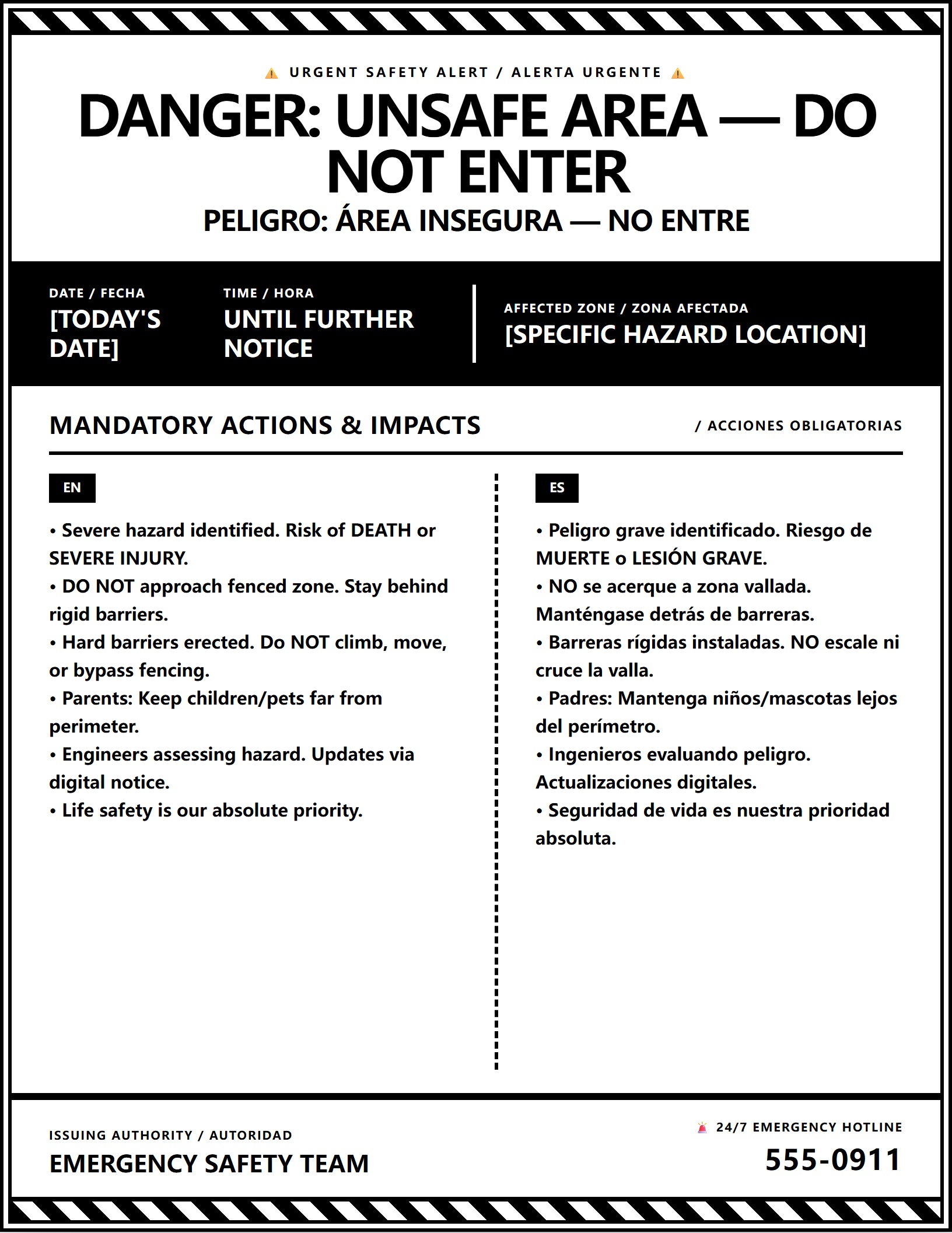
📋 Field Execution Asset
Download the OSHA-compliant manager checklist to ensure zero liability on-site.
🏠 Tenant Distribution Asset
Attach this prep-guide to your notice to reduce tenant front-desk calls by 60%.
Notice Editor & Preview
Edit Notice
Live Print Preview
US Letter • 8.5" x 11"
Execution Protocol
Operational Timeline & Compliance Checklist
- Minute 0-15 (Discovery) Responsible: property manager
Immediate Hazard Isolation & Human Sentry Deployment
⚠️Liability Alert
Do NOT leave a newly discovered, highly dangerous hazard (like an open sinkhole or exposed live high-voltage wire) protected ONLY by caution tape while you go to the office to draft an email. Under Premises Liability law, the property owner has an immediate "duty to warn and protect." If a child or resident falls in before hard barriers are erected, the HOA faces catastrophic gross negligence liability.
💡Pro Strategy
The moment a severe physical hazard is discovered (e.g., a sinkhole opening, a large tree splitting, structural collapse), deploy temporary caution tape AND station a human sentry (staff member or security guard) to physically block access. Caution tape is easily blown away or ignored; a human sentry is the only 100% effective immediate barrier. Call 911 if the hazard poses an imminent threat to life or adjacent structures (e.g., gas line rupture, building collapse).
- Hour 1-4 Responsible: maintenance
Deploy ANSI Z535 Compliant Signage & Hard Physical Barriers at Hazard Perimeter (Minimum 10-foot buffer), Approaching Pedestrian Routes, Adjacent Parking Areas
⚠️Liability Alert
Do NOT use the word "CAUTION" (Yellow/Black) for life-threatening hazards. "Caution" legally implies only minor or moderate injury is possible. If a resident suffers a severe injury in a "Caution" zone, plaintiff attorneys will argue the HOA deliberately downplayed the severity of the hazard to avoid panic, constituting "willful and wanton" negligence. Match the signal word exactly to the ANSI severity matrix.
💡Pro Strategy
Replace caution tape with rigid, anti-climb physical barriers (e.g., 6-foot chain-link fencing with privacy slats). Post bilingual signs that strictly follow ANSI Z535.4 standards: Use "DANGER" (Red/White, meaning imminent hazard that WILL cause death/serious injury) for open trenches, live wires, or structural collapse. Use "WARNING" (Orange/Black, meaning potential hazard that COULD cause death/serious injury) for uneven ground, toxic mold, or falling debris. Include the universal hazard icon (e.g., exclamation triangle) for non-English speakers and children.
- Hour 2-4 Responsible: property manager AUTOMATABLE
Broadcast High-Priority Bilingual Avoidance Alert
⚠️Liability Alert
Do NOT post a photo of the actual hazard (e.g., the giant sinkhole or collapsed roof) on social media or the community portal. Visuals of dramatic hazards attract "rubberneckers" (curious residents who gather to look), increasing the risk of someone accidentally falling in or being struck by secondary debris. Show the BARRIER, not the HAZARD.
💡Pro Strategy
Send a high-priority SMS + App Push + Email blast. The message must be urgent and explicit: "DANGER: An unsafe area has been identified at [Location]. This area poses a risk of SEVERE INJURY OR DEATH. A hard physical barrier has been erected. Do NOT approach, bypass, or allow children/pets near the fenced zone. Professional engineers are assessing the situation." Include a photo of the barrier (not the hazard itself, to prevent "rubbernecking" and crowd gathering).
- Hour 12-24 Responsible: contractor
Professional Engineer Assessment & ADA Tactile Warning Installation
⚠️Liability Alert
Failing to provide a tactile or physical cane-detectable warning for a sudden drop-off or open trench violates the ADA and creates strict liability if a visually impaired resident falls in. A printed sign is legally insufficient for life-safety hazards affecting the visually impaired.
💡Pro Strategy
Dispatch a licensed structural or geotechnical engineer to assess the root cause and stability of the hazard. If the hazard is adjacent to a pedestrian walkway (e.g., a sudden drop-off or open trench near a path), install ADA-compliant tactile warning surfaces (truncated domes / detectable warning plates) at the approach routes. Visually impaired residents cannot read "DANGER" signs; they rely on cane-detectable physical changes in the ground surface to stop before a drop-off.
- Day 2 Responsible: property manager
Conduct "Attractive Nuisance" Child-Safety Audit
⚠️Liability Alert
Standard 4-foot chain-link fencing with horizontal climbable rails is legally insufficient for an Attractive Nuisance. If a child climbs the fence and is injured, the HOA is strictly liable because the fence itself facilitated the trespass. Use anti-climb barriers and remove any "footholds" (like trash cans or pallets) placed near the fence.
💡Pro Strategy
Under the legal doctrine of "Attractive Nuisance," if a hazard (like an excavated dirt pile, a partially filled pool, or heavy machinery left behind) is likely to attract children who cannot understand the danger, the property owner owes them the highest duty of care. Walk the perimeter and ask: "Would a 6-year-old want to climb this?" If yes, the barrier MUST be anti-climb (no horizontal rails, no chain-link without privacy slats, minimum 6 feet high) and gates MUST be padlocked.
- Throughout Remediation Period Responsible: contractor
Execute Remediation Plan & Conduct Daily Barrier Integrity Checks
⚠️Liability Alert
Do NOT assume the contractor is checking the fence integrity daily. The contractor's duty is to perform the work; the HOA/property manager's duty (Premises Liability) is to protect the public from the work zone. If a resident is injured due to a fence that blew down 3 days ago and was never checked, the HOA bears the liability for negligent monitoring.
💡Pro Strategy
As the contractor executes the long-term remediation plan (e.g., filling the sinkhole, shoring up the foundation), the property manager must conduct and log DAILY visual inspections of the barrier perimeter. High winds, landscaping equipment, or vandals frequently compromise temporary fencing. Log the date, time, and condition of the fence/signs. If a breach is found, repair it immediately and document the repair.
- Upon Completion & Engineer Approval Responsible: property manager
Engineer Sign-Off, Remove Barriers & Broadcast All-Clear at Hazard Perimeter, Approaching Pedestrian Routes, Adjacent Parking Areas
⚠️Liability Alert
Never remove barriers based on a verbal "it looks good" from a foreman. Require written sign-off. If the ground subsides again a week later and someone is injured, the lack of written engineering approval will be used as evidence of premature and negligent restoration by the HOA.
💡Pro Strategy
Do NOT remove the barriers until the licensed engineer or contractor provides a written "Certificate of Substantial Completion" or written confirmation that the hazard is fully remediated and the ground/structure is safe for pedestrian load. Once signed off, remove all fencing, signs, and tactile warnings, and send a bilingual "All-Clear" digital notice to the community.
Required Posting Locations
Physical Distribution Checklist
- Hazard Perimeter (Minimum 10-foot buffer)
- Approaching Pedestrian Routes
- Adjacent Parking Areas
- Hazard Perimeter
Liability Defense Rule
Always take a timestamped wide-angle photo of the posted notice in its physical location. If a tenant claims they were not notified, this photo is your primary legal defense.
Tenant Communication Brief
Anticipated Questions & Official Responses
-
Q
Why is there a tall fence with "DANGER" signs around the lawn?
- "A severe physical hazard (such as a sinkhole, underground utility collapse, or structural failure) has been identified. The tall, anti-climb fencing is required by law to protect residents, especially children, from life-threatening injury. Please do not attempt to look over, reach through, or move the fencing.
Manager's Note
Providing these answers in your initial notice can reduce management office phone volume by up to 60% during service interruptions.
Operational Guidance
Industry Best Practices & Field-Tested Strategies
Deploy a HUMAN SENTRY immediately upon discovering a life-threatening hazard (e.g., open sinkhole, exposed high-voltage wire). Caution tape is easily blown away or ignored. A staff member or security guard physically blocking the approach is the only 100% effective immediate barrier while hard fencing is being delivered. Leaving a lethal hazard guarded only by tape constitutes gross negligence under Premises Liability law.
Strictly follow the ANSI Z535.4 signal word matrix for all safety signage: Use "DANGER" (Red/White background) ONLY for imminent hazards that WILL result in death or serious injury if not avoided (e.g., open trench, live wire). Use "WARNING" (Orange/Black) for potential hazards that COULD result in death or serious injury (e.g., falling debris, toxic mold). Never use "CAUTION" (Yellow/Black) for life-threatening hazards — doing so legally implies only minor injury is possible and exposes the HOA to "willful downplaying" negligence claims.
Conduct a formal "Attractive Nuisance" audit for any hazard that might attract children (e.g., excavated dirt piles, heavy machinery, partially filled trenches). Under this legal doctrine, children who cannot understand the danger are owed the highest duty of care. Standard 4-foot chain-link fencing with horizontal climbable rails is legally insufficient. You MUST deploy minimum 6-foot anti-climb barriers (no horizontal rails, privacy slats) and padlock all gates.
Install ADA-compliant tactile warning surfaces (truncated domes / detectable warning plates) at the approach routes to sudden drop-offs or open trenches. Visually impaired residents cannot read "DANGER" signs; they rely on cane-detectable physical changes in the ground surface to stop before a hazard. Failing to provide tactile warnings creates strict liability under the ADA if a visually impaired person falls in.
When broadcasting digital alerts, include a photo of the BARRIER (the fence/signs), NOT the hazard itself. Dramatic photos of sinkholes or collapsed roofs attract "rubberneckers" (curious residents who gather to look), significantly increasing the risk of someone accidentally falling in or being struck by secondary debris.
Conduct and log DAILY visual inspections of the barrier perimeter throughout the remediation period. High winds, landscaping equipment, or vandals frequently compromise temporary fencing. If a resident is injured due to a fence that blew down days ago and was never checked, the HOA bears the liability for negligent monitoring, not the contractor.
Never remove barriers and send the "All-Clear" notice based on a verbal "it looks good" from a contractor foreman. Require a written "Certificate of Substantial Completion" or written engineering sign-off confirming the hazard is fully remediated and safe for pedestrian load. This written document is your primary legal defense against future subsidence or collapse claims.
Manager Checklist
- Minute 0: Upon discovering a severe hazard, immediately deploy caution tape AND station a human sentry to physically block access
- Minute 0: Call 911 if the hazard poses an imminent threat to life, adjacent structures, or involves gas/live high-voltage wires
- Hour 1-4: Replace caution tape with rigid, anti-climb physical barriers (minimum 6-foot chain-link with privacy slats for Attractive Nuisances)
- Hour 1-4: Post bilingual ANSI Z535 compliant signs: "DANGER" (Red) for imminent lethal threats, "WARNING" (Orange) for potential severe threats
- Hour 1-4: Ensure signs include universal hazard icons (exclamation triangle) for non-English speakers and children
- Hour 2-4: Broadcast high-priority SMS/Push/Email alert. Include a photo of the BARRIER, not the hazard itself, to prevent rubbernecking
- Hour 12-24: Dispatch licensed engineer to assess root cause and stability. Obtain written assessment report
- Hour 12-24: Install ADA-compliant tactile warning surfaces (truncated domes) at approach routes to sudden drop-offs for the visually impaired
- Day 2: Conduct formal "Attractive Nuisance" child-safety audit. Remove any "footholds" (trash cans, pallets) placed near the fence
- Daily: Conduct and log visual inspections of the barrier perimeter. Repair any wind, equipment, or vandalism breaches immediately
- Ongoing: Send periodic digital updates to the community regarding the remediation progress and expected timeline
- Completion: Do NOT remove barriers until the licensed engineer provides WRITTEN sign-off confirming the area is safe for pedestrian load
- Completion: Remove all fencing, signs, and tactile warnings. Broadcast the bilingual "All-Clear" digital notice
- Archive: Retain all incident logs, daily barrier inspection checklists, engineer reports, and written sign-offs for minimum 5 years
Common Costly Mistakes
- ✗ Leaving a newly discovered, highly dangerous hazard (like an open sinkhole) protected ONLY by caution tape while going to the office to draft an email. The property owner has an immediate "duty to warn and protect." If someone falls in before hard barriers are erected, the HOA faces catastrophic gross negligence liability. Station a human sentry immediately.
- ✗ Using the word "CAUTION" (Yellow) on signs for life-threatening hazards like open trenches or structural collapse. "Caution" legally implies only minor or moderate injury is possible. Plaintiff attorneys will argue the HOA deliberately downplayed the severity of the hazard to avoid panic, constituting "willful and wanton" negligence. Always use "DANGER" (Red) for imminent lethal threats.
- ✗ Using standard 4-foot chain-link fencing with horizontal climbable rails around an "Attractive Nuisance" (e.g., a giant dirt pile or construction equipment). If a child climbs the fence and is injured, the HOA is strictly liable because the fence itself facilitated the trespass. Anti-climb barriers (6-foot, no horizontal rails) are legally required.
- ✗ Posting dramatic photos of the actual hazard (e.g., the giant sinkhole) on the community portal or social media. This attracts curious "rubberneckers" who gather near the edge to look, dramatically increasing the risk of secondary collapse or accidental falls. Show the barrier, not the hazard.
- ✗ Failing to install ADA-compliant tactile warning surfaces (truncated domes) near sudden drop-offs or open trenches. Visually impaired residents cannot read printed signs. Without cane-detectable ground warnings, the HOA is strictly liable under the ADA if a visually impaired person falls into the hazard.
- ✗ Assuming the contractor is checking the fence integrity daily. The contractor's duty is to perform the work; the HOA/property manager's duty (Premises Liability) is to protect the public. If a fence blows down and is not repaired for days because no one checked, the HOA is liable for negligent monitoring.
- ✗ Removing barriers and sending the "All-Clear" notice based on a verbal "it looks good" from a foreman. If the ground subsides again a week later and someone is injured, the lack of written engineering approval will be used as evidence of premature and negligent restoration.
Resident Preparation Checklist
Include this checklist in your notice to reduce tenant calls by up to 60%
- ☐ Read the emergency alert carefully and identify the exact location of the unsafe area
- ☐ Understand that "DANGER" (Red) means an imminent threat of severe injury or death — do NOT approach the area under any circumstances
- ☐ Respect all hard physical barriers (fencing, barricades). Do NOT attempt to climb over, crawl under, or reach through the fencing
- ☐ Parents: Explicitly instruct your children about the danger and ensure they do not play near or attempt to bypass the fenced perimeter
- ☐ Pet Owners: Keep dogs on a short leash when walking near the restricted zone to prevent them from digging under or slipping through barriers
- ☐ Do NOT gather near the barrier to take photos or "rubberneck" — secondary collapses or falling debris can occur without warning
- ☐ If you observe a breach in the fencing (e.g., a panel blown down by wind, a gate left open), report it to the management emergency line IMMEDIATELY
- ☐ Visually impaired residents: Use your cane to detect tactile warning surfaces (bumpy truncated domes) on the ground, which indicate you are approaching a drop-off or hazard zone
- ☐ Do not rely on yellow "Caution" tape as a primary barrier — it is a visual warning only and will not stop a fall. Stay behind the rigid fencing
- ☐ Wait for the official "All-Clear" digital notice before entering the area again. Do not assume it is safe just because the contractors have left for the day
Frequently Asked Questions
What is the difference between "DANGER", "WARNING", and "CAUTION" signs?
Why is the fence so tall and hard to see through?
I need to walk past the hazard to get to my car — is it safe if I stay behind the tape?
How do visually impaired residents know about the hazard?
The contractors left for the day and the hazard is still there — is it safe to go in?
Disclaimer
- • Premises Liability Law imposes a strict "duty to warn and protect" on property owners. Failing to immediately isolate a known lethal hazard (even with temporary human sentries before hard barriers arrive) constitutes gross negligence and exposes the HOA to catastrophic punitive damages.
- • The "Attractive Nuisance" Doctrine mandates that property owners owe the highest duty of care to children who may be attracted to a hazard (e.g., excavations, machinery) but cannot comprehend the danger. Standard fencing is legally insufficient; anti-climb barriers (minimum 6-foot, no horizontal rails) are required to prevent strict liability.
- • ANSI Z535.4 Standard for Product Safety Signs and Labels strictly defines signal words: DANGER (imminent, will cause death/severe injury), WARNING (potential, could cause death/severe injury), CAUTION (minor/moderate injury). Misusing "CAUTION" for a lethal hazard is heavily penalized in civil litigation as deliberate downplaying of risk.
- • The Americans with Disabilities Act (ADA) requires that life-safety hazards involving sudden drop-offs, open trenches, or pedestrian route closures be communicated via cane-detectable tactile warning surfaces (truncated domes) for visually impaired individuals. Printed signs alone are legally insufficient.
- • OSHA 29 CFR 1926 Subpart P (Excavations) and Subpart M (Fall Protection) mandate rigid physical barriers and specific signage for open trenches and fall hazards. Caution tape is explicitly excluded as a primary fall protection barrier.
- • Fair Housing Act obligations require that all life-safety warnings be communicated in all required community languages and that alternative safe routes be fully accessible to residents with mobility disabilities.
- • This template provides formatting and operational guidance only and does not constitute legal advice. Consult your property attorney, risk management broker, and licensed structural/geotechnical engineers for jurisdiction-specific life-safety and liability compliance.
- • Retain all incident logs, daily barrier inspection checklists, engineer assessment reports, and written completion sign-offs for a minimum of 5 years (or the statute of limitations for personal injury in your state) to defend against late-filed liability claims.
Related Operational Tasks
Complete your communication workflow with these related notices