Property Communication Task Center
Emergency Repair In Progress 🛡️ 2026 OSHA/FHA Compliant
Execute rapid, legally compliant emergency repairs for unplanned facility failures (water leaks, power loss, elevator breakdown, gas leaks) while ensuring immediate life-safety protection, satisfying state "emergency entry" statutes, minimizing secondary property damage (mold, structural), and providing continuous bilingual communication to residents during high-stress operational disruptions.
Not just a template.
A reality execution tool.
Don't risk tenant disputes with messy Word docs. Generate a print-ready, OSHA-compliant physical notice in exactly 30 seconds.
- 1Bilingual Architecture English & Spanish integrated into a single US Letter design. Crucial for legal compliance in 14+ states.
- 2Toner-Friendly Print Engineered for black-and-white office printers. High contrast hierarchy ensures readability from 10 feet away.
- 3Locked Formatting Zero layout breakage. Type your details, and the engine physicalizes it without overflowing the page.
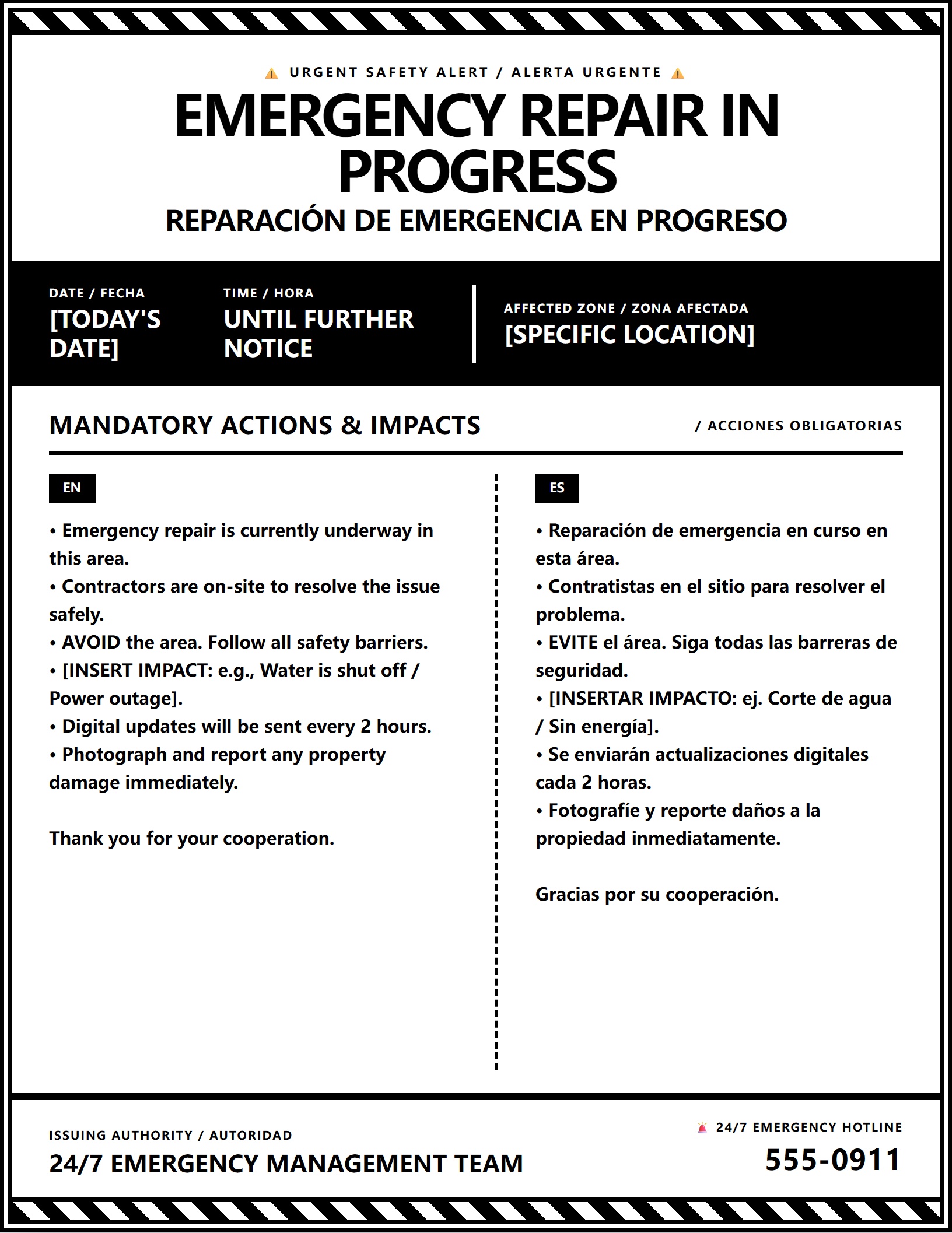
EMERGENCY REPAIR IN PROGRESS
REPARACIÓN DE EMERGENCIA EN PROGRESO
Why use this template?
- ✓ Bilingual output (English/Spanish) prevents FHA liability
- ✓ Formatted strictly for US Letter B&W physical printing
- ✓ Zero JS bloat, generates instantly in your browser
Print Output Preview
📋 Field Execution Asset
Download the OSHA-compliant manager checklist to ensure zero liability on-site.
🏠 Tenant Distribution Asset
Attach this prep-guide to your notice to reduce tenant front-desk calls by 60%.
Notice Editor & Preview
Edit Notice
Live Print Preview
US Letter • 8.5" x 11"
Execution Protocol
Operational Timeline & Compliance Checklist
- Minute 0-15 (Immediate) Responsible: property manager
Triage Incident, Isolate Hazard & Dispatch Emergency Contractor
⚠️Liability Alert
Do NOT enter a private unit to perform emergency isolation unless you have a reasonable belief of imminent danger to life or severe property damage. While all states grant HOAs/landlords "emergency entry rights" without 24-hour notice, you MUST document the specific emergency justification (e.g., "water pouring through the ceiling of the unit below") in writing before entry. Unjustified emergency entry is illegal trespass.
💡Pro Strategy
Immediately assess the severity and isolate the hazard. For water leaks: shut off the main water valve. For electrical: trip the main breaker. For gas: evacuate and call 911/utility company (do NOT flip electrical switches). Dispatch the 24/7 emergency contractor while simultaneously drafting the digital alert. Every minute of delay in isolation increases secondary damage (e.g., water damage costs increase by 50% for every hour a leak is active).
- Minute 15-30 Responsible: property manager AUTOMATABLE
Broadcast Immediate SMS & Digital Emergency Alert
⚠️Liability Alert
Do NOT speculate on the cause or the estimated repair time in the initial alert unless absolutely certain. Incorrect ETAs (e.g., "Water will be back in 1 hour") create massive resident anger if the repair takes 6 hours. Use "Updates will be provided every 2 hours" instead of guessing.
💡Pro Strategy
Send a high-priority SMS + App Push + Email blast simultaneously. The message must be extremely concise and actionable: (1) WHAT is happening (e.g., "Major water leak in Building B"), (2) WHERE it is happening, (3) WHAT residents must do NOW (e.g., "Avoid the east stairwell," "Do not use elevators," "Expect water shutoff at 2 PM"), (4) WHEN the next update will be provided. Use ALL CAPS for the subject line: "EMERGENCY ALERT / ALERTA DE EMERGENCIA".
- Minute 30-60 Responsible: maintenance
Deploy Physical Safety Barriers & Bilingual Warning Signage at Incident Site Perimeter, Affected Building Entrances, Elevator Lobbies, Parking Lot Detours
⚠️Liability Alert
Never rely solely on caution tape in high-traffic areas. Tape is easily ignored or torn. Use rigid A-frame signs and physical barricades (e.g., folding gates) to prevent residents and children from accidentally walking into an active repair zone, especially near open trenches, exposed wiring, or falling debris hazards.
💡Pro Strategy
Before the contractor begins heavy work, maintenance must deploy physical safety barriers: yellow caution tape, A-frame "Wet Floor" or "Danger" signs, and traffic cones for parking lot detours. Post bilingual "Emergency Repair In Progress / Reparación de Emergencia en Progreso" signs at all entry points to the affected zone. This satisfies OSHA 29 CFR 1910.22 (Walking-Working Surfaces) requirements for hazard communication.
- Hour 1 to Completion Responsible: contractor
Execute Emergency Repair with Safety & LOTO Protocols
⚠️Liability Alert
If the repair involves disturbing more than 2 square feet of interior painted surface in a pre-1978 building, EPA RRP rules require certified lead-safe work practices. Failure to comply carries EPA fines up to $37,500 per violation. For major water leaks, if drywall is not dried within 48 hours, mold remediation (a much more expensive and disruptive process) becomes legally required.
💡Pro Strategy
The contractor must follow strict safety protocols: (1) Lockout/Tagout (LOTO) per OSHA 1910.147 for all electrical/mechanical energy sources before work begins, (2) If the building was built before 1978, comply with EPA Lead-Safe Renovation rules (RRP) — do not dry-sand or dry-scrape lead paint during the repair, (3) For water damage, deploy commercial dehumidifiers and air movers within 24 hours to prevent mold growth (IICRC S500 standard).
- Every 2 Hours During Repair Responsible: property manager AUTOMATABLE
Send Periodic Progress Updates (If Repair > 2 Hours)
⚠️Liability Alert
Do NOT go silent. The #1 complaint during emergency repairs is lack of communication. Even if the update is "No change — contractors are still working on the main valve," sending it proves management is actively monitoring the situation.
💡Pro Strategy
If the repair extends beyond 2 hours, send a brief progress update via SMS + Portal every 2 hours. Format: "UPDATE [Time]: [Current Status]. [What is happening now]. [Revised ETA if known]. Next update at [Time]." Consistent communication reduces inbound call volume to the management office by up to 80% during high-stress emergencies.
- Immediately Upon Service Restoration Responsible: property manager AUTOMATABLE
Broadcast Service Restoration & All-Clear Notice
⚠️Liability Alert
Do NOT declare "All Clear" until the contractor has explicitly confirmed the system is fully operational and safe. Premature "All Clear" notices (e.g., turning water back on before a pipe joint is fully cured) can cause secondary flooding and destroy management credibility.
💡Pro Strategy
The moment the emergency is resolved and services are restored, send a high-priority "ALL CLEAR" notice. Include: (1) Confirmation that the emergency is over, (2) Services restored (water/power/elevators), (3) Instructions for residents (e.g., "Run cold water for 5 minutes to clear air from pipes," "Reset your microwave clocks"), (4) Instructions for reporting secondary damage (e.g., "If you experienced water damage in your unit, submit a claim form with photos within 48 hours").
- Within 24 Hours After Completion Responsible: property manager
Remove Physical Barriers & Archive Incident Documentation at Incident Site Perimeter, Affected Building Entrances, Elevator Lobbies, Parking Lot Detours
⚠️Liability Alert
Do NOT discard the damaged parts (e.g., the burst pipe, the burnt electrical panel). Retain all failed components for a minimum of 90 days. Insurance adjusters and forensic engineers frequently require physical inspection of the failed part to determine the root cause (e.g., manufacturer defect vs. wear-and-tear) and approve the claim.
💡Pro Strategy
Remove all physical barriers, caution tape, and emergency signage as soon as the area is safe for pedestrian traffic. Create a comprehensive Incident Report file containing: (1) Time of initial report, (2) Isolation actions taken, (3) Timestamps of all digital alerts sent, (4) Photos of the damage and the repair process, (5) Contractor invoices and LOTO/safety documentation, (6) List of affected units and damage claims. Submit this file to the HOA master insurance carrier if the damage exceeds the deductible.
Required Posting Locations
Physical Distribution Checklist
- Incident Site Perimeter
- Affected Building Entrances
- Elevator Lobbies
- Parking Lot Detours
Liability Defense Rule
Always take a timestamped wide-angle photo of the posted notice in its physical location. If a tenant claims they were not notified, this photo is your primary legal defense.
Tenant Communication Brief
Anticipated Questions & Official Responses
-
Q
Why did maintenance enter my apartment without 24-hour notice?
- "State landlord-tenant laws and HOA CC&Rs grant "emergency entry rights" without advance notice when there is an imminent threat to life or severe property damage (e.g., a pipe bursting and flooding the unit below). Management must document the emergency justification and leave a written "Notice of Emergency Entry" inside your unit if you were not home.
-
Q
Will I be compensated for damage to my personal property?
- "The HOA/master insurance policy typically covers building structures and common areas. Damage to your personal property (furniture, electronics, clothing) is covered by YOUR renter's or homeowner's insurance (HO-6 policy). File a claim with your insurance provider immediately and take photos of all damage before cleaning up.
Manager's Note
Providing these answers in your initial notice can reduce management office phone volume by up to 60% during service interruptions.
Operational Guidance
Industry Best Practices & Field-Tested Strategies
Execute the "Minute 0-15" protocol flawlessly: (1) Assess the hazard, (2) Isolate the source (shut off main water valve, trip main breaker, evacuate for gas), (3) Dispatch the 24/7 emergency contractor, (4) Draft the digital alert. Every minute of delay in isolation increases secondary damage exponentially — water damage costs increase by 50% for every hour a leak remains active.
Broadcast a high-priority SMS + App Push + Email blast within 15-30 minutes of the incident. The initial alert must be extremely concise: WHAT is happening, WHERE, WHAT residents must do NOW, and WHEN the next update will be sent. Use ALL CAPS for the subject line: "EMERGENCY ALERT / ALERTA DE EMERGENCIA". Do NOT speculate on the cause or guess the repair time.
If the repair extends beyond 2 hours, send a brief progress update via SMS + Portal every 2 hours. Even if the update is "No change — contractors are still working," sending it proves management is actively monitoring the situation and reduces inbound panic calls to the management office by up to 80%.
Before the contractor begins heavy work, deploy physical safety barriers: rigid A-frame signs, traffic cones, and caution tape. OSHA 29 CFR 1910.22 (Walking-Working Surfaces) requires physical hazard communication. Never rely solely on easily ignored or torn caution tape in high-traffic areas.
When restoring services, send a high-priority "ALL CLEAR" notice with specific resident action items: "Run cold water for 5 minutes to clear air from pipes," "Reset microwave clocks," or "Report water damage with photos within 48 hours." This guides residents through the post-emergency recovery process.
Retain all failed components (burst pipes, burnt electrical panels, broken elevator parts) for a minimum of 90 days. Insurance adjusters and forensic engineers frequently require physical inspection of the failed part to determine the root cause (manufacturer defect vs. wear-and-tear) and approve the master insurance claim. Discarding the evidence can result in claim denial.
Create a comprehensive Incident Report file within 24 hours of completion: time of initial report, isolation actions, timestamps of all alerts sent, photos of damage and repair, contractor invoices, and a list of affected units. Submit this file to the HOA master insurance carrier if the estimated damage exceeds the policy deductible.
Manager Checklist
- Minute 0-15: Assess hazard severity and immediately isolate the source (shut off main valve, trip breaker, evacuate for gas)
- Minute 0-15: Dispatch the 24/7 emergency contractor and confirm their ETA
- Minute 0-15: If entering a private unit, document the specific "emergency justification" in writing before entry
- Minute 15-30: Broadcast high-priority SMS + App Push + Email bilingual emergency alert (WHAT, WHERE, ACTION, NEXT UPDATE TIME)
- Minute 30-60: Deploy physical safety barriers (A-frame signs, cones, caution tape) around the incident perimeter
- Minute 30-60: Post bilingual "Emergency Repair In Progress" signs at all entry points to the affected zone
- Hour 1+: Verify contractor implements OSHA Lockout/Tagout (LOTO) before working on electrical/mechanical systems
- Hour 1+: If pre-1978 building, verify contractor uses EPA Lead-Safe (RRP) certified work practices
- Every 2 Hours: Send brief SMS/Portal progress update, even if the status is "No change"
- For Water Leaks: Deploy commercial dehumidifiers and air movers within 24 hours to prevent mold (IICRC S500)
- Upon Completion: Do NOT declare "All Clear" until contractor explicitly confirms system is fully operational and safe
- Upon Completion: Broadcast bilingual "ALL CLEAR" notice with specific resident action items (flush pipes, report damage)
- Post-Incident: Retain all failed components (burst pipes, burnt panels) for minimum 90 days for insurance inspection
- Within 24 Hours: Compile Incident Report file (timeline, photos, alerts, invoices) and submit to master insurance carrier
- Within 24 Hours: Remove all physical barriers, caution tape, and emergency signage from the site
Common Costly Mistakes
- ✗ Delaying hazard isolation to draft the perfect notification email — always isolate the hazard (shut off water/power) FIRST, then send the alert. A 10-minute delay in shutting off a main water valve can cause $50,000+ in additional secondary damage to the building structure.
- ✗ Entering a private unit without documenting the "emergency justification" — while state laws grant emergency entry rights without 24-hour notice for imminent threats, failing to document the specific reason (e.g., "water pouring through the ceiling of the unit below") in writing before entry exposes the HOA to illegal trespass lawsuits.
- ✗ Guessing the repair time in the initial alert (e.g., "Water will be back in 1 hour") — if the repair takes 6 hours, the HOA loses all credibility and faces massive resident anger. Use "Updates will be provided every 2 hours" instead of guessing ETAs you cannot guarantee.
- ✗ Going silent during a multi-hour repair — the #1 complaint during emergencies is lack of communication. Failing to send 2-hour interval updates causes panic, overwhelms the management office with inbound calls, and creates a perception of incompetence.
- ✗ Allowing contractors to work on electrical/mechanical systems without verifying Lockout/Tagout (LOTO) compliance per OSHA 1910.147 — failure to de-energize and lock out energy sources before repair is a leading cause of severe injury and carries OSHA fines exceeding $15,000 per violation.
- ✗ Disturbing painted surfaces in pre-1978 buildings without EPA Lead-Safe Renovation (RRP) compliance — dry-sanding or dry-scraping lead paint during an emergency repair without certified work practices carries EPA fines up to $37,500 per violation.
- ✗ Failing to deploy commercial dehumidifiers within 24 hours of a major water leak — per IICRC S500 standards, if drywall and insulation are not dried within 48 hours, mold growth begins, triggering a much more expensive and legally complex mold remediation process.
- ✗ Discarding the failed part (e.g., throwing away the burst pipe) before the insurance adjuster inspects it — without the physical evidence, the insurance carrier may deny the claim, shifting the entire repair cost to the HOA reserves.
Resident Preparation Checklist
Include this checklist in your notice to reduce tenant calls by up to 60%
- ☐ Read the emergency alert carefully: identify WHAT is happening, WHERE it is happening, and WHAT you must do immediately
- ☐ AVOID the affected area completely — do not attempt to walk past safety barriers, caution tape, or A-frame signs
- ☐ If instructed to shut off your own water/power, do so immediately to prevent secondary damage to your unit
- ☐ If you experience property damage (water leak into your unit, power surge damaging electronics), photograph the damage immediately before cleaning up
- ☐ Report the damage to the management office with photos and a description within 48 hours to initiate the insurance claim process
- ☐ File a claim with your own renter's or homeowner's insurance (HO-6) for personal property damage — the HOA master policy typically only covers building structures
- ☐ Monitor your SMS and resident portal for 2-hour progress updates and the final "ALL CLEAR" notice
- ☐ When water service is restored, run cold water from all faucets for 5 minutes to clear air and sediment from the pipes
- ☐ When power is restored, check all appliances, reset microwave/oven clocks, and verify HVAC systems are functioning normally
- ☐ If you smell gas at any point during or after the repair, evacuate the building immediately and call 911 from outside — do NOT flip light switches or use cell phones inside
Frequently Asked Questions
Why did maintenance enter my apartment without giving me 24-hour notice?
Who pays for damage to my personal belongings (furniture, electronics, clothes)?
How long will the water/power/elevator be out?
What should I do if I smell gas during the emergency?
Will the HOA pay for my hotel if my unit is uninhabitable during the repair?
Disclaimer
- • State landlord-tenant laws and HOA CC&Rs grant "emergency entry rights" without 24-hour notice for imminent threats to life or severe property damage. Management MUST document the specific emergency justification in writing before or immediately upon entry to defend against trespass claims.
- • OSHA 29 CFR 1910.147 (Lockout/Tagout) requires all electrical and mechanical energy sources to be de-energized, locked out, and tagged before contractors begin repair work. Failure to comply carries OSHA fines exceeding $15,000 per violation and creates severe life-safety risks.
- • EPA Lead Renovation, Repair and Painting (RRP) Rule (40 CFR 745) requires certified lead-safe work practices when disturbing more than 2 square feet of interior painted surface in pre-1978 buildings. Fines for non-compliance reach $37,500 per violation per day.
- • IICRC S500 Standard for Professional Water Damage Restoration requires commercial drying equipment (dehumidifiers, air movers) to be deployed within 24 hours of a water event. Failure to dry materials within 48 hours triggers mandatory mold remediation protocols under most state health codes.
- • OSHA 29 CFR 1910.22 (Walking-Working Surfaces) requires physical hazard communication (signage, barriers) to protect pedestrians from active repair zones. Caution tape alone is insufficient in high-traffic areas; rigid barriers are required.
- • Fair Housing Act obligations apply during emergencies — ensure emergency alerts are sent in all required community languages, and provide reasonable accommodations (e.g., physical assistance with evacuation, alternative accessible routes) for residents with documented disabilities.
- • Retain all failed components and comprehensive incident documentation (timeline, photos, alerts, invoices) for a minimum of 90 days (or until the insurance claim is fully closed) to support forensic engineering inspections and master insurance claim approvals.
- • This template provides formatting and operational guidance only and does not constitute legal advice. Consult your property attorney and insurance broker for jurisdiction-specific emergency response and liability compliance.
Related Operational Tasks
Complete your communication workflow with these related notices