Property Communication Task Center
Restricted Access Notice 🛡️ 2026 OSHA/FHA Compliant
Temporarily restrict resident and public access to specific common areas, amenities, or pedestrian routes for safety, maintenance, or private events, while strictly complying with NFPA 101 fire egress codes (never locking fire exits), ADA requirements for accessible alternative routes, and lease/CC&R obligations regarding amenity availability and quiet enjoyment.
Not just a template.
A reality execution tool.
Don't risk tenant disputes with messy Word docs. Generate a print-ready, OSHA-compliant physical notice in exactly 30 seconds.
- 1Bilingual Architecture English & Spanish integrated into a single US Letter design. Crucial for legal compliance in 14+ states.
- 2Toner-Friendly Print Engineered for black-and-white office printers. High contrast hierarchy ensures readability from 10 feet away.
- 3Locked Formatting Zero layout breakage. Type your details, and the engine physicalizes it without overflowing the page.
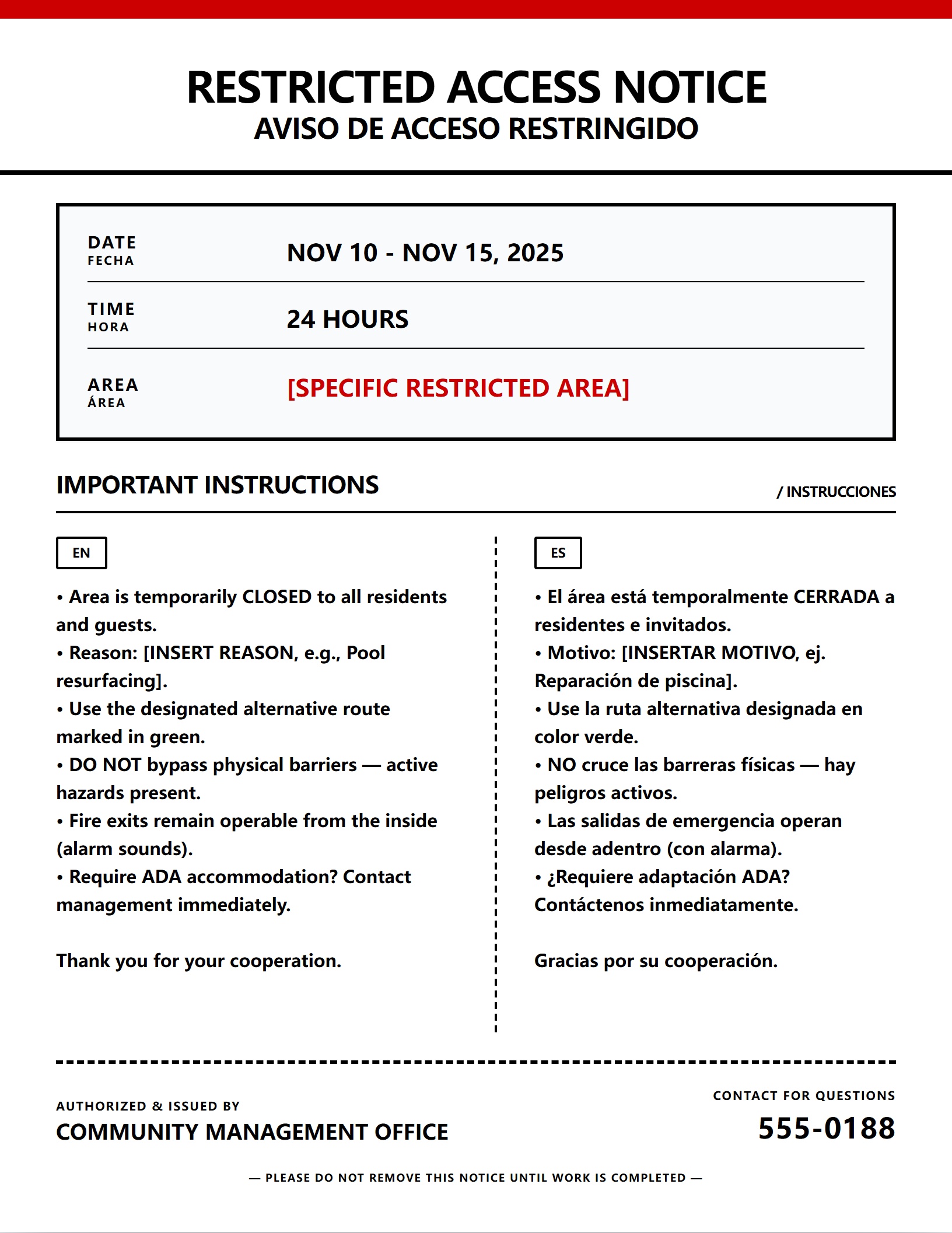
RESTRICTED ACCESS NOTICE
AVISO DE ACCESO RESTRINGIDO
Why use this template?
- ✓ Bilingual output (English/Spanish) prevents FHA liability
- ✓ Formatted strictly for US Letter B&W physical printing
- ✓ Zero JS bloat, generates instantly in your browser
Print Output Preview
📋 Field Execution Asset
Download the OSHA-compliant manager checklist to ensure zero liability on-site.
🏠 Tenant Distribution Asset
Attach this prep-guide to your notice to reduce tenant front-desk calls by 60%.
Notice Editor & Preview
Edit Notice
Live Print Preview
US Letter • 8.5" x 11"
Legal Deadline Calculator
Powered by US Office of Personnel Management (OPM) rules.
Conduct Fire Egress & ADA Compliance Audit
Obtain Board Approval for Long-Term Amenity Closures
Send Community-Wide Digital Restriction Notice
Deploy Rigid Physical Barriers & Bilingual Signage
Compliance & Legal Disclaimer: Calculations are strictly based on U.S. Office of Personnel Management (OPM) observed federal holiday rules and standard weekend exclusions. While this tool is designed for enterprise-grade accuracy regarding FLSA and standard property management protocols (e.g., CA Civil Code §1950.5), local municipal codes may vary. NoticeMint is a workflow software, not a law firm. Always verify critical statutory deadlines with your legal counsel.
Execution Protocol
Operational Timeline & Compliance Checklist
- 14 Days Before Restriction Responsible: property manager
Conduct Fire Egress & ADA Compliance Audit
⚠️Liability Alert
Locking a fire exit door with a padlock, chain, or deadbolt during a restriction is a severe life-safety violation and a criminal offense in most jurisdictions. If a fire occurs and residents cannot escape, the property manager and HOA board face gross negligence charges and massive civil liability. If an ADA route is blocked without an alternative, the property faces HUD discrimination complaints and DOJ fines up to $75,000 for a first violation.
💡Pro Strategy
Before restricting ANY area, walk the site and verify two critical legal requirements: (1) NFPA 101 Life Safety Code: You must NEVER lock, chain, or barricade a designated fire exit in a way that prevents immediate, unobstructed egress from the inside. If a fire exit must be restricted from the outside, it MUST remain equipped with panic hardware (push-bar) and an audible exit alarm. (2) ADA Compliance: If the restriction blocks the primary accessible route (e.g., the main ramp or elevator), you MUST establish and clearly signpost an alternative accessible route that is equally safe and convenient.
- 10 Days Before Restriction Responsible: hoa board
Obtain Board Approval for Long-Term Amenity Closures
⚠️Liability Alert
Prolonged closure of a heavily marketed amenity without compensation or board approval can trigger "Constructive Eviction" claims from tenants or breach-of-fiduciary-duty lawsuits from HOA members who pay dues specifically for those amenities. Document the board's decision and the mitigation plan (e.g., expedited construction schedule, substitute access) in the meeting minutes.
💡Pro Strategy
If the restriction involves closing a core amenity (pool, gym, clubhouse) for more than 14 days (e.g., for major renovation or resurfacing), the HOA Board should formally approve the closure at a noticed meeting. Review the CC&Rs or lease agreements: some documents require the HOA/landlord to provide a substitute amenity (e.g., free passes to a neighboring gym) or offer a proportional fee/rent credit if core amenities are unavailable for extended periods.
- 7 Days Before Restriction Responsible: property manager AUTOMATABLE
Send Community-Wide Digital Restriction Notice
⚠️Liability Alert
Do NOT use vague terms like "some areas will be closed." Residents need precise boundaries to avoid accidental trespass into active construction zones. If the restriction affects mail delivery or trash pickup locations, explicitly state the temporary alternative locations.
💡Pro Strategy
Send a bilingual digital notice via portal + SMS + email. The message must clearly state: (1) EXACTLY which area is restricted (e.g., "North stairwell, 2nd to 4th floor"), (2) The reason (e.g., "stairwell railing repair," "pool resurfacing"), (3) The exact start and end dates/times, (4) The alternative route or substitute amenity. Include a simple map image showing the restricted zone (in red) and the alternative route (in green).
- Day of Restriction (Before Work Begins) Responsible: maintenance
Deploy Rigid Physical Barriers & Bilingual Signage at Restricted Area Entrances, Alternative Route Waypoints, Fire Exit Doors (with Alarms)
⚠️Liability Alert
Caution tape is NOT a physical barrier under OSHA 1926 Subpart M for fall hazards or active construction zones. If a resident or child bypasses caution tape and is injured by falling debris or an open trench, the HOA is strictly liable for failing to provide adequate physical protection. Rigid barriers are legally required for active hazard zones.
💡Pro Strategy
Deploy rigid physical barriers (e.g., A-frame barricades, plastic construction fencing, or locked gates) rather than relying solely on caution tape, which is easily ignored or torn by children and pets. Post bilingual "Restricted Access — No Entry / Acceso Restringido — Prohibida la Entrada" signs at eye level on all barriers. For fire exits that must be restricted from the outside, verify the interior panic hardware is fully functional and post a sign: "Emergency Exit Only — Alarm Will Sound / Salida de Emergencia — Sonará la Alarma".
- Throughout Restriction Period Responsible: property manager
Monitor Restricted Zone & Enforce No-Entry Policy
⚠️Liability Alert
Do NOT use aggressive or physical force to remove a resident from a restricted area, even if they are trespassing in a construction zone. Verbally direct them to leave, document the interaction, and issue a formal CC&R/lease violation notice later. Physical confrontation creates severe liability and potential assault claims.
💡Pro Strategy
Conduct daily perimeter checks to ensure barriers remain intact, signage is visible, and no residents have bypassed the restriction. If a resident is found inside the restricted zone, politely but firmly escort them out and document the incident. If the restricted zone involves hazardous materials (asbestos abatement, lead paint removal, chemical application), unauthorized entry requires immediate evacuation and potential medical evaluation.
- Upon Completion of Work Responsible: maintenance
Remove Barriers, Clean Area & Restore Access at Restricted Area Entrances, Alternative Route Waypoints, Fire Exit Doors (with Alarms)
⚠️Liability Alert
Do NOT remove barriers and allow access until the area is 100% safe and clean. Leaving behind nails, sharp debris, or wet paint creates a slip/trip hazard. If a resident is injured immediately after access is restored due to leftover construction debris, the HOA is liable for negligent restoration.
💡Pro Strategy
Once the contractor or maintenance team confirms the area is safe, thoroughly clean the zone (remove all dust, debris, tools, and construction materials), remove all physical barriers and signage, and restore normal access. If a fire exit alarm was temporarily disabled or modified during the restriction, verify it is fully reactivated and tested before leaving the site.
- Within 24 Hours After Restoration Responsible: property manager AUTOMATABLE
Send Access Restored & All-Clear Notice
⚠️Liability Alert
Do NOT skip the All-Clear notice. Residents who altered their daily routines (e.g., using a longer detour route) need official confirmation that the normal route is safe to use again. Failing to notify them creates confusion and unnecessary ongoing inconvenience.
💡Pro Strategy
Send a brief digital notice confirming the restriction is lifted: "The [Area Name] is now fully open and accessible. Thank you for your patience during the [maintenance/repair]. If you notice any remaining debris or safety concerns, please contact the management office immediately." This closes the communication loop and reassures residents.
Required Posting Locations
Physical Distribution Checklist
- Restricted Area Entrances
- Alternative Route Waypoints
- Fire Exit Doors (with Alarms)
Liability Defense Rule
Always take a timestamped wide-angle photo of the posted notice in its physical location. If a tenant claims they were not notified, this photo is your primary legal defense.
Operational Guidance
Industry Best Practices & Field-Tested Strategies
NEVER lock, chain, or barricade a designated fire exit in a way that prevents immediate, unobstructed egress from the inside. NFPA 101 Life Safety Code mandates that all egress doors must be operable from the inside without a key, tool, or special knowledge. If a fire exit must be restricted from the outside to prevent unauthorized entry, it MUST remain equipped with panic hardware (push-bar) and an audible exit alarm. Violations carry massive civil liability and potential criminal negligence charges in the event of a fire.
If the restriction blocks the primary ADA accessible route (e.g., the main ramp, elevator, or lobby), you MUST establish, clearly signpost, and maintain an alternative accessible route that is equally safe and convenient. Failing to provide an ADA-compliant detour violates the Americans with Disabilities Act and Fair Housing Act, exposing the property to HUD discrimination complaints and DOJ fines up to $75,000 for a first violation.
Deploy rigid physical barriers (A-frame barricades, plastic construction fencing, locked gates) rather than relying solely on caution tape for active hazard zones. Under OSHA standards, caution tape is a "warning" but not a "physical barrier." If a child or resident bypasses caution tape and is injured by an open trench or falling debris, the HOA is strictly liable for failing to provide adequate physical protection.
For long-term closure of core amenities (pool, gym, clubhouse exceeding 14 days), obtain formal HOA Board approval and review CC&Rs/lease agreements. Prolonged unavailability of heavily marketed amenities can trigger "Constructive Eviction" claims from tenants or breach-of-fiduciary-duty lawsuits from HOA members. Mitigate risk by offering substitute amenities (e.g., free passes to a neighboring gym) or proportional fee credits.
Include a simple visual map in the digital notice showing the restricted zone (in red) and the alternative route (in green). Text-only descriptions of detours ("use the east stairwell instead of the west") are frequently misunderstood, leading to accidental trespass into active construction zones and resident frustration.
Conduct daily perimeter checks during the restriction period to ensure barriers remain intact and signage is visible. If a resident bypasses the barrier, politely escort them out and document the incident. Never use physical force to remove a trespassing resident — issue a formal CC&R/lease violation notice later to avoid assault claims.
Before restoring access, conduct a thorough "broom-clean" inspection to ensure no nails, sharp debris, tools, or wet paint remain in the area. If a resident is injured immediately after access is restored due to leftover construction debris, the HOA is liable for negligent restoration.
Manager Checklist
- Walk the site and verify the restriction does NOT lock or obstruct any designated fire exit from the inside (NFPA 101 compliance)
- Verify that any restricted fire exit remains equipped with functional panic hardware (push-bar) and an audible alarm
- If the restriction blocks the primary ADA route, establish and map an alternative accessible route that is equally safe and convenient
- For amenity closures > 14 days, obtain formal HOA Board approval and review CC&Rs/leases for compensation or substitute amenity requirements
- Draft the digital notice with precise boundaries, exact dates/times, reason for restriction, and a visual map (red/green) of the detour
- Send bilingual digital notice via portal + SMS + email 7 days before the restriction begins
- Deploy rigid physical barriers (A-frames, construction fencing) — do NOT rely solely on caution tape for active hazard zones
- Post bilingual "Restricted Access / Acceso Restringido" signs at eye level on all physical barriers
- Conduct daily perimeter checks to ensure barriers are intact and no residents have bypassed the restriction
- If a resident trespasses, politely escort them out, document the incident, and issue a formal violation notice (no physical force)
- Upon work completion, conduct a thorough "broom-clean" inspection to remove all nails, debris, tools, and wet paint
- Reactivate and test any fire exit alarms that were temporarily modified during the restriction
- Remove all physical barriers and signage, and restore normal access
- Send the bilingual "Access Restored / All-Clear" digital notice within 24 hours
- Archive all documentation: egress audit photos, board minutes, barrier deployment photos, trespass incident reports
Common Costly Mistakes
- ✗ Locking a fire exit door with a padlock, chain, or deadbolt to enforce a restricted zone — this is a severe life-safety violation. If a fire occurs and residents cannot escape through the locked door, the property manager and HOA board face gross negligence charges and catastrophic civil liability. Fire exits must ALWAYS remain operable from the inside.
- ✗ Blocking the primary ADA accessible route (e.g., the main ramp) without providing a clearly signed, equally safe alternative route — this is a direct violation of the ADA and Fair Housing Act. "Just use the stairs" is never an acceptable ADA detour.
- ✗ Using only yellow caution tape to restrict access to an active construction zone or fall hazard — caution tape is easily ignored or torn by children and pets. OSHA requires rigid physical barriers (fencing, barricades) for active hazard zones. Failure to use rigid barriers creates strict liability if a resident is injured.
- ✗ Closing a core amenity (pool, gym) for weeks without board approval, resident compensation, or a substitute offering — this violates the implied warranty of quiet enjoyment in leases and the CC&R obligations in HOAs, triggering rent-withholding, "constructive eviction" claims, or lawsuits demanding proportional fee refunds.
- ✗ Sending vague text-only detour instructions ("use the other stairwell") without a visual map — residents frequently misunderstand text directions and accidentally wander into restricted, hazardous zones. Always provide a simple red/green visual map.
- ✗ Using physical force or aggressive confrontation to remove a resident who has bypassed the barrier and entered the restricted zone — this creates severe liability and potential assault/battery claims. Verbally direct them to leave, document the interaction, and issue a formal violation notice later.
- ✗ Restoring access and removing barriers before the area is 100% clean and safe — leaving behind nails, sharp debris, or wet paint creates a slip/trip hazard. The "broom-clean" inspection must be completed and documented before sending the All-Clear notice.
Resident Preparation Checklist
Include this checklist in your notice to reduce tenant calls by up to 60%
- ☐ Read the notice carefully to identify EXACTLY which area is restricted and the exact dates/times of the closure
- ☐ Review the provided visual map to understand the restricted zone (red) and the designated alternative route (green)
- ☐ If you use a wheelchair, walker, or stroller, verify that the alternative route is fully ADA accessible — if not, contact management immediately to request accommodation
- ☐ Respect all physical barriers (A-frames, fencing, gates) — do NOT attempt to step over, crawl under, or move them
- ☐ Understand that caution tape alone is not a physical barrier, but it indicates a hazard — do not cross it
- ☐ If a fire exit is within the restricted zone, remember you can STILL open it from the inside in an emergency (an alarm will sound)
- ☐ If you need to access a restricted area to retrieve essential personal property (e.g., medication left in a closed clubhouse), contact management to arrange a supervised, safe escort — do not enter alone
- ☐ If you observe a barrier that has been knocked down, moved, or bypassed by someone else, report it to the management office immediately so it can be restored
- ☐ If you are a tenant and a core amenity (pool/gym) is closed for an extended period, review your lease regarding amenity guarantees and contact management to discuss potential rent credits or substitute access
- ☐ When the "All-Clear" notice is received, visually inspect the restored area for any leftover debris, nails, or wet paint before fully resuming use, and report any hazards immediately
Frequently Asked Questions
Can management lock the fire exit door to keep people out of the construction zone?
The main ramp is closed for repairs — how do I get into the building with my wheelchair?
The pool/gym has been closed for a month — am I entitled to a refund or rent reduction?
I saw a child crawl under the construction fence — what should I do?
Why is there only caution tape? Is it safe to walk past it?
Disclaimer
- • NFPA 101 Life Safety Code strictly prohibits locking, chaining, or barricading designated fire egress doors in a manner that prevents immediate, unobstructed escape from the inside. Violations carry severe civil liability and potential criminal negligence charges in the event of a fire-related injury or fatality.
- • The Americans with Disabilities Act (ADA) and the Fair Housing Act (FHA) mandate that if a primary accessible route is restricted, an equally safe and convenient alternative accessible route must be established and clearly signposted. Failure to provide an ADA-compliant detour exposes the property to HUD discrimination complaints and DOJ fines (up to $75,000 for a first violation).
- • OSHA 29 CFR 1926 Subpart M (Fall Protection) and general industry standards require rigid physical barriers (e.g., fencing, barricades) for active construction zones and fall hazards. Caution tape is considered a "warning" but not a "physical barrier" and is insufficient to prevent strict liability if a resident is injured.
- • Prolonged closure of core amenities (typically exceeding 14-30 days) may trigger "Constructive Eviction" claims from tenants or breach-of-fiduciary-duty claims from HOA members, depending on the specific language in the lease agreement or CC&Rs regarding amenity guarantees and quiet enjoyment.
- • Property managers must never use physical force to remove a resident who has trespassed into a restricted zone. Verbal direction, documentation, and subsequent formal violation notices are the legally defensible enforcement methods. Physical confrontation creates assault/battery liability.
- • Fair Housing Act obligations require that all restriction notices, detour signage, and alternative routes be communicated in all required community languages and that reasonable accommodations be provided for residents with disabilities who cannot navigate the standard detour.
- • This template provides formatting and operational guidance only and does not constitute legal advice. Consult your property attorney, fire marshal, and insurance broker for jurisdiction-specific life-safety, ADA, and liability compliance.
- • Retain all compliance documentation (egress audit photos, ADA detour maps, board minutes for amenity closures, barrier deployment photos, trespass incident reports) for a minimum of 3 years to defend against potential life-safety, discrimination, or personal injury claims.
Related Operational Tasks
Complete your communication workflow with these related notices