Property Communication Task Center
Landscape Maintenance Notice 🛡️ 2026 OSHA/FHA Compliant
Coordinate scheduled community landscape maintenance — including mowing, trimming, edging, mulching, and chemical application — while protecting residents from flying debris, minimizing noise complaints, preventing irrigation system damage, securing vehicles and pets, and ensuring contractor compliance with safety and environmental regulations.
Not just a template.
A reality execution tool.
Don't risk tenant disputes with messy Word docs. Generate a print-ready, OSHA-compliant physical notice in exactly 30 seconds.
- 1Bilingual Architecture English & Spanish integrated into a single US Letter design. Crucial for legal compliance in 14+ states.
- 2Toner-Friendly Print Engineered for black-and-white office printers. High contrast hierarchy ensures readability from 10 feet away.
- 3Locked Formatting Zero layout breakage. Type your details, and the engine physicalizes it without overflowing the page.
LANDSCAPE MAINTENANCE NOTICE
AVISO DE MANTENIMIENTO DE ÁREAS VERDES
Why use this template?
- ✓ Bilingual output (English/Spanish) prevents FHA liability
- ✓ Formatted strictly for US Letter B&W physical printing
- ✓ Zero JS bloat, generates instantly in your browser
Print Output Preview
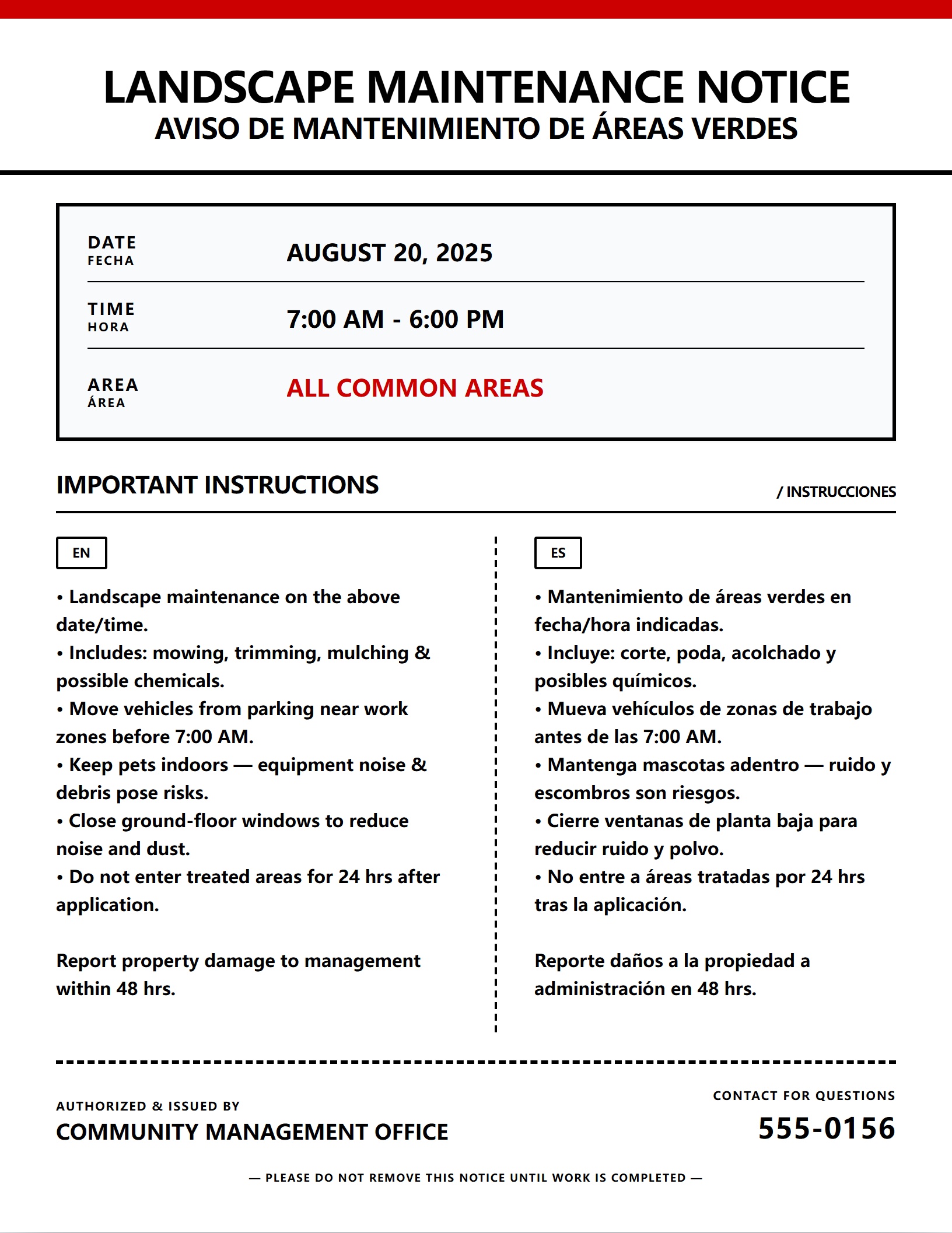
📋 Field Execution Asset
Download the OSHA-compliant manager checklist to ensure zero liability on-site.
🏠 Tenant Distribution Asset
Attach this prep-guide to your notice to reduce tenant front-desk calls by 60%.
Notice Editor & Preview
Edit Notice
Live Print Preview
US Letter • 8.5" x 11"
Legal Deadline Calculator
Powered by US Office of Personnel Management (OPM) rules.
Send Community-Wide Digital Notice
Post Physical Notices in Common Areas
Inspect & Mark Irrigation Heads and Obstacles
Verify Contractor Licenses, Insurance & Safety Plan
Execute Landscaping Work with Safety Buffer Zones
Compliance & Legal Disclaimer: Calculations are strictly based on U.S. Office of Personnel Management (OPM) observed federal holiday rules and standard weekend exclusions. While this tool is designed for enterprise-grade accuracy regarding FLSA and standard property management protocols (e.g., CA Civil Code §1950.5), local municipal codes may vary. NoticeMint is a workflow software, not a law firm. Always verify critical statutory deadlines with your legal counsel.
Execution Protocol
Operational Timeline & Compliance Checklist
- 7 Days Before Responsible: property manager AUTOMATABLE
Send Community-Wide Digital Notice
⚠️Liability Alert
If chemical application (herbicide, pesticide, fertilizer) is part of the scope, the notice MUST disclose the product name, EPA registration number, and reentry interval. Failure to disclose chemical application violates state pesticide notification laws in most jurisdictions (e.g., CA Food & Ag Code §12996).
💡Pro Strategy
Send via resident portal + SMS + email simultaneously. Include the exact work date, time window, affected areas, and a bulleted action list for residents (move vehicles, secure pets, close windows). Email-only delivery misses 35-40% of residents for operational alerts — SMS is critical.
- 3 Days Before Responsible: property manager
Post Physical Notices in Common Areas at Lobby, Mailbox Kiosk, Pool Area, Clubhouse, Parking Lot Entry
⚠️Liability Alert
Do NOT post notices on fire-rated doors, exit signage, ADA signage, or utility panels. Never obscure building code-required safety signage.
💡Pro Strategy
Post bilingual notices at eye level on community bulletin boards and near mailboxes — the two highest-visibility locations. Use bright green or yellow paper to visually distinguish landscaping notices from white enforcement notices and red emergency alerts.
- 2 Days Before Responsible: maintenance
Inspect & Mark Irrigation Heads and Obstacles
⚠️Liability Alert
Document the pre-existing condition of all irrigation components and hardscape with timestamped photos. Without pre-work documentation, the property cannot prove whether damage was caused by the contractor or pre-existed.
💡Pro Strategy
Walk all work areas and flag exposed sprinkler heads, valve boxes, drip irrigation lines, and low-voltage lighting fixtures with high-visibility markers. Mower damage to irrigation systems is the #1 source of landscaping contractor disputes — each broken sprinkler head costs $75-$150 to repair. A 15-minute pre-walk saves thousands in damage claims.
- 1 Day Before Responsible: property manager
Verify Contractor Licenses, Insurance & Safety Plan
⚠️Liability Alert
Never allow an uninsured or underinsured contractor to begin work. If a crew member is injured on your property without workers' comp coverage, the HOA becomes the employer of record and is liable for all medical costs, lost wages, and potential OSHA penalties exceeding $15,000 per violation.
💡Pro Strategy
Before the contractor begins work, verify: (1) Current state landscape contractor license (e.g., CA C-27 license), (2) General liability insurance ≥ $1M with the HOA named as additional insured, (3) Workers' compensation coverage for all crew members, (4) Pesticide applicator license if chemicals will be applied. File copies of all documents before work begins.
- Work Day Responsible: contractor
Execute Landscaping Work with Safety Buffer Zones
⚠️Liability Alert
If flying debris strikes a vehicle, window, or person, the HOA is jointly liable with the contractor unless you can prove: (1) adequate safety zones were established, (2) the contractor carried required insurance, and (3) residents were properly notified to move vehicles. Photograph all safety zones before work begins.
💡Pro Strategy
Require the contractor to establish 15-foot safety buffer zones around parked vehicles, building entrances, and pedestrian walkways before starting mowing or trimming. Use physical barriers (cones, caution tape) — verbal "stay back" warnings are not legally sufficient for flying debris protection. OSHA 29 CFR 1910.212 requires machine guarding and debris deflection controls on commercial mowers.
- Within 24 Hours After Responsible: property manager
Post-Work Quality & Damage Inspection
⚠️Liability Alert
If any damage is discovered, photograph it immediately and notify the contractor in writing within 24 hours. Most landscape contracts include a 48-hour damage reporting window — missing this deadline shifts liability to the HOA.
💡Pro Strategy
Conduct a thorough walk-through within 24 hours of work completion. Check: (1) All clippings and debris blown off walkways and driveways, (2) No irrigation heads damaged, (3) No vehicle damage from flying debris, (4) No window or siding damage from trimmers, (5) Chemical application areas properly marked with reentry warning signs, (6) All work areas meet the contracted scope and quality standards.
- Within 48 Hours After Responsible: property manager AUTOMATABLE
Notify Residents of Work Completion
⚠️Liability Alert
If chemical application was performed, the completion notice MUST include: product name, application date, and reentry interval (typically 24-48 hours for granular, 4-6 hours for liquid). Residents must be informed when it is safe for children and pets to reenter treated areas.
💡Pro Strategy
Send a brief completion notice via portal + SMS: "Landscape maintenance completed on [date]. If you observed any property damage or quality concerns, please report to the management office within 7 days with photos." This creates a documented reporting window that protects the HOA from late-filed claims.
- Within 3 Days After Completion Responsible: property manager
Remove Outdated Maintenance Notices at Lobby, Mailbox Kiosk, Pool Area, Clubhouse, Parking Lot Entry
⚠️Liability Alert
Do NOT remove chemical reentry warning signs until the reentry interval has fully expired — these are legally required postings that protect residents from pesticide exposure.
💡Pro Strategy
Remove all physical postings within 3 days of work completion. Outdated maintenance notices create visual clutter and train residents to ignore future notices (notice fatigue).
Required Posting Locations
Physical Distribution Checklist
- Lobby
- Mailbox Kiosk
- Pool Area
- Clubhouse
- Parking Lot Entry
Liability Defense Rule
Always take a timestamped wide-angle photo of the posted notice in its physical location. If a tenant claims they were not notified, this photo is your primary legal defense.
Tenant Communication Brief
Anticipated Questions & Official Responses
-
Q
Will the landscapers enter my fenced backyard?
- "No. Routine community landscaping covers common areas, parkways, perimeter landscaping, and open green spaces only. Fenced private yards are the homeowner's responsibility unless your CC&Rs specify otherwise.
-
Q
What if I have a pet in the yard?
- "All pets must be secured indoors during the maintenance window. Landscaping equipment (mowers, trimmers, blowers) can injure or frighten pets. Chemical application areas require a minimum reentry interval (typically 24-48 hours) before pets can return.
-
Q
What hours will the work be performed?
- "Work will begin no earlier than 7:00 AM and end no later than 6:00 PM to comply with local noise ordinances. Some municipalities restrict leaf blowers to 8:00 AM start times.
-
Q
A rock from the mower hit my car — who pays?
- "File a claim with the management office immediately with photos of the damage and the date/time. The landscaping contractor's liability insurance covers debris damage if proper safety zones were not maintained. Do NOT attempt to confront the crew directly.
-
Q
The landscapers blew clippings onto my driveway and it's stained.
- "Report the issue with photos to the management office within 48 hours. The contractor is responsible for cleanup of all work areas including adjacent driveways and walkways. Staining from fresh grass clippings on concrete is a documented maintenance issue and should be addressed promptly.
Manager's Note
Providing these answers in your initial notice can reduce management office phone volume by up to 60% during service interruptions.
Operational Guidance
Industry Best Practices & Field-Tested Strategies
Send bilingual digital notification (portal + SMS + email) at least 7 days before scheduled maintenance. Include a specific resident action list: move vehicles, secure pets, close windows. This 3-channel approach achieves 85%+ resident awareness vs. 45% for email-only.
Require the landscape contractor to establish 15-foot physical safety buffer zones (cones + caution tape) around parked vehicles, building entrances, and pedestrian paths before any mowing or trimming begins. Verbal "stay back" warnings are not legally sufficient — OSHA 29 CFR 1910.212 requires physical machine guarding and debris deflection.
Conduct a 15-minute pre-walk with maintenance staff 48 hours before work day to flag all exposed sprinkler heads, valve boxes, drip lines, and low-voltage lighting with high-visibility markers. Mower damage to irrigation systems is the #1 contractor dispute source — each broken head costs $75-$150 to repair.
If chemical application is included, disclose the product name, EPA registration number, application method, and reentry interval (typically 24-48 hours for granular, 4-6 hours for liquid) in BOTH the advance notice and the post-work completion notice. This satisfies state pesticide notification laws (e.g., CA Food & Ag Code §12996, NY ECL §33-1301) and protects the HOA from chemical exposure liability.
Verify contractor compliance BEFORE work begins: current state landscape license (CA C-27, TX nursery/landscape registration), ≥$1M general liability with HOA as additional insured, workers' comp for all crew. An uninsured crew member injured on your property makes the HOA the employer of record — liable for all medical costs plus OSHA penalties exceeding $15,000 per violation.
Photograph all safety buffer zones and pre-existing irrigation/hardscape conditions with timestamps before the contractor starts. This documentation package is the single most critical evidence for resolving post-work damage disputes and insurance claims.
Send a completion notice within 48 hours that includes a 7-day damage reporting window. This creates a documented claim period that protects the HOA from late-filed damage disputes while giving residents adequate time to inspect their property.
Manager Checklist
- Confirm landscaping scope with contractor: mowing areas, trimming zones, mulching beds, chemical application (product names + rates)
- Verify contractor holds current state landscape license, ≥$1M GL insurance with HOA as additional insured, and workers' comp for all crew
- If chemical application included: obtain EPA labels, SDS sheets, and reentry interval documentation from contractor
- Send bilingual digital notice (portal + SMS + email) 7 days before with resident action list
- Post bilingual physical notices in all common areas 3 days before
- Conduct pre-walk with maintenance staff 48 hours before: flag all sprinkler heads, valve boxes, drip lines, and low-voltage fixtures
- Photograph pre-existing condition of all irrigation, hardscape, and building exteriors adjacent to work zones
- Verify contractor establishes 15-foot safety buffer zones (cones + caution tape) around vehicles and entrances before work starts
- Photograph safety zones before work begins — this is your liability defense package
- Monitor work progress — ensure noise compliance (no work before 7 AM or after 6 PM)
- Conduct post-work inspection within 24 hours: debris cleanup, irrigation integrity, vehicle/window damage check
- If chemical application: verify reentry warning signs are posted at all treated areas
- Send completion notice within 48 hours with 7-day damage reporting window
- Remove all physical notices within 3 days of completion (except chemical reentry signs)
- Archive all documentation: photos, contractor credentials, notices, damage reports for minimum 3 years
Common Costly Mistakes
- ✗ Starting mowing before 7:00 AM — most municipal noise ordinances prohibit commercial landscaping equipment operation before 7:00 AM (some cities require 8:00 AM for leaf blowers specifically). Early starts generate noise complaints and can result in municipal fines of $250-$1,000 per violation.
- ✗ Failing to disclose chemical application in the advance notice — this violates state pesticide notification laws in 30+ states and exposes the HOA to chemical exposure lawsuits, particularly from residents with asthma, chemical sensitivities, or young children.
- ✗ No pre-work irrigation inspection — mowers routinely destroy $2,000-$5,000 worth of sprinkler heads per visit when heads are not flagged. Without pre-work photos, the HOA cannot prove whether damage was caused by the contractor or pre-existed.
- ✗ Allowing the contractor to work without verifying workers' compensation coverage — if a crew member is injured (laceration, heat stroke, equipment accident), the HOA becomes liable as the de facto employer. Average workers' comp claim for landscaping injuries exceeds $25,000.
- ✗ No safety buffer zones around parked vehicles — flying debris from string trimmers travels at 150+ mph and routinely cracks windshields, chips paint, and breaks side mirrors. Each vehicle damage claim averages $300-$800, and the HOA is jointly liable if adequate protection was not provided.
- ✗ Leaving grass clippings and debris on resident driveways and walkways — decomposing clippings stain concrete within 48 hours and create slip hazards when wet. Contractor cleanup is a standard scope item that must be enforced, not assumed.
- ✗ Providing English-only notices in communities with >30% Spanish-speaking households — this violates Fair Housing Act communication requirements and creates liability if a Spanish-speaking resident's pet is injured or a vehicle is damaged because they did not understand the notice.
Resident Preparation Checklist
Include this checklist in your notice to reduce tenant calls by up to 60%
- ☐ Review the maintenance date, time window, and affected areas in the notice
- ☐ Move all vehicles from parking areas adjacent to work zones before 7:00 AM on the work date — vehicles left in work zones risk flying debris damage
- ☐ Secure all pets indoors for the entire work window (7:00 AM - 6:00 PM) — equipment noise can cause pets to bolt, and debris can cause injury
- ☐ Close all ground-floor windows and balcony doors during the work window to reduce noise, dust, and debris intrusion
- ☐ Remove personal items from common area patios, balconies, and yard edges — planters, furniture, and decorations may be damaged by trimmers or blowers
- ☐ If you have a garden hose, sprinkler, or children's toys in common areas, move them before the work date
- ☐ Do NOT enter chemically treated areas (marked with reentry signs) for at least 24 hours — keep children and pets away
- ☐ After work completion, inspect your vehicle, windows, and adjacent areas for damage within 48 hours
- ☐ Photograph any damage immediately and report to the management office with photos, date, and description
- ☐ If you experience allergic reactions to freshly cut grass or chemical odors, stay indoors with windows closed and HVAC on recirculate mode during the work window
Frequently Asked Questions
What hours are landscapers legally allowed to operate in residential areas?
Can flying debris from landscaping equipment damage my car?
Is the HOA required to notify residents about pesticide/herbicide application?
What should I do if my pet is injured by landscaping equipment?
Can I request that the landscapers not use leaf blowers near my unit?
Disclaimer
- • Noise ordinance hours vary by municipality — always verify your local code before scheduling. Many cities now ban or restrict gas-powered leaf blowers entirely (e.g., Washington DC, Evanston IL, Montclair NJ, parts of Los Angeles and Seattle).
- • Over 30 states have pesticide/herbicide notification laws for residential communities — verify your state's specific requirements (product name, EPA number, reentry interval, advance notice period) before any chemical application.
- • OSHA 29 CFR 1910.212 requires machine guarding on commercial mowing equipment — verify the contractor's equipment has proper debris deflection shields and operator PPE (eye protection, hearing protection, steel-toe boots).
- • The HOA must be named as "additional insured" on the contractor's general liability policy — a certificate of insurance (COI) naming the HOA is not sufficient; request an endorsement or rider.
- • Fair Housing Act reasonable accommodation obligations apply to landscaping operations — residents with documented disabilities (respiratory conditions, noise sensitivity, autism) may request modified work schedules or equipment near their units.
- • California Civil Code §4735 prohibits HOAs from requiring homeowners to maintain lawns during declared drought emergencies — landscaping notices in drought-affected areas should acknowledge water-conservation exemptions.
- • Retain all contractor credentials, inspection photos, posted notices, and damage reports for a minimum of 3 years (5 years recommended) to defend against late-filed property damage or personal injury claims.
- • This template provides formatting and operational guidance only and does not constitute legal advice. Consult your property attorney for jurisdiction-specific compliance.
Related Operational Tasks
Complete your communication workflow with these related notices