Property Communication Task Center
Warning: Construction Dust & Paint Fumes 🛡️ 2026 OSHA/FHA Compliant
Notify occupants of airborne hazards (silica dust, VOCs, paint fumes) generated by construction activities, enforce strict HVAC isolation and negative air pressure protocols, ensure OSHA/EPA regulatory compliance, and mitigate "Sick Building Syndrome" liability and respiratory health complaints.
Not just a template.
A reality execution tool.
Don't risk tenant disputes with messy Word docs. Generate a print-ready, OSHA-compliant physical notice in exactly 30 seconds.
- 1Bilingual Architecture English & Spanish integrated into a single US Letter design. Crucial for legal compliance in 14+ states.
- 2Toner-Friendly Print Engineered for black-and-white office printers. High contrast hierarchy ensures readability from 10 feet away.
- 3Locked Formatting Zero layout breakage. Type your details, and the engine physicalizes it without overflowing the page.
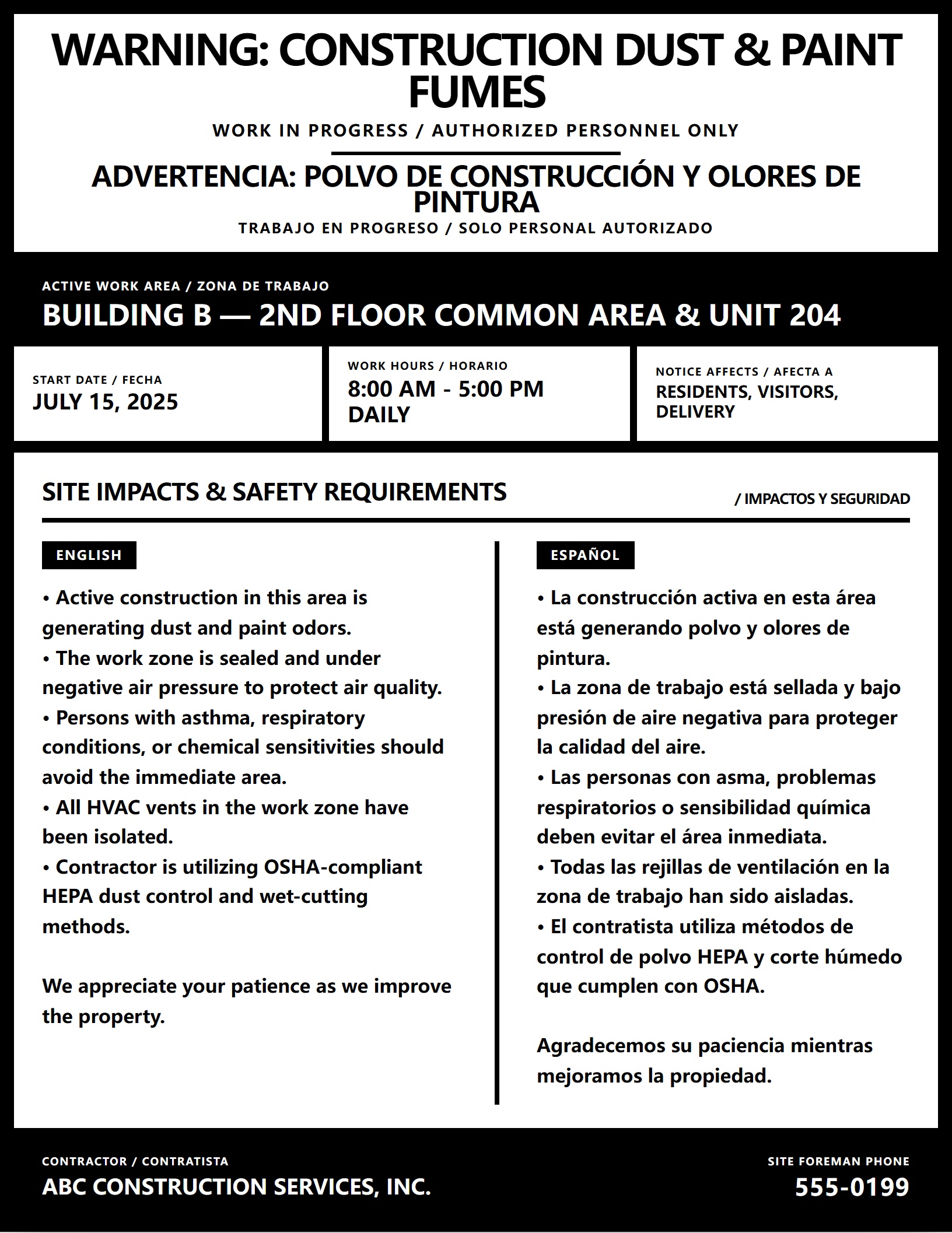
WARNING: CONSTRUCTION DUST & PAINT FUMES
ADVERTENCIA: POLVO DE CONSTRUCCIÓN Y OLORES DE PINTURA
Why use this template?
- ✓ Bilingual output (English/Spanish) prevents FHA liability
- ✓ Formatted strictly for US Letter B&W physical printing
- ✓ Zero JS bloat, generates instantly in your browser
Print Output Preview
📋 Field Execution Asset
Download the OSHA-compliant manager checklist to ensure zero liability on-site.
🏠 Tenant Distribution Asset
Attach this prep-guide to your notice to reduce tenant front-desk calls by 60%.
Notice Editor & Preview
Edit Notice
Live Print Preview
US Letter • 8.5" x 11"
Legal Deadline Calculator
Powered by US Office of Personnel Management (OPM) rules.
Post Advance Air Quality Warnings
Isolate HVAC & Establish Negative Air Pressure
Execute OSHA-Compliant Dust & Fume Controls
Daily Barrier & Airflow Inspection
Compliance & Legal Disclaimer: Calculations are strictly based on U.S. Office of Personnel Management (OPM) observed federal holiday rules and standard weekend exclusions. While this tool is designed for enterprise-grade accuracy regarding FLSA and standard property management protocols (e.g., CA Civil Code §1950.5), local municipal codes may vary. NoticeMint is a workflow software, not a law firm. Always verify critical statutory deadlines with your legal counsel.
Execution Protocol
Operational Timeline & Compliance Checklist
- 24 Hours Before Responsible: contractor
Isolate HVAC & Establish Negative Air Pressure
⚠️Liability Alert
Failing to isolate the HVAC system is the #1 cause of building-wide "Sick Building Syndrome" complaints. If paint fumes or concrete dust enter the return air plenum, it will be distributed to every connected unit within minutes, triggering mass tenant distress and potential habitability lawsuits.
💡Pro Strategy
Seal all supply and return air vents in the work zone with 6-mil polyethylene and duct tape. Deploy HEPA-filtered negative air machines (air scrubbers) venting to the exterior. This prevents silica dust and VOCs from migrating through the central HVAC system into occupied tenant units.
- 48 Hours Before Responsible: property manager
Post Advance Air Quality Warnings at Building Lobby, Elevator Cabs, Adjacent Unit Doors, Work Zone Entrances
💡Pro Strategy
Specifically advise tenants with asthma, COPD, chemical sensitivities, or pregnant women to minimize time in common areas adjacent to the work zone during active painting or cutting hours.
- Start of Work Responsible: contractor
Execute OSHA-Compliant Dust & Fume Controls
⚠️Liability Alert
Dry sweeping or using compressed air to clean up dust is STRICTLY PROHIBITED under OSHA standards. These methods aerosolize hazardous particles. Only HEPA-filtered vacuums or wet sweeping methods are permitted.
💡Pro Strategy
For silica-generating tasks (cutting concrete, brick, or tile), OSHA 29 CFR 1926.1153 Table 1 mandates using tools with integrated water delivery systems or HEPA vacuum shrouds. For interior work, erect floor-to-ceiling ZipWall® dust barriers with zipper doors to physically contain the work area.
- Each Workday Start Responsible: contractor
Daily Barrier & Airflow Inspection
⚠️Liability Alert
If the negative air machine filter is clogged or the exhaust hose has detached, the work zone immediately becomes a positive pressure source, pumping dust and fumes into the building. Stop work and repair before continuing.
💡Pro Strategy
Verify that ZipWall barriers are fully sealed to the ceiling and walls, and that negative air machines are running and maintaining negative pressure (check the manometer or tissue test). Ensure paint cans and solvent containers are tightly sealed when not in active use to minimize VOC off-gassing.
- Upon Completion Responsible: contractor
HEPA Clean & Restore Ventilation
⚠️Liability Alert
Dismantling dust barriers before HEPA cleaning will release a massive plume of settled dust into the surrounding common areas, undoing days of containment effort.
💡Pro Strategy
Perform a thorough HEPA vacuuming of all surfaces in the work zone before dismantling barriers. Run the negative air scrubbers for at least 2 hours after work ceases to capture lingering airborne particles. Only then should HVAC vents be unsealed and normal ventilation restored.
- Within 4 Hours After Completion Responsible: property manager
Remove Warnings & Verify Air Clearance at Building Lobby, Elevator Cabs, Adjacent Unit Doors, Work Zone Entrances
💡Pro Strategy
Conduct a "sniff test" and visual inspection of adjacent common areas before removing notices. If paint odors persist, extend the notice posting and increase fresh air intake via the building HVAC system until the odor dissipates.
Required Posting Locations
Physical Distribution Checklist
- Building Lobby
- Elevator Cabs
- Adjacent Unit Doors
- Work Zone Entrances
Liability Defense Rule
Always take a timestamped wide-angle photo of the posted notice in its physical location. If a tenant claims they were not notified, this photo is your primary legal defense.
Tenant Communication Brief
Anticipated Questions & Official Responses
-
Q
Are the paint fumes toxic?
- "We are using low-VOC (Volatile Organic Compound) paints where possible, but all paints emit some odor during curing. The work zone is under negative air pressure to prevent fumes from entering your unit, but brief odors may be noticeable in adjacent common areas.
-
Q
Is the dust dangerous?
- "Cutting concrete or masonry generates silica dust, which is strictly regulated by OSHA. The contractor is required to use wet-cutting methods or HEPA vacuum attachments to capture dust at the source before it becomes airborne.
Manager's Note
Providing these answers in your initial notice can reduce management office phone volume by up to 60% during service interruptions.
Operational Guidance
Industry Best Practices & Field-Tested Strategies
Isolate all HVAC supply and return vents in the work zone with 6-mil polyethylene and duct tape before any dust-generating work begins. This is the single most critical step to prevent building-wide contamination.
Deploy HEPA-filtered negative air machines (air scrubbers) venting to the exterior to maintain negative pressure inside the work zone. Verify negative pressure daily using a manometer or the "tissue test" on the zipper door.
For silica-generating tasks (cutting concrete, brick, tile), strictly follow OSHA 29 CFR 1926.1153 Table 1: use tools with integrated water delivery systems or HEPA vacuum shrouds. Dry cutting is unacceptable.
Erect floor-to-ceiling physical dust barriers (e.g., ZipWall® systems with zipper doors) rather than relying on plastic sheeting taped to walls, which easily detaches and fails to contain fine particulates.
Specify low-VOC (Volatile Organic Compound) or zero-VOC paints and primers for all interior work to minimize off-gassing and tenant odor complaints. Ensure paint cans are tightly sealed when not in active use.
Perform a thorough HEPA vacuuming of all surfaces BEFORE dismantling dust barriers. Dismantling barriers before cleaning releases a massive plume of settled dust into adjacent areas.
Manager Checklist
- Verify contractor has submitted a written Dust & Fume Control Plan before work begins
- Confirm all HVAC supply and return vents in the work zone are sealed with 6-mil poly
- Inspect floor-to-ceiling dust barriers (ZipWall or equivalent) for complete sealing at ceiling, walls, and floors
- Verify negative air machines (HEPA scrubbers) are deployed, venting exterior, and maintaining negative pressure
- Confirm contractor is using OSHA Table 1 compliant tools (water-fed or HEPA-vacuum shrouded) for concrete/masonry cutting
- Verify low-VOC or zero-VOC paints and adhesives are specified and on-site
- Ensure bilingual warning notices are posted at all approach points 48 hours in advance, specifically advising sensitive populations
- Establish daily inspection protocol for barrier integrity and negative air machine function
- Verify contractor understands dry sweeping and compressed air cleanup are strictly prohibited
- Conduct final "sniff test" and visual inspection before authorizing barrier removal and HVAC reactivation
Common Costly Mistakes
- ✗ Failing to seal HVAC return air grilles — this allows dust and VOCs to be sucked into the central system and distributed to every connected unit, triggering mass tenant distress and "Sick Building Syndrome" lawsuits.
- ✗ Using compressed air or dry sweeping to clean up dust — these methods aerosolize hazardous particles (silica, lead) and are STRICTLY PROHIBITED under OSHA standards. Only HEPA vacuums or wet sweeping are permitted.
- ✗ Relying on "open windows and fans" for ventilation instead of engineered negative air pressure — fans often create positive pressure, pushing contaminated air into adjacent corridors and units.
- ✗ Ignoring EPA RRP (Renovation, Repair and Painting) rules in pre-1978 buildings — disturbing lead-based paint without certified containment, HEPA cleanup, and clearance testing carries federal fines up to $46,517 per violation.
- ✗ Posting generic "Pardon Our Dust" signs instead of specific health warnings — failing to warn tenants with asthma or chemical sensitivities about VOC fumes can result in severe liability if a tenant suffers a respiratory attack.
- ✗ Dismantling dust barriers and removing negative air machines while the area is still dusty — the containment system must remain active until the final HEPA cleaning is complete and the area is visually dust-free.
Resident Preparation Checklist
Include this checklist in your notice to reduce tenant calls by up to 60%
- ☐ Keep windows and doors to the common area closed if you are adjacent to the work zone
- ☐ If you have asthma, COPD, or chemical sensitivities, minimize time in the immediate common areas during active work hours
- ☐ Report any strong chemical odors, visible dust migration, or detached plastic barriers to management immediately
- ☐ Do not attempt to enter or peek inside the sealed work zone — the negative air pressure will pull you and your clothing dust into the containment area
- ☐ If you notice dust settling in your unit despite the containment, notify management immediately so they can inspect the HVAC isolation
- ☐ Run your bathroom exhaust fans to help maintain positive pressure inside your unit and push air out, preventing common area air from seeping in under the door
Frequently Asked Questions
What is silica dust and why is it dangerous?
Are paint fumes dangerous to tenants in adjacent units?
What if the building was built before 1978?
Why is the HVAC system turned off or sealed in the work area?
Disclaimer
- • OSHA 29 CFR 1926.1153 (Respirable Crystalline Silica Standard for Construction) mandates strict engineering controls (water or HEPA vacuum) for all silica-generating tasks.
- • EPA RRP Rule (40 CFR Part 745) governs lead-safe work practices in pre-1978 housing and child-occupied facilities. Certified firms and trained renovators are required.
- • OSHA 29 CFR 1926.57 (Ventilation) and 1926.55 (Gases, Vapors, Fumes, Dusts, and Mists) govern general airborne hazard control and exhaust requirements.
- • ASHRAE Standard 62.1 and local building codes dictate minimum ventilation rates, but during construction, source control and isolation supersede standard ventilation.
- • This template provides formatting and operational guidance only and does not constitute legal advice. Consult your industrial hygienist and construction attorney for jurisdiction-specific compliance.
Related Operational Tasks
Complete your communication workflow with these related notices