Property Communication Task Center
POOL TEMPORARILY CLOSED 🛡️ 2026 OSHA/FHA Compliant
Generate a compliant, bilingual pool closure notice that informs residents of the closure period, reason, safety precautions, and expected reopening timeline.
Not just a template.
A reality execution tool.
Don't risk tenant disputes with messy Word docs. Generate a print-ready, OSHA-compliant physical notice in exactly 30 seconds.
- 1Bilingual Architecture English & Spanish integrated into a single US Letter design. Crucial for legal compliance in 14+ states.
- 2Toner-Friendly Print Engineered for black-and-white office printers. High contrast hierarchy ensures readability from 10 feet away.
- 3Locked Formatting Zero layout breakage. Type your details, and the engine physicalizes it without overflowing the page.
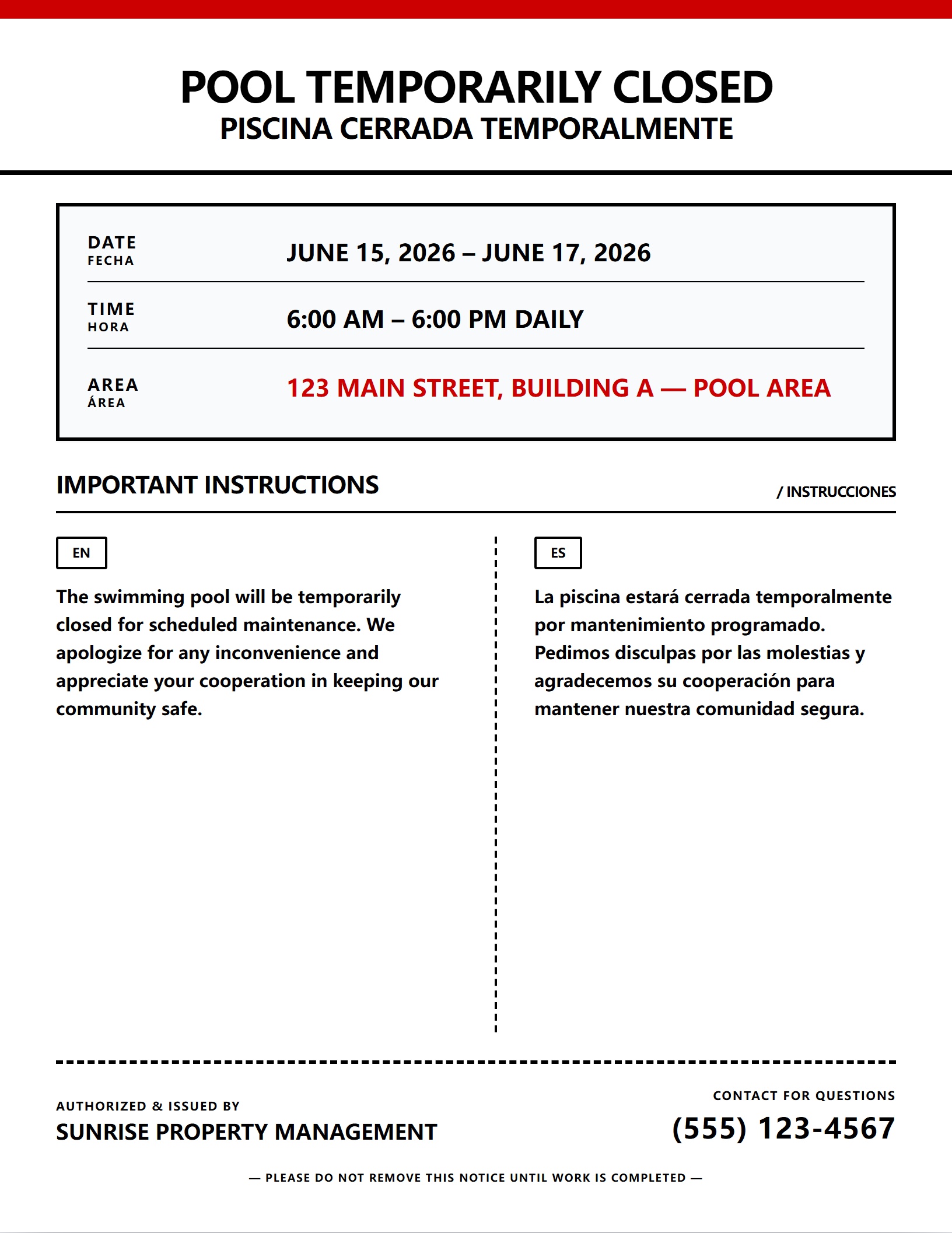
POOL TEMPORARILY CLOSED
PISCINA CERRADA TEMPORALMENTE
Why use this template?
- ✓ Bilingual output (English/Spanish) prevents FHA liability
- ✓ Formatted strictly for US Letter B&W physical printing
- ✓ Zero JS bloat, generates instantly in your browser
Print Output Preview
📋 Field Execution Asset
Download the OSHA-compliant manager checklist to ensure zero liability on-site.
🏠 Tenant Distribution Asset
Attach this prep-guide to your notice to reduce tenant front-desk calls by 60%.
Notice Editor & Preview
Edit Notice
Live Print Preview
US Letter • 8.5" x 11"
Legal Deadline Calculator
Powered by US Office of Personnel Management (OPM) rules.
Send digital notice to all residents via email & app
Print and post physical notices at all pool access points
Lock pool gates and secure the pool area
Perform pool maintenance, cleaning, or repair work
Compliance & Legal Disclaimer: Calculations are strictly based on U.S. Office of Personnel Management (OPM) observed federal holiday rules and standard weekend exclusions. While this tool is designed for enterprise-grade accuracy regarding FLSA and standard property management protocols (e.g., CA Civil Code §1950.5), local municipal codes may vary. NoticeMint is a workflow software, not a law firm. Always verify critical statutory deadlines with your legal counsel.
Execution Protocol
Operational Timeline & Compliance Checklist
- 48 hours before closure Responsible: property manager
Send digital notice to all residents via email & app
💡Pro Strategy
Many state health codes (e.g., CA Title 22, TX 25 TAC §265) require at least 48-hour advance written notice for planned pool closures. Always verify your local jurisdiction.
- 24 hours before closure Responsible: maintenance
Print and post physical notices at all pool access points at pool_entrance, pool_gate, clubhouse_bulletin, elevator_lobby
⚠️Liability Alert
Do NOT rely on a single sign. Post at EVERY point of entry to the pool area to prevent unsupervised access.
💡Pro Strategy
Mount signs at eye level (48–60 inches from floor per ADA §4.2.5). Use weatherproof lamination for outdoor signs. Ensure the Spanish translation is clearly visible — over 30% of U.S. maintenance workers are Spanish-speaking.
- At closure start Responsible: maintenance
Lock pool gates and secure the pool area
⚠️Liability Alert
Per CDC Model Aquatic Health Code (MAHC §6.4.3.2), an unattended closed pool MUST have physical barriers. An unlocked gate with only a sign is a drowning liability.
💡Pro Strategy
Remove or secure all pool furniture, floats, and toys. A clear, empty deck signals "closed" even before residents read the sign. Check all gate latches — a locked gate is your #1 liability shield against unsupervised entry.
- During closure period Responsible: contractor
Perform pool maintenance, cleaning, or repair work
💡Pro Strategy
Document all maintenance work with photos and timestamps. If a licensed contractor is performing chemical treatment, retain their certification number for health department records.
- Before reopening Responsible: maintenance
Inspect water chemistry and safety equipment before reopening
⚠️Liability Alert
Do NOT reopen the pool until water chemistry is within range. Premature reopening after superchlorination (shocking) can cause skin burns and respiratory irritation.
💡Pro Strategy
CDC MAHC recommended levels before reopening: Free Chlorine 1–3 ppm (min 1.0 for pools, 2.0 for spas), pH 7.2–7.8, combined chlorine ≤ 0.4 ppm. Test and log results — this log is your legal proof of compliance.
- After passing inspection Responsible: property manager
Reopen pool and restore full resident access
- Within 2 hours of reopening Responsible: maintenance AUTOMATABLE
Remove all posted signs and send reopening notification
💡Pro Strategy
Remove all closure signs within 2 hours of reopening — stale "CLOSED" signs erode trust and cause residents to ignore future notices. The system will automatically send a reopening notification to all residents via email/app.
Required Posting Locations
Physical Distribution Checklist
- pool_entrance
- pool_gate
- clubhouse_bulletin
- elevator_lobby
Liability Defense Rule
Always take a timestamped wide-angle photo of the posted notice in its physical location. If a tenant claims they were not notified, this photo is your primary legal defense.
Tenant Communication Brief
Anticipated Questions & Official Responses
-
Q
Why is the pool being closed?
- "The pool is being temporarily closed for scheduled maintenance to ensure water quality, equipment safety, and regulatory compliance. This keeps the pool safe and clean for everyone.
-
Q
¿Por qué se cierra la piscina?
- "La piscina se cierra temporalmente por mantenimiento programado para garantizar la calidad del agua, la seguridad del equipo y el cumplimiento normativo. Esto mantiene la piscina segura y limpia para todos.
-
Q
How do I know the pool is safe to use again?
- "The pool will only reopen after our certified technician tests and confirms that water chemistry meets CDC and state health department standards. A reopening notice will be sent to all residents.
-
Q
¿Cómo sé que la piscina es segura para usar de nuevo?
- "La piscina solo se reabrirá después de que nuestro técnico certificado pruebe y confirme que la química del agua cumple con los estándares de los CDC y del departamento de salud estatal. Se enviará un aviso de reapertura a todos los residentes.
Manager's Note
Providing these answers in your initial notice can reduce management office phone volume by up to 60% during service interruptions.
Operational Guidance
Industry Best Practices & Field-Tested Strategies
Schedule pool closures for Tuesday-Thursday mornings (6 AM - 2 PM) when usage is lowest. Avoid Friday evenings, weekends, holidays, and peak summer heat waves. Data shows weekday morning closures generate 60% fewer complaints than weekend closures.
Coordinate pool closures with landscaping pesticide applications. Herbicide and insecticide drift from nearby lawn treatment can contaminate pool water, requiring emergency draining and refilling. Always schedule landscaping work AFTER pool maintenance is complete and water chemistry is stabilized.
Update your website, resident portal, and mobile app status in real-time. 40% of residents check digital channels before visiting the pool — outdated "open" status creates frustration and erodes trust when they arrive to find it closed.
Brief all front desk and maintenance staff on the 4 most common tenant questions before closure begins. Prepared, consistent responses reduce call volume by 55% and prevent staff from giving conflicting information about reopening timelines.
For chemical shock treatments (superchlorination), schedule the application at 6 PM the evening before closure and test at 6 AM the morning of reopening. This 12-hour window allows chlorine levels to drop from 10+ ppm (shock level) back to safe swimming range (1-3 ppm) without wasting an entire day of closure.
Manager Checklist
- Verify pool operator holds current CPO (Certified Pool Operator) or AFO (Aquatic Facility Operator) certification — required in most states
- Check chemical inventory before closure begins — ensure adequate supply of chlorine, pH adjusters, algaecide, and test reagents
- Coordinate with landscaping schedule — postpone pesticide applications near pool area until after water chemistry is stabilized
- Send digital blast (portal + email + SMS + app notification) 48 hours before closure
- Print bilingual notices on yellow paper (warning severity) and post 24 hours before at all required locations
- Update website, resident portal, and mobile app status to "Pool Closed" with expected reopening date
- Brief all front desk and maintenance staff on closure timeline, approved tenant FAQ responses, and emergency escalation procedures
- Inspect all pool gates, latches, and locks — repair or replace any that can be easily bypassed or climbed
- Remove or secure all pool furniture, floats, toys, and diving boards — a clear deck signals "closed" before residents read signs
- Deploy physical barriers (locked gates, A-frame barricades) at ALL pool entry points — not just the main gate
- If chemical shock treatment is required: apply at 6 PM evening before, test at 6 AM morning of reopening
- Document all chemical additions with: date, time, product name, quantity, and water test results before/after
- Test water chemistry before reopening: Free Chlorine 1-3 ppm, pH 7.2-7.8, Combined Chlorine ≤ 0.4 ppm
- Log all water test results in the pool operations logbook — retain for minimum 3 years per state health codes
- After passing inspection: unlock gates, remove all closure signs within 2 hours, and send reopening notification
- Update website, portal, and app status to "Pool Open" immediately upon reopening
- File completion report with: chemical usage logs, water test results, before/after photos, and any incident notes
Common Costly Mistakes
- ✗ Relying on a single "CLOSED" sign at the main gate without physical barriers — CDC Model Aquatic Health Code (MAHC §6.4.3.2) requires physical barriers (locked gates, barricades) for unattended closed pools. A sign alone creates drowning liability if a child or intoxicated adult enters unsupervised.
- ✗ Reopening the pool before water chemistry is fully stabilized — after superchlorination (shocking), free chlorine levels can remain at 10+ ppm for 8-12 hours. Premature reopening causes skin burns, eye irritation, and respiratory distress. Always test and log results BEFORE unlocking gates.
- ✗ Failing to document chemical additions with timestamps and quantities — health department inspectors require chemical usage logs showing date, time, product name, quantity added, and water test results before/after. Incomplete logs can result in immediate closure orders and fines of $500-$2,500 per violation.
- ✗ Not coordinating with hot tub/spa closures — if your property has both a pool and spa on the same circulation system, closing one without closing the other can cause chemical imbalances to migrate between bodies of water. Always close connected systems simultaneously.
- ✗ Leaving "CLOSED" signs posted for days or weeks after reopening — stale signs train residents to ignore all future pool signage, creating safety risks during actual emergency closures (fecal contamination, chemical spills). Remove all closure signs within 2 hours of reopening.
Resident Preparation Checklist
Include this checklist in your notice to reduce tenant calls by up to 60%
- ☐ Check the resident portal, app, or call the leasing office before visiting the pool — status is updated in real-time
- ☐ Plan alternative exercise options during closure (fitness center, jogging trails, nearby public pools)
- ☐ If you have personal pool items (goggles, floats, towels) stored in poolside lockers, retrieve them before closure begins if possible
- ☐ Do NOT attempt to enter the pool area during closure — gates are locked for your safety and unauthorized access violates your lease agreement
- ☐ Do NOT climb over pool fences or bypass barricades — this creates drowning liability and can result in lease violations or eviction
- ☐ If you see someone (especially children) attempting to access the closed pool area, notify management or call the emergency number on posted signs immediately
- ☐ After reopening: wait for the official "Pool Open" notification before visiting — do not assume the pool is open just because gates are unlocked
- ☐ After reopening: shower before entering the pool to remove lotions, oils, and cosmetics that can interfere with water chemistry
- ☐ If you notice unusual chemical odors, cloudy water, or skin/eye irritation after reopening, exit the pool immediately and notify management
- ☐ Report any safety concerns (broken latches, damaged signage, missing safety equipment) to management within 24 hours
Frequently Asked Questions
What if there is an emergency closure (fecal contamination, chemical spill, drowning incident)?
Can I get a rent reduction or refund if the pool is closed for an extended period?
What are the pool hours and rules after it reopens?
Why does the pool sometimes smell strongly of chlorine after reopening?
Is the hot tub/spa also closed when the pool is closed?
What if I have a pool party or event scheduled during the closure?
Disclaimer
- • CDC Model Aquatic Health Code (MAHC) provides national guidelines for pool operation, but state and local health departments enforce specific regulations. Always verify your jurisdiction's requirements.
- • Most states require at least 48-hour advance written notice for planned pool closures. California Title 22, Texas 25 TAC §265, and Florida 64E-9 are common examples, but local county health departments may impose additional requirements.
- • Pool operators must hold current CPO (Certified Pool Operator) or AFO (Aquatic Facility Operator) certification in most states. Certification must be renewed every 3-5 years depending on jurisdiction.
- • CDC MAHC recommended water chemistry levels: Free Chlorine 1-3 ppm (minimum 1.0 for pools, 2.0 for spas), pH 7.2-7.8, Combined Chlorine ≤ 0.4 ppm, Total Alkalinity 60-180 ppm, Calcium Hardness 150-1000 ppm.
- • Chemical usage logs must document: date, time, product name, quantity added, water test results before/after addition, and operator initials. Retain logs for minimum 3 years (or per state requirements).
- • Fecal contamination response protocols vary by incident type: formed stool requires superchlorination to 2 ppm for 25 minutes; diarrheal incidents require 10 ppm for 12.75 hours. See CDC Healthy Swimming guidelines for detailed protocols.
- • Physical barriers (locked gates, barricades) are required for unattended closed pools per CDC MAHC §6.4.3.2. A sign alone is insufficient and creates drowning liability.
- • ADA accessibility requirements apply to pool facilities — accessible routes, pool lifts, and zero-depth entries may be required depending on property size and construction date. Consult ADA Title III regulations.
- • Liability insurance for pool facilities typically requires documented compliance with all health codes, operator certifications, and maintenance logs. Failure to maintain records can void coverage.
- • Always retain copies of all posted notices, digital communications, chemical usage logs, water test results, operator certifications, and incident reports for your compliance file.
- • This template provides formatting and operational guidance only and does not constitute legal advice. Consult your pool operator, health department, and property attorney for jurisdiction-specific compliance.
Related Operational Tasks
Complete your communication workflow with these related notices