Property Communication Task Center
Balcony Closure Notice 🛡️ 2026 OSHA/FHA Compliant
Temporarily restrict balcony access to support structural inspections, waterproofing projects, exterior repairs, and safety assessments while protecting residents from falling-debris hazards and reducing liability associated with unauthorized access.
Not just a template.
A reality execution tool.
Don't risk tenant disputes with messy Word docs. Generate a print-ready, OSHA-compliant physical notice in exactly 30 seconds.
- 1Bilingual Architecture English & Spanish integrated into a single US Letter design. Crucial for legal compliance in 14+ states.
- 2Toner-Friendly Print Engineered for black-and-white office printers. High contrast hierarchy ensures readability from 10 feet away.
- 3Locked Formatting Zero layout breakage. Type your details, and the engine physicalizes it without overflowing the page.
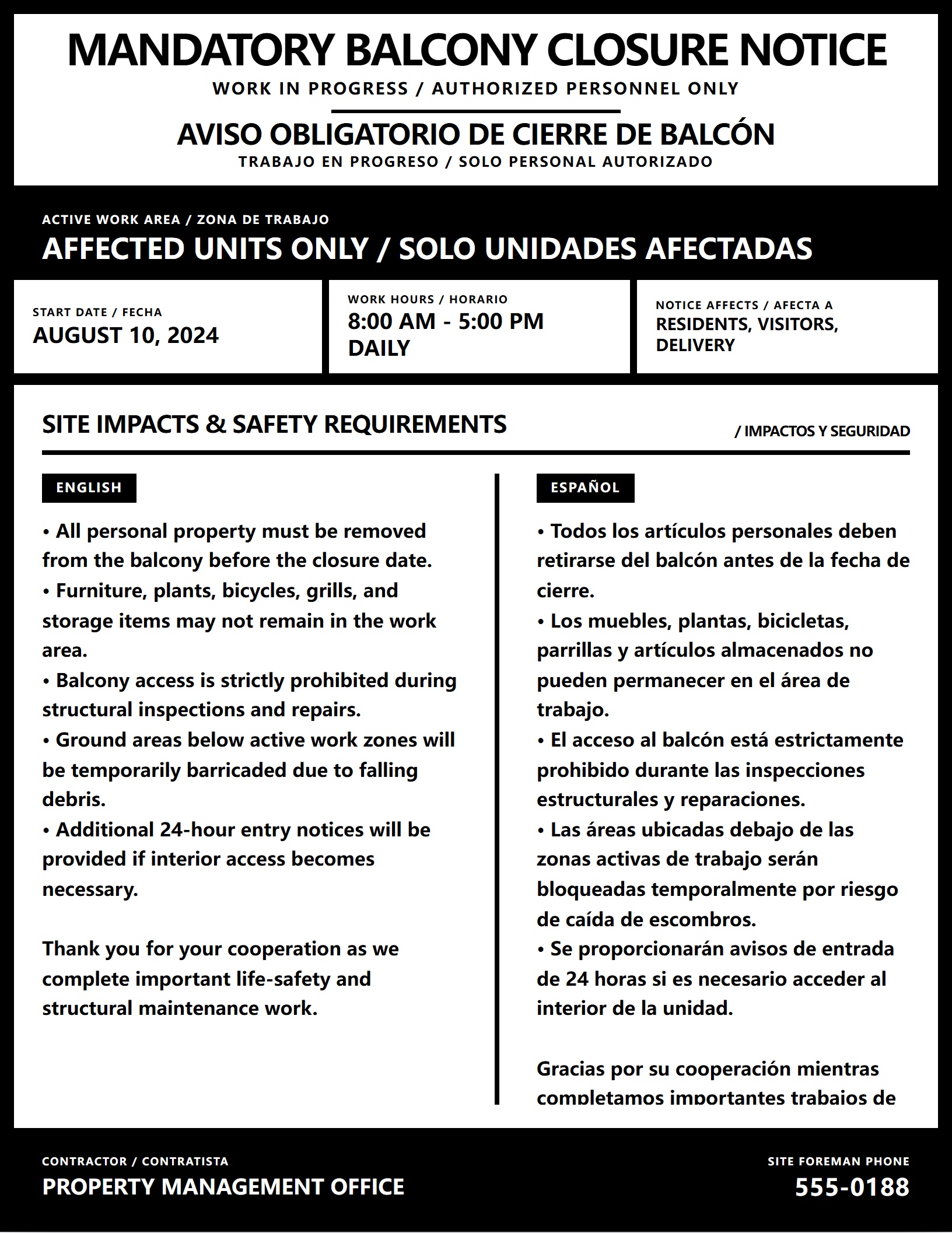
MANDATORY BALCONY CLOSURE NOTICE
AVISO OBLIGATORIO DE CIERRE DE BALCÓN
Why use this template?
- ✓ Bilingual output (English/Spanish) prevents FHA liability
- ✓ Formatted strictly for US Letter B&W physical printing
- ✓ Zero JS bloat, generates instantly in your browser
Print Output Preview
📋 Field Execution Asset
Download the OSHA-compliant manager checklist to ensure zero liability on-site.
🏠 Tenant Distribution Asset
Attach this prep-guide to your notice to reduce tenant front-desk calls by 60%.
Notice Editor & Preview
Edit Notice
Live Print Preview
US Letter • 8.5" x 11"
Legal Deadline Calculator
Powered by US Office of Personnel Management (OPM) rules.
SEND DIGITAL
POST NOTICE
Clear Personal Belongings
SEND DIGITAL
BARRICADE
BARRICADE
Execute Inspection & Repair
Compliance & Legal Disclaimer: Calculations are strictly based on U.S. Office of Personnel Management (OPM) observed federal holiday rules and standard weekend exclusions. While this tool is designed for enterprise-grade accuracy regarding FLSA and standard property management protocols (e.g., CA Civil Code §1950.5), local municipal codes may vary. NoticeMint is a workflow software, not a law firm. Always verify critical statutory deadlines with your legal counsel.
Execution Protocol
Operational Timeline & Compliance Checklist
- 7-14 Days Before Responsible: system AUTOMATABLE
SEND DIGITAL
💡Pro Strategy
Provide advance notice through resident portals, email, and SMS whenever available. Early communication gives residents time to remove belongings and prepare for temporary access restrictions.
- 7 Days Before Responsible: property manager
POST NOTICE at Main Lobby, Mailroom, Building Entry Doors, Elevator Cars, Affected Unit Balcony Doors
⚠️Liability Alert
Avoid placing notices on emergency equipment, exit signage, accessibility signage, or surfaces that may be damaged by adhesives.
💡Pro Strategy
Post notices at eye level and place additional notices directly on affected balcony doors whenever permitted by property policy.
- 48 Hours Before Responsible: tenant
Clear Personal Belongings
⚠️Liability Alert
Residents MUST remove furniture, plants, bicycles, grills, storage containers, and decorations before the closure begins. Items left on the balcony may be removed and stored at the resident's expense to allow structural access.
💡Pro Strategy
Photograph the balcony and all personal property before removal for documentation purposes.
- 24 Hours Before Responsible: system AUTOMATABLE
SEND DIGITAL
💡Pro Strategy
Send a final reminder that includes the access restriction start time, expected work schedule, and management contact information.
- Closure Start Date Responsible: maintenance
BARRICADE
⚠️Liability Alert
Balconies must remain closed throughout the project. Apply tamper-evident security seals or zip-ties to sliding door tracks to prevent unauthorized access during high-wind or active work days.
💡Pro Strategy
Use temporary barriers, warning signage, security seals, or other approved access-control measures consistent with property procedures.
- During Active Overhead Work Responsible: maintenance
BARRICADE at Ground-level Patios, Sidewalks Beneath Work Zones
⚠️Liability Alert
CRITICAL: Ground-level patios, sidewalks, and pedestrian areas beneath active work zones MUST be temporarily barricaded due to falling-debris hazards. Use OSHA-compliant caution tape and A-frame signs.
- During Closure Period Responsible: contractor
Execute Inspection & Repair
💡Pro Strategy
If interior access becomes necessary for inspection or repair activities, provide any required 24-hour entry notices in accordance with local landlord-tenant laws.
- Upon Completion of Work Responsible: contractor
Verify Structural Safety
⚠️Liability Alert
Do not reopen balconies until structural inspections, repairs, safety reviews, and contractor sign-offs have been completed and documented.
💡Pro Strategy
Verify that all barriers have been removed, surfaces are clean, and the area is safe for normal resident use before restoring access.
- Immediately After Reopening Responsible: system AUTOMATABLE
SEND DIGITAL
💡Pro Strategy
Notify residents that access has been restored. If waterproofing was applied, remind them of the curing time (usually 24-48 hours) before placing heavy furniture back on the surface.
- Within 24 Hours of Reopening Responsible: property manager
REMOVE NOTICE at All Posted Locations
⚠️Liability Alert
Leaving outdated closure notices in place may create resident confusion and generate unnecessary maintenance requests.
💡Pro Strategy
Remove all temporary notices and document project completion within the maintenance tracking system.
Required Posting Locations
Physical Distribution Checklist
- Main Lobby
- Mailroom
- Building Entry Doors
- Elevator Cars
- Affected Unit Balcony Doors
- Ground-level Patios
- Sidewalks Beneath Work Zones
- All Posted Locations
Liability Defense Rule
Always take a timestamped wide-angle photo of the posted notice in its physical location. If a tenant claims they were not notified, this photo is your primary legal defense.
Tenant Communication Brief
Anticipated Questions & Official Responses
-
Q
Why is my balcony being closed?
- "Balconies, decks, and other exterior elevated elements (EEEs) require periodic structural inspection and maintenance to comply with state safety codes (e.g., SB 326/SB 721) and ensure long-term weather protection.
-
Q
How long will the closure last?
- "Closure duration depends on inspection findings, weather conditions, contractor schedules, and repair requirements. Property management will provide updates as work progresses.
-
Q
What if I cannot move heavy furniture by myself?
- "Contact management before the closure date. Depending on property policy, additional guidance or scheduling accommodations may be available.
-
Q
Can I leave small items on the balcony?
- "No. Even lightweight objects may interfere with structural inspections, waterproofing work, or safety procedures.
-
Q
Will workers enter my apartment?
- "Not necessarily. If interior access becomes necessary to inspect the structural connection points, management will provide a separate 24-hour Notice to Enter.
-
Q
Can I open my balcony door for fresh air?
- "No. Doors must remain closed and locked to maintain safety controls, prevent debris from entering the unit, and stop unauthorized access to the compromised structure.
Manager's Note
Providing these answers in your initial notice can reduce management office phone volume by up to 60% during service interruptions.
Operational Guidance
Industry Best Practices & Field-Tested Strategies
Provide 7-14 days advance notice for balcony closures — not 48 hours. Residents need time to remove heavy furniture, relocate plants, cancel balcony-based activities (smoking, dining, exercise), and arrange storage. Studies show 7-day notice reduces "I didn't know" complaints by 70% and unauthorized access attempts by 45%.
Require your structural inspector or engineer to hold current California licenses (PE — Professional Engineer or SE — Structural Engineer for SB 326; licensed architect, engineer, or contractor for SB 721). Unlicensed inspectors produce reports that will be rejected by local building departments, wasting $3,000-$8,000 in inspection fees.
Photograph every balcony condition BEFORE closure begins — date-stamped, GPS-tagged images from multiple angles. This protects against false damage claims from tenants who blame you for pre-existing cracks, stains, or wear that was documented before your work started.
Coordinate balcony closures with scaffolding erection schedules. If scaffolding is already deployed for other exterior work (painting, window replacement), combining balcony inspection into the same project window reduces mobilization costs by 40-60% and eliminates the need for a second closure notice.
For waterproofing repairs, communicate curing times clearly in the reopening notice. Most deck coating systems (elastomeric, polyurethane) require 24-72 hours of curing before heavy furniture can be replaced. Tenants who drag patio furniture back immediately can damage $15,000-$30,000 waterproofing jobs within hours.
Manager Checklist
- Verify structural inspector or engineer holds current California PE/SE license (SB 326) or licensed contractor/architect credentials (SB 721)
- Confirm SB 326/SB 721 inspection deadline compliance — check if initial inspection has been completed and filed with local building department
- Obtain contractor certificates of insurance (general liability + workers compensation) and verify coverage is current
- Review previous inspection reports to identify known deficiencies and prioritize repair scope
- Send digital blast (portal + email + SMS) 7-14 days before closure start date
- Print bilingual notices on RED paper (danger severity) and post 7 days before at all required locations
- Contact each affected tenant personally if balcony contains large/heavy items requiring special removal assistance
- Schedule pre-closure photography session — document every balcony from multiple angles with date stamps
- Coordinate scaffolding or swing-stage deployment if required for exterior access
- Verify ground-level barricade materials are available (OSHA-compliant A-frames, caution tape, concrete barriers for high-traffic areas)
- Brief all on-site staff on closure timeline, approved tenant FAQ responses, and unauthorized access escalation procedures
- Deploy physical barricades (security seals, zip-ties on sliding door tracks) on closure start date
- Monitor weather forecasts daily — communicate delays to residents within 24 hours of any schedule changes
- Conduct post-repair inspection with structural engineer sign-off before reopening any balcony
- Send reopening notification with waterproofing curing time requirements (typically 24-72 hours)
- Remove all posted notices within 24 hours of reopening and document project completion
- File completion report with: inspection certifications, repair invoices, before/after photos, insurance certificates, and any incident notes
Common Costly Mistakes
- ✗ Failing to verify SB 326/SB 721 inspection deadlines — California requires apartment buildings with 3+ units to complete initial EEE inspections by January 1, 2025 (SB 721) and condo associations by January 1, 2025 (SB 326). Missing these deadlines exposes property owners to $100-$500/day penalties and potential criminal liability if a structural failure occurs.
- ✗ Allowing "partial access" during active work — tenants who "just step out for a cigarette" or "grab a plant" create catastrophic liability. Any unauthorized balcony access during structural work must be treated as a safety incident and documented with written warnings.
- ✗ Not barricading ground-level areas beneath active work zones — falling debris (concrete chunks, rebar fragments, tools) from 3+ story heights can be lethal. OSHA requires ground barricades with warning signage during all overhead work, and failure to deploy them creates strict liability for any injuries.
- ✗ Skipping pre-closure photography documentation — without before/after photos, you cannot prove that damage (cracks, stains, water intrusion) existed before your work, making you vulnerable to false tenant claims and insurance disputes.
- ✗ Ignoring weather delays and failing to update residents — rain, high winds, or extreme temperatures can delay waterproofing curing or structural repairs by days or weeks. Without proactive communication, tenants assume the closure is "forgotten" and begin circumventing barricades.
Resident Preparation Checklist
Include this checklist in your notice to reduce tenant calls by up to 60%
- ☐ Remove ALL personal property from the balcony before the closure date — furniture, plants, bicycles, grills, storage bins, decorations, rugs, and umbrellas
- ☐ Photograph your balcony condition before work begins — document any existing cracks, stains, or damage for your records
- ☐ Secure sliding door locks and ensure balcony door remains closed and locked throughout the closure period
- ☐ Plan alternative arrangements for activities that require outdoor space (smoking, dining, exercise, plant care)
- ☐ If you have large/heavy items you cannot move alone, contact management at least 48 hours before closure to request assistance
- ☐ Do NOT attempt to access the balcony during the closure period — structural work creates falling hazards and unauthorized access voids insurance coverage
- ☐ Do NOT prop open or tamper with security seals, zip-ties, or barricades on your balcony door
- ☐ Report any water intrusion, unusual odors, or debris entering your unit through the balcony door during work
- ☐ After reopening: wait the full curing time (typically 24-72 hours for waterproofing) before replacing heavy furniture
- ☐ Inspect your balcony after reopening — report any damage to personal property or new structural concerns to management within 48 hours
- ☐ If waterproofing was applied, avoid dragging furniture across the surface — lift and place to prevent coating damage
Frequently Asked Questions
What are SB 326 and SB 721, and why do they require balcony inspections?
Who pays for balcony repairs — the landlord or the tenant?
What if I refuse to remove my belongings from the balcony?
Can I use my balcony just for smoking or to step outside briefly during the closure?
How do I know if the balcony repairs were done correctly?
What if I notice water leaks or damage inside my apartment after balcony work is completed?
Will balcony closure affect my rent or qualify me for a rent reduction?
Disclaimer
- • California SB 721 requires apartment buildings with 3+ dwelling units to complete initial Exterior Elevated Element (EEE) inspections by January 1, 2025, with recurring inspections every 6 years thereafter.
- • California SB 326 requires condominium associations and HOAs to complete initial EEE inspections by January 1, 2025, with recurring inspections every 9 years thereafter.
- • EEEs are defined as balconies, decks, porches, stairways, walkways, and entry structures that extend beyond exterior walls and rely on wood or wood-based products for structural support, and are more than 6 feet above ground level.
- • SB 721 inspections must be performed by licensed architects, civil/structural engineers, or contractors holding specific CSLB classifications (A, B, or C-5 with additional certifications).
- • SB 326 inspections must be performed by licensed structural engineers (SE) or professional engineers (PE) with structural competency.
- • Inspection reports must be filed with the local building enforcement department within 30 days of completion, and a copy must be provided to the property owner/HOA board.
- • Non-compliance with SB 326/SB 721 inspection deadlines can result in penalties of $100-$500 per day and potential criminal liability if structural failure occurs due to uninspected deficiencies.
- • OSHA regulations (29 CFR 1926 Subpart M) require fall protection and ground-level barricades during overhead construction work. Failure to barricade ground areas beneath active balcony work creates strict liability for falling-debris injuries.
- • Waterproofing coating systems typically require 24-72 hours curing time (depending on product and weather conditions) before furniture placement or foot traffic. Premature use can void manufacturer warranties and cause coating failure.
- • Always retain copies of all inspection reports, repair invoices, contractor licenses, insurance certificates, before/after photos, and tenant communications for your compliance file.
- • This template provides formatting and operational guidance only and does not constitute legal advice. Consult your structural engineer, property attorney, and local building department for jurisdiction-specific compliance.
Related Operational Tasks
Complete your communication workflow with these related notices