Property Communication Task Center
DANGER: FALLING DEBRIS 🛡️ 2026 OSHA/FHA Compliant
Establish a strict OSHA-compliant Drop Zone, warn pedestrians and ground workers of overhead struck-by hazards, mandate protective headgear, and legally document the deployment of physical debris containment (nets/canopies).
Not just a template.
A reality execution tool.
Don't risk tenant disputes with messy Word docs. Generate a print-ready, OSHA-compliant physical notice in exactly 30 seconds.
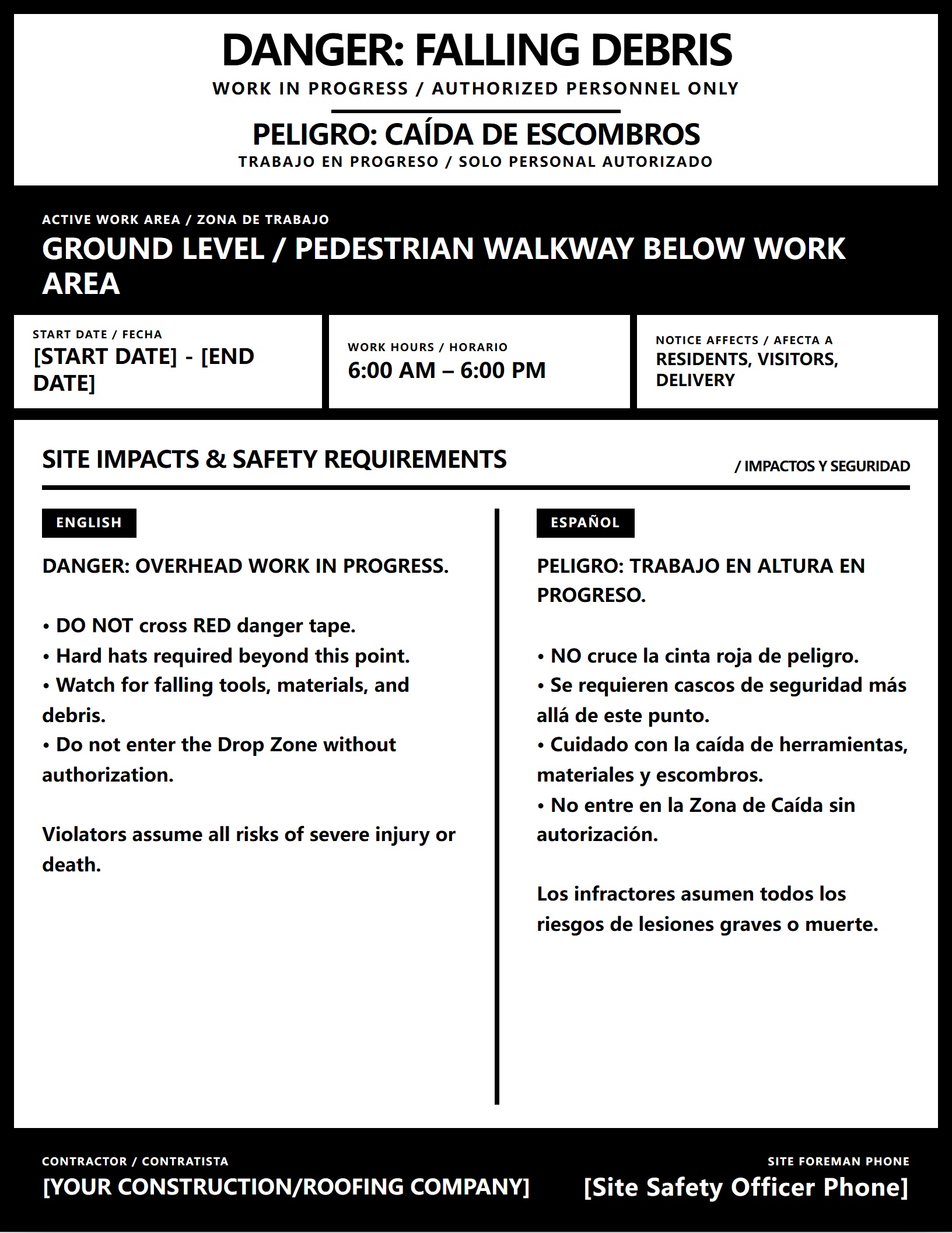
- 1Bilingual Architecture English & Spanish integrated into a single US Letter design. Crucial for legal compliance in 14+ states.
- 2Toner-Friendly Print Engineered for black-and-white office printers. High contrast hierarchy ensures readability from 10 feet away.
- 3Locked Formatting Zero layout breakage. Type your details, and the engine physicalizes it without overflowing the page.
DANGER: FALLING DEBRIS
PELIGRO: CAÍDA DE ESCOMBROS
Why use this template?
- ✓ Bilingual output (English/Spanish) prevents FHA liability
- ✓ Formatted strictly for US Letter B&W physical printing
- ✓ Zero JS bloat, generates instantly in your browser
Print Output Preview
📋 Field Execution Asset
Download the OSHA-compliant manager checklist to ensure zero liability on-site.
🏠 Tenant Distribution Asset
Attach this prep-guide to your notice to reduce tenant front-desk calls by 60%.
Notice Editor & Preview
Edit Notice
Live Print Preview
US Letter • 8.5" x 11"
Legal Deadline Calculator
Powered by US Office of Personnel Management (OPM) rules.
Alert ground-floor tenants and adjacent businesses
Install debris netting, toe boards, or sidewalk canopy
Tape off the Drop Zone with RED Danger tape
Compliance & Legal Disclaimer: Calculations are strictly based on U.S. Office of Personnel Management (OPM) observed federal holiday rules and standard weekend exclusions. While this tool is designed for enterprise-grade accuracy regarding FLSA and standard property management protocols (e.g., CA Civil Code §1950.5), local municipal codes may vary. NoticeMint is a workflow software, not a law firm. Always verify critical statutory deadlines with your legal counsel.
Execution Protocol
Operational Timeline & Compliance Checklist
- 48 hours before overhead work begins Responsible: property manager
Alert ground-floor tenants and adjacent businesses
💡Pro Strategy
Ground-floor tenants must be instructed to close and lock all windows, retract outdoor awnings, and clear balconies/patios of any items that could be damaged by dust or stray debris.
- Before any overhead work commences Responsible: contractor
Install debris netting, toe boards, or sidewalk canopy
💡Pro Strategy
OSHA 1926.250 requires physical containment. If working over a public sidewalk, a heavy-timber Sidewalk Shed (Canopy) is legally mandatory. For interior/exterior non-public zones, heavy-duty debris netting and 4-inch toe boards on all scaffold edges are required.
- Immediately before shift start Responsible: contractor
Tape off the Drop Zone with RED Danger tape at ground_level_directly_below_work, material_staging_areas
⚠️Liability Alert
NEVER use yellow caution tape for a Drop Zone. OSHA requires RED tape for immediate life-safety hazards like falling objects.
💡Pro Strategy
Calculate the Drop Zone radius based on the work height. Tape off the area with RED "Danger" tape (Yellow "Caution" is legally insufficient for overhead lethal hazards). Mount this NoticeMint sign on A-frames at all pedestrian approach vectors.
- Start of every shift (Repeat Daily) Responsible: contractor
Enforce 100% tool lanyard and hard hat compliance
💡Pro Strategy
A 2lb wrench dropped from 30ft can be fatal. Mandate that ALL hand tools used near edges are secured with tool lanyards (tool tethers). Verify all ground workers inside the Drop Zone are wearing ANSI Z89.1 Type II hard hats.
- During active material hoisting or heavy tear-off Responsible: contractor
Deploy dedicated ground spotter with radio
💡Pro Strategy
When heavy materials are being hoisted or debris is being actively dropped into a chute, a dedicated ground spotter must halt pedestrian traffic using a whistle and hand signals. The spotter must NEVER perform other tasks while hoisting is active.
- End of daily shift (Repeat Daily) Responsible: contractor
Clear all loose materials from roof/ledge edges
💡Pro Strategy
High winds overnight can turn loose bricks, plywood scraps, or unsecured tarps into lethal projectiles. All materials within 6 feet of the roof edge must be tied down, banded, or moved to the center of the roof before the crew leaves.
- After all overhead work is 100% complete Responsible: contractor AUTOMATABLE
Remove Drop Zone barriers and overhead warning signs
💡Pro Strategy
Only remove the Red Danger tape and signs after the roof/facade is completely clear of loose materials, tools, and equipment, and the physical debris netting/canopy has been dismantled.
Required Posting Locations
Physical Distribution Checklist
- ground_level_directly_below_work
- material_staging_areas
Liability Defense Rule
Always take a timestamped wide-angle photo of the posted notice in its physical location. If a tenant claims they were not notified, this photo is your primary legal defense.
Operational Guidance
Industry Best Practices & Field-Tested Strategies
Mandate a 100% Tool Tethering (Lanyard) policy for all workers operating near edges. A 2lb wrench dropped from 30ft reaches lethal terminal velocity. All hand tools must be physically tied off to the worker's harness or wrist; relying on "being careful" is not an OSHA-compliant defense.
Calculate the Drop Zone radius dynamically based on work height and wind conditions. Debris does not always fall straight down; wind shear can carry lightweight materials (insulation, tarps, shingles) significantly outside the immediate vertical footprint. Expand the RED Danger tape perimeter accordingly.
Deploy a dedicated Ground Spotter during active hoisting or heavy tear-off. The spotter's SOLE responsibility is to halt pedestrian traffic using a whistle, air horn, or hand signals. They must NEVER perform secondary tasks (like sweeping or moving materials) while overhead operations are active.
Require ANSI Z89.1 Type II hard hats for all personnel inside the Drop Zone. Type I hard hats only protect against top-down impacts. Type II hard hats are engineered to absorb lateral (side) impacts and off-center strikes, which are far more common from bouncing or deflecting falling debris.
Implement strict end-of-shift "Housekeeping" protocols for roof and ledge edges. High overnight winds can turn loose bricks, plywood scraps, or unsecured tarps into lethal projectiles. All materials within 6 feet of the edge must be tied down, banded, or moved to the center of the roof before the crew leaves.
Manager Checklist
- Verify that the contractor has obtained all required municipal permits for Sidewalk Sheds (Canopies) or scaffolding debris netting, especially if the Drop Zone encroaches on public sidewalks or streets.
- Distribute bilingual "Falling Debris" alerts to all ground-floor tenants and adjacent businesses 48 hours prior, explicitly instructing them to close windows, retract awnings, and clear balconies/patios.
- Verify the contractor's General Liability insurance includes specific coverage for third-party property damage (e.g., vehicles or adjacent storefronts struck by falling debris).
- Conduct a Day 1 site walkthrough to ensure the Drop Zone is physically barricaded with RED Danger tape and that heavy-duty debris netting or toe boards are installed on all overhead scaffold edges.
- Monitor the site daily to ensure the Ground Spotter is present, highly visible (high-vis vest), and exclusively focused on pedestrian control during active overhead work.
- Enforce strict end-of-shift site clearance. Walk the perimeter to verify that no loose materials are left near the roof edge or scaffold platforms where overnight winds could dislodge them.
- Retain all municipal shed permits, daily spotter logs, and tenant notification receipts in the property compliance file for liability defense.
Common Costly Mistakes
- ✗ Relying exclusively on RED Danger tape without physical overhead protection. Tape warns, but it does not stop a falling cinderblock. If working over a public right-of-way, a heavy-timber Sidewalk Shed (Canopy) engineered to withstand impact is legally mandatory by municipal DOB/DOT codes.
- ✗ Allowing the Ground Spotter to become distracted. If the spotter is looking at their phone or helping a colleague carry drywall, they cannot react in time to blow the whistle and stop a pedestrian from walking into the Drop Zone right as a load is being lowered.
- ✗ Failing to notify ground-floor tenants to retract outdoor awnings and clear balcony furniture. Falling debris or heavy construction dust will easily destroy canvas awnings and ruin outdoor patio sets, leading to preventable property damage claims against the property manager.
- ✗ Using yellow "Caution" tape to mark a Drop Zone. Yellow tape signifies a minor trip or tripping hazard. Overhead falling objects are an immediate life-safety hazard; using yellow tape instead of red "Danger" tape is a severe OSHA citable offense.
- ✗ Ignoring the "Swing Radius" of hoisted materials. When a crane or gin wheel hoists a pallet of materials, wind can cause the load to swing wildly. The Drop Zone must account for the maximum potential swing arc, not just the static vertical drop point.
Resident Preparation Checklist
Include this checklist in your notice to reduce tenant calls by up to 60%
- ☐ NEVER cross the RED Danger tape or walk inside the barricaded Drop Zone, even if you do not hear active construction noise. Tools or materials can fall unexpectedly.
- ☐ Keep all windows and balcony doors facing the construction zone CLOSED and LOCKED. This prevents heavy construction dust from entering your unit and protects against stray debris.
- ☐ Retract all canvas window awnings and move all patio furniture, plants, and personal items off your balcony or ground-floor patio. Falling debris will easily destroy these items.
- ☐ Always use the designated pedestrian walkways or heavy timber canopies (sidewalk sheds) when entering and exiting the building. Do not take shortcuts through the taped-off zones.
- ☐ Be aware of the "Wind Effect." Lightweight debris, dust, and insulation can be blown by wind shear far outside the immediate vertical drop zone. Maintain a wide berth around the construction perimeter.
- ☐ If you hear a whistle or air horn from a Ground Spotter, STOP IMMEDIATELY and follow their hand signals. They are actively controlling a heavy load or hazardous operation above.
- ☐ Report any torn debris netting, missing red tape, or loose materials hanging from the roof/scaffold edge to the property management office IMMEDIATELY.
Frequently Asked Questions
What is the OSHA "Fatal Four" and how does "Struck-by Object" fit in?
What is the difference between a Type I and Type II hard hat for falling debris protection?
When is a Sidewalk Shed (Canopy) legally required for construction?
Why are Tool Lanyards (Tethers) preferred over Toe Boards for falling object prevention?
Disclaimer
- • OSHA 29 CFR 1926 Subpart M (Fall Protection), Subpart T (Demolition), and 1926.250 (Material Storage) strictly govern falling object prevention. This template provides operational guidance and does not replace a certified Site Safety and Health Plan (SSHP).
- • Municipal codes (such as NYC DOB Chapter 33 or Local Law 11/FISP) have extremely strict, specific engineering and permitting requirements for Sidewalk Sheds (canopies) and debris chutes. Always verify local municipal codes before erecting overhead protection.
- • The "Struck-by Object" hazard is not limited to vertical drops. The swing radius of cranes, hoists, and excavators must also be barricaded and treated as a dynamic Drop Zone.
- • Contractors must maintain a daily log of tool lanyard inspections, Drop Zone barricade integrity checks, and ground spotter deployments. These logs are critical evidence in the event of a third-party injury lawsuit.
- • Always retain all municipal sidewalk shed permits, engineered drawings, daily safety logs, and tenant property damage waivers for a minimum of 5 years, or as required by your state's statute of repose for construction defects.
Related Operational Tasks
Complete your communication workflow with these related notices