Property Communication Task Center
PARKING LOT TEMPORARILY CLOSED 🛡️ 2026 OSHA/FHA Compliant
Generate a legally compliant, bilingual parking lot closure notice with clear towing warnings, alternative parking instructions, and timeline to minimize tenant disputes and liability.
Not just a template.
A reality execution tool.
Don't risk tenant disputes with messy Word docs. Generate a print-ready, OSHA-compliant physical notice in exactly 30 seconds.
- 1Bilingual Architecture English & Spanish integrated into a single US Letter design. Crucial for legal compliance in 14+ states.
- 2Toner-Friendly Print Engineered for black-and-white office printers. High contrast hierarchy ensures readability from 10 feet away.
- 3Locked Formatting Zero layout breakage. Type your details, and the engine physicalizes it without overflowing the page.
PARKING LOT TEMPORARILY CLOSED
ESTACIONAMIENTO CERRADO TEMPORALMENTE
Why use this template?
- ✓ Bilingual output (English/Spanish) prevents FHA liability
- ✓ Formatted strictly for US Letter B&W physical printing
- ✓ Zero JS bloat, generates instantly in your browser
Print Output Preview
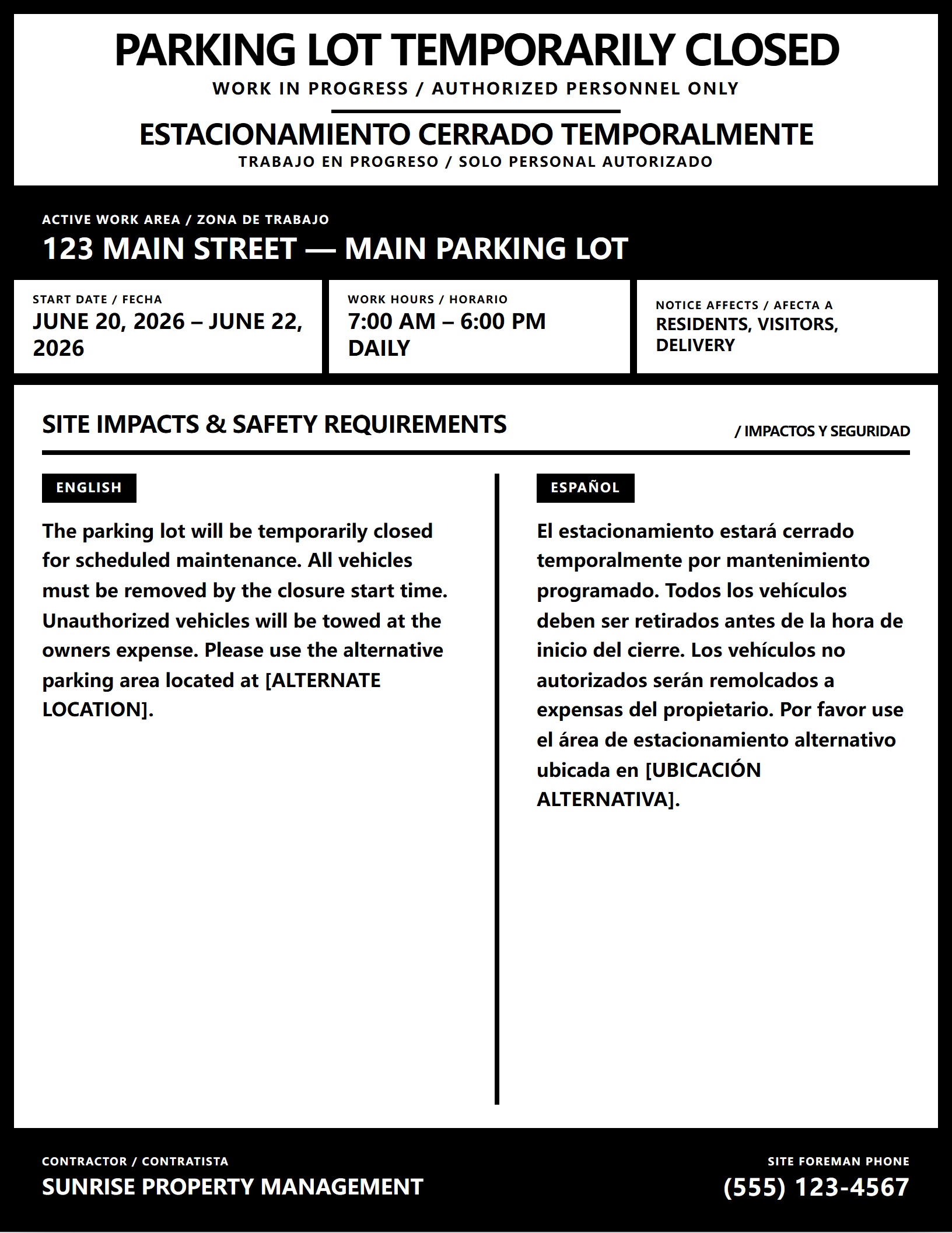
📋 Field Execution Asset
Download the OSHA-compliant manager checklist to ensure zero liability on-site.
🏠 Tenant Distribution Asset
Attach this prep-guide to your notice to reduce tenant front-desk calls by 60%.
Notice Editor & Preview
Edit Notice
Live Print Preview
US Letter • 8.5" x 11"
Legal Deadline Calculator
Powered by US Office of Personnel Management (OPM) rules.
Send digital notice to all residents via email & app
Place physical notices on vehicle windshields and at lot entrances
Install barricades, cones, and caution tape at all lot access points
Install directional signs to alternative parking areas
Perform parking lot maintenance, paving, or striping work
Compliance & Legal Disclaimer: Calculations are strictly based on U.S. Office of Personnel Management (OPM) observed federal holiday rules and standard weekend exclusions. While this tool is designed for enterprise-grade accuracy regarding FLSA and standard property management protocols (e.g., CA Civil Code §1950.5), local municipal codes may vary. NoticeMint is a workflow software, not a law firm. Always verify critical statutory deadlines with your legal counsel.
Execution Protocol
Operational Timeline & Compliance Checklist
- 7 days before closure Responsible: property manager
Send digital notice to all residents via email & app
💡Pro Strategy
Most state laws and standard lease agreements require at least 72 hours written notice for parking lot closures. 7 days is the industry best practice to reduce tenant complaints and allow time for alternative parking arrangements.
- 72 hours before closure Responsible: maintenance
Place physical notices on vehicle windshields and at lot entrances at parking_lot_entrance, vehicle_windshields, mail_kiosk
⚠️Liability Alert
Do NOT use adhesive or tape that could damage vehicle paint. Use windshield wiper clips or door handle hangers. Property can be liable for vehicle damage caused by improper notice placement.
💡Pro Strategy
Use bright-colored paper (yellow or orange) for windshield notices — they are 3x more likely to be noticed than white paper. Post signs at EVERY vehicle entrance to the lot. Ensure signs are at 48–60" height per ADA §4.2.5.
- At closure start Responsible: contractor
Install barricades, cones, and caution tape at all lot access points
💡Pro Strategy
Use OSHA-compliant barricades and high-visibility cones. Ensure fire lanes and emergency vehicle access remain unobstructed at all times — this is a non-negotiable fire code requirement.
- At closure start Responsible: maintenance
Install directional signs to alternative parking areas
⚠️Liability Alert
Failure to provide equivalent ADA parking during closure is a federal ADA violation and can result in fines up to $75,000 for first offense.
💡Pro Strategy
Alternative parking MUST be clearly marked and comparable in distance/safety to the original lot. If ADA spaces are affected, temporary ADA-compliant spaces must be provided with proper signage and access aisles per ADA §4.1.2.
- During closure period Responsible: contractor
Perform parking lot maintenance, paving, or striping work
💡Pro Strategy
Document all work with timestamped photos. If asphalt work is being done, ensure proper curing time before allowing vehicle traffic (typically 24-48 hours for fresh asphalt).
- 2 hours after closure start Responsible: property manager
Enforce towing of unauthorized vehicles remaining in closed lot
⚠️Liability Alert
Illegal towing is one of the highest-liability actions in property management. Tenants can sue for 2-4x the towing cost plus emotional distress. NEVER tow without documented proper notice and legal signage.
💡Pro Strategy
Per CA Vehicle Code §22658 and similar state laws, vehicles can only be towed from private property if proper notice was given (typically 72+ hours) AND clear "No Parking / Tow Away Zone" signs are posted. Ensure your towing company has all required documentation.
- Before reopening Responsible: maintenance
Inspect lot surface, striping, and ADA compliance before reopening
💡Pro Strategy
Verify: (1) All striping is clearly visible, (2) ADA spaces have proper signage and 60" access aisles, (3) Speed bumps and wheel stops are intact, (4) Lighting is functional, (5) No debris or equipment remains.
- After passing inspection Responsible: property manager
Reopen parking lot and restore full resident access
- Within 2 hours of reopening Responsible: maintenance AUTOMATABLE
Remove all barricades and closure signs, send reopening notification
💡Pro Strategy
Remove all closure signs promptly — stale signs cause confusion and erode trust. The system will automatically send a reopening notification to all residents via email/app.
Required Posting Locations
Physical Distribution Checklist
- parking_lot_entrance
- vehicle_windshields
- mail_kiosk
Liability Defense Rule
Always take a timestamped wide-angle photo of the posted notice in its physical location. If a tenant claims they were not notified, this photo is your primary legal defense.
Tenant Communication Brief
Anticipated Questions & Official Responses
-
Q
Why is the parking lot being closed?
- "The parking lot is being temporarily closed for essential maintenance, repairs, or resurfacing. This work is necessary to maintain a safe, functional parking area for all residents.
-
Q
¿Por qué se cierra el estacionamiento?
- "El estacionamiento se cierra temporalmente por mantenimiento esencial, reparaciones o repavimentación. Este trabajo es necesario para mantener un área de estacionamiento segura y funcional para todos los residentes.
-
Q
Where do I park during the closure?
- "Please use the designated alternative parking area located at [ALTERNATE LOCATION]. Temporary ADA-accessible spaces are available at [ADA LOCATION]. Follow the directional signs posted throughout the property.
-
Q
¿Dónde estaciono durante el cierre?
- "Por favor use el área de estacionamiento alternativo designada en [UBICACIÓN ALTERNATIVA]. Hay espacios temporales accesibles para ADA disponibles en [UBICACIÓN ADA]. Siga los letreros direccionales colocados en toda la propiedad.
-
Q
Will my car be towed if I leave it in the closed lot?
- "YES. Any vehicles remaining in the closed parking lot after the closure start time will be towed at the vehicle owners expense. Please move your vehicle to the alternative parking area before the closure begins.
-
Q
¿Remolcarán mi auto si lo dejo en el estacionamiento cerrado?
- "SÍ. Cualquier vehículo que permanezca en el estacionamiento cerrado después de la hora de inicio será remolcado a expensas del propietario del vehículo. Por favor mueva su vehículo al área de estacionamiento alternativo antes de que comience el cierre.
Manager's Note
Providing these answers in your initial notice can reduce management office phone volume by up to 60% during service interruptions.
Operational Guidance
Industry Best Practices & Field-Tested Strategies
Provide 7 days advance notice for parking lot closures — not the legal minimum of 72 hours. Parking disruptions affect daily routines, work commutes, and family logistics. Properties that give 7-day notice report 65% fewer complaints and 80% fewer vehicles requiring towing compared to 72-hour notice.
Schedule closures for Tuesday-Thursday when possible. Avoid Mondays (weekend accumulation of vehicles), Fridays (weekend move-in/out traffic), month-end (move-out season peak), and never schedule during major local events that limit street parking availability.
Phase closures by section rather than closing the entire lot at once. If your lot has 200 spaces, close 50 at a time over 4 days instead of all 200 for 1 day. Phased closures reduce alternative parking demand by 75%, eliminate the need for expensive off-site parking arrangements, and dramatically reduce tenant frustration.
For asphalt resurfacing projects, schedule during warm, dry weather with temperatures above 50°F (10°C) and no rain forecast for 48 hours. Asphalt requires proper curing time that varies with temperature: 24 hours at 70°F+, 48 hours at 50-70°F, and should not be applied below 50°F or in wet conditions. Weather delays can extend closures by days.
Photograph every vehicle in the lot BEFORE closure begins — license plates, condition, and location. This protects against false damage claims from tenants who blame construction equipment for pre-existing scratches, dents, or broken windows. Use timestamped, GPS-tagged photos from multiple angles.
Manager Checklist
- Verify towing company holds current state license, proper insurance, and compliant storage facility — obtain copies of all certificates
- Confirm towing company rates and storage fees in writing — ensure they are posted on all "Tow Away Zone" signage
- Review lease agreement parking clauses — verify your right to close lots and tow vehicles with proper notice
- Check weather forecast for closure period — asphalt work requires 50°F+ and 48 hours dry weather
- Identify EV charging stations in closure area — coordinate alternative charging access for affected residents
- Identify ADA-designated spaces in closure area — prepare temporary ADA spaces with proper signage and access aisles
- Send digital blast (portal + email + SMS) 7 days before closure
- Print bilingual notices on bright yellow paper and place on ALL vehicle windshields 72 hours before closure
- Post "Tow Away Zone" signs at EVERY lot entrance and at 50-foot intervals — include towing company name, phone, address, and rates
- Photograph ALL vehicles in the lot before closure begins — license plates, condition, and location with timestamps
- Install OSHA-compliant barricades and cones at ALL lot access points at closure start time
- Deploy directional signs to alternative parking areas — ensure routes are clear and well-lit
- Verify temporary ADA spaces are properly marked with signage, access aisles, and van-accessible options if required
- Wait 2 hours after closure start before authorizing any tows — gives stragglers final opportunity to move vehicles
- Document every tow with: vehicle make/model/license, tow time, towing company, and storage location
- After work completion: inspect lot surface, striping, ADA compliance, lighting, and debris removal
- Verify asphalt curing time before reopening — typically 24 hours at 70°F+, 48 hours at 50-70°F
- Remove all closure signs and barricades within 2 hours of reopening
- Send reopening notification via portal, email, SMS, and app
- File completion report with: towing log, vehicle photos, contractor certificates, weather documentation, and any incident notes
Common Costly Mistakes
- ✗ Towing vehicles without proper legal signage — most states require "No Parking / Tow Away Zone" signs posted at EVERY entrance and at intervals not exceeding 50 feet along the lot perimeter. Signs must include the towing company name, phone number, and storage facility address. Missing or improper signage makes towing illegal and exposes you to 2-4x towing cost damages plus emotional distress claims.
- ✗ Failing to coordinate with EV charging station users — residents with electric vehicles cannot simply park anywhere; they need access to charging infrastructure. If EV stations are in the closed area, you MUST provide alternative charging access or the closure effectively prevents EV owners from using their vehicles, creating ADA-like accommodation liability.
- ✗ Not providing written documentation of the towing company contract and rates — tenants have the right to know the towing company name, storage location, and fee schedule BEFORE their vehicle is towed. Surprise towing bills of $300-$800 (common in major metro areas) generate immediate legal threats and social media complaints.
- ✗ Using the same towing company for multiple properties without verifying their current licensing and insurance — towing companies must hold current state licenses, proper insurance, and compliant storage facilities. If a towing company loses their license or has insurance lapses, ALL tows they perform become illegal retroactively.
- ✗ Closing ADA-designated spaces without providing equivalent temporary ADA spaces — federal ADA requires temporary accessible spaces with proper signage, 60-inch access aisles, and van-accessible options if original spaces were van-accessible. First offense fines start at $75,000 and escalate rapidly for repeat violations.
Resident Preparation Checklist
Include this checklist in your notice to reduce tenant calls by up to 60%
- ☐ Move your vehicle to the alternative parking area BEFORE the closure start time — vehicles remaining in the closed lot WILL be towed at your expense
- ☐ Check your email, resident portal, and SMS for closure notifications — multiple reminders are sent at 7 days, 72 hours, and 24 hours before closure
- ☐ If you have an electric vehicle: check if your charging station is in the closure area and locate alternative charging options
- ☐ If you have an ADA placard: locate the temporary ADA parking area and verify it meets your accessibility needs
- ☐ Remove all valuables, important documents, and personal items from your vehicle before moving to alternative parking
- ☐ Photograph your vehicle condition before moving it — document any existing damage for your records
- ☐ If you cannot move your vehicle (medical emergency, vehicle breakdown, out of town): contact management IMMEDIATELY to discuss accommodations
- ☐ Do NOT park in fire lanes, loading zones, or other restricted areas during the closure — these will also be towed
- ☐ Do NOT attempt to bypass barricades or drive through closed areas — fresh asphalt and construction equipment create vehicle damage and personal injury hazards
- ☐ After reopening: wait for the official "Parking Lot Open" notification before returning your vehicle — premature use can damage fresh asphalt and void contractor warranties
- ☐ After reopening: inspect your vehicle for any new damage and report concerns to management within 24 hours with photos
Frequently Asked Questions
How much will it cost if my vehicle is towed?
What if I'm out of town and can't move my vehicle in time?
What about overnight guests, delivery trucks, or moving vehicles during the closure?
My vehicle was damaged during the parking lot work. What should I do?
What if the closure takes longer than expected due to weather or construction delays?
Can I get a rent reduction or parking fee refund for the closure period?
What about my EV charging station during the closure?
What if I see someone tampering with barricades or driving through the closed area?
Disclaimer
- • Most states require minimum 72-hour written notice for parking lot closures and vehicle towing. California Vehicle Code §22658, Texas Property Code §92.013, and Florida Statute §715.07 are common examples, but local ordinances may impose additional requirements.
- • Towing from private property requires proper "No Parking / Tow Away Zone" signage posted at EVERY entrance and at intervals not exceeding 50 feet. Signs must include: towing company name, phone number, storage facility address, and fee schedule.
- • Illegal towing exposes property owners to liability of 2-4x the towing cost plus storage fees, emotional distress damages, and attorney fees. Tenants can sue in small claims court or civil court depending on the amount.
- • ADA requires equivalent temporary accessible parking spaces when permanent ADA spaces are closed. Temporary spaces must have proper signage, 60-inch access aisles, and van-accessible options if original spaces were van-accessible. First offense fines start at $75,000.
- • Fire lanes and emergency vehicle access must remain unobstructed at all times during parking lot closures. Blocking fire lanes violates local fire codes and can result in immediate closure orders and fines of $500-$5,000 per violation.
- • Asphalt resurfacing requires proper curing time before vehicle traffic: typically 24 hours at 70°F+, 48 hours at 50-70°F, and should not be applied below 50°F or in wet conditions. Premature traffic causes permanent surface damage.
- • EV charging stations in closure areas require alternative charging access arrangements or written exceptions. Failure to provide charging access for electric vehicles may create accommodation liability similar to ADA requirements.
- • Photograph all vehicles in the lot before closure begins — license plates, condition, and location with timestamps. This documentation protects against false damage claims and provides evidence for legitimate claims.
- • Towing companies must hold current state licenses, proper insurance, and compliant storage facilities. Property owners can be held liable for tows performed by unlicensed or uninsured towing companies.
- • Always retain copies of all posted notices, digital communications, towing logs, vehicle photographs, contractor certificates, weather documentation, and incident reports for your compliance file.
- • This template provides formatting and operational guidance only and does not constitute legal advice. Consult your property attorney, towing company, and local authorities for jurisdiction-specific compliance.
Related Operational Tasks
Complete your communication workflow with these related notices