Property Communication Task Center
Caution: Ladder In Use — Overhead Work 🛡️ 2026 OSHA/FHA Compliant
Warn pedestrians and occupants of active ladder work and overhead falling-object hazards, enforce OSHA-compliant barricading of the drop zone below, ensure ladder stability and 3-point contact protocols, and eliminate premises liability for both fall injuries and struck-by incidents.
Not just a template.
A reality execution tool.
Don't risk tenant disputes with messy Word docs. Generate a print-ready, OSHA-compliant physical notice in exactly 30 seconds.
- 1Bilingual Architecture English & Spanish integrated into a single US Letter design. Crucial for legal compliance in 14+ states.
- 2Toner-Friendly Print Engineered for black-and-white office printers. High contrast hierarchy ensures readability from 10 feet away.
- 3Locked Formatting Zero layout breakage. Type your details, and the engine physicalizes it without overflowing the page.
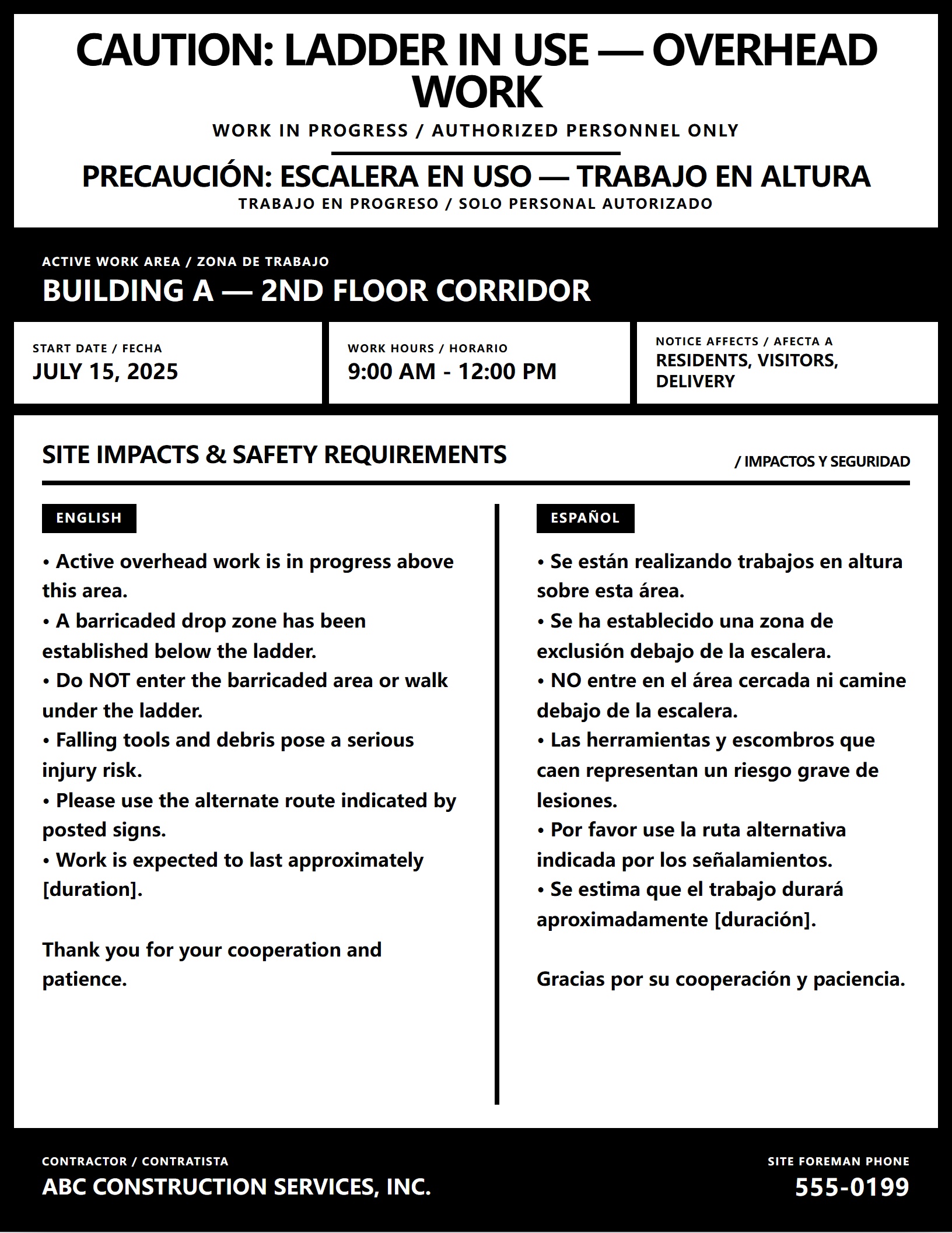
CAUTION: LADDER IN USE — OVERHEAD WORK
PRECAUCIÓN: ESCALERA EN USO — TRABAJO EN ALTURA
Why use this template?
- ✓ Bilingual output (English/Spanish) prevents FHA liability
- ✓ Formatted strictly for US Letter B&W physical printing
- ✓ Zero JS bloat, generates instantly in your browser
Print Output Preview
📋 Field Execution Asset
Download the OSHA-compliant manager checklist to ensure zero liability on-site.
🏠 Tenant Distribution Asset
Attach this prep-guide to your notice to reduce tenant front-desk calls by 60%.
Notice Editor & Preview
Edit Notice
Live Print Preview
US Letter • 8.5" x 11"
Execution Protocol
Operational Timeline & Compliance Checklist
- Before Each Use Responsible: contractor
Inspect Ladder & Ground Conditions
⚠️Liability Alert
Using a defective ladder or placing it on an unstable surface is an OSHA 1926.1053(b) violation. Falls from ladders account for approximately 1/3 of all construction fall fatalities — most occur from heights of only 6-15 feet, not from extreme elevations.
💡Pro Strategy
Conduct a pre-use inspection of the ladder: check for cracked rungs, bent rails, missing feet, and damaged spreaders. Verify the ladder is rated for the task (Type I Industrial = 250 lbs minimum for construction work). Confirm the ground surface is firm, level, and dry — never set a ladder on boxes, barrels, or unstable bases to gain extra height.
- Before Climbing Responsible: contractor
Barricade Drop Zone Below Ladder
⚠️Liability Alert
The drop zone must be barricaded BEFORE anyone climbs the ladder. Workers reaching for tools outside their body footprint cause ladder shifts that send unsecured tools and materials tumbling. Never rely on verbal warnings alone — pedestrians in busy corridors will walk past a worker shouting "watch out."
💡Pro Strategy
Establish a barricaded drop zone below and around the ladder with a minimum radius equal to the ladder height (e.g., a 12-ft ladder requires a 12-ft radius exclusion zone). Use cones, caution tape, or A-frame signs to mark the perimeter. A wrench dropped from 12 feet strikes the ground at approximately 28 mph — sufficient to cause fatal head injuries.
- Before Work Begins Responsible: contractor
Post Overhead Work Warning Signs at Both ends of work corridor, Lobby, Elevator landing
💡Pro Strategy
Post bilingual warning signs at every approach point to the ladder work zone. Signs must be visible from a distance and include the universal "falling objects" pictogram. In high-traffic corridors, add a floor-level "STOP — Overhead Work Ahead" sign with a detour arrow.
- Active Work Period Responsible: contractor
Execute Ladder Work with 3-Point Contact
⚠️Liability Alert
Leaning outside the ladder rails (belt buckle past the rail) is the #1 cause of ladder tip-overs. The rule of thumb: if your belt buckle extends beyond the ladder rail, you are overreaching and must descend and reposition the ladder.
💡Pro Strategy
Maintain 3-point contact (two hands and one foot, or two feet and one hand) at all times while climbing or working. Tools and materials must be hoisted with a rope and bucket or carried in a tool belt — never carried in hands while climbing. Set straight/extension ladders at the 4:1 ratio (1 foot out from the wall for every 4 feet of height).
- During Active Work in Corridors Responsible: contractor
Deploy Spotter for High-Traffic Areas
⚠️Liability Alert
A ladder placed in a doorway or corridor without a spotter or barricade is a catastrophic hazard. A pedestrian pushing through a door can strike the ladder base, causing an immediate tip-over. OSHA 1926.1053(b)(8) specifically requires that ladders placed in passageways or doorways be secured or barricaded.
💡Pro Strategy
In high-traffic corridors, lobbies, or near building entrances, station a ground-level spotter to redirect pedestrians away from the drop zone. The spotter should also monitor ladder stability — if the ladder is bumped by a pedestrian or cart, the spotter alerts the climber immediately.
- Upon Task Completion Responsible: contractor
Clear Drop Zone & Reopen Corridor
⚠️Liability Alert
Do not leave the ladder in place "for the next task" without maintaining the barricade. An unattended ladder in an un-barricaded area is an attractive nuisance — children, curious tenants, or untrained staff may attempt to climb it.
💡Pro Strategy
After the worker descends, sweep the floor below the ladder for any dropped fasteners, wire clippings, drywall fragments, or tool parts that could become tripping hazards. Remove all barricades and warning signs, and verify the corridor is fully passable before reopening.
- Immediately After Reopening Responsible: contractor
Remove Warning Signs & Store Ladder at Both ends of work corridor, Lobby, Elevator landing
💡Pro Strategy
Remove all posted warning signs and store the ladder in a designated equipment room or locked vehicle — never leave ladders in common areas, hallways, or unlocked storage closets where unauthorized persons could access them.
Required Posting Locations
Physical Distribution Checklist
- Both ends of work corridor
- Lobby
- Elevator landing
Liability Defense Rule
Always take a timestamped wide-angle photo of the posted notice in its physical location. If a tenant claims they were not notified, this photo is your primary legal defense.
Tenant Communication Brief
Anticipated Questions & Official Responses
-
Q
How long will the ladder work take?
- "Most indoor ladder tasks (light fixture replacement, ceiling tile repair, smoke detector service) take 15-60 minutes per location. The barricaded zone will be removed as soon as the worker descends and clears the area.
-
Q
Can I walk past the ladder if I'm careful?
- "No. The barricaded drop zone is a hard exclusion — you must use the alternate route. A dropped tool or debris fragment falls at speeds that make it impossible to dodge, even if you are alert.
Manager's Note
Providing these answers in your initial notice can reduce management office phone volume by up to 60% during service interruptions.
Operational Guidance
Industry Best Practices & Field-Tested Strategies
Conduct a pre-use ladder inspection every time: check for cracked rungs, bent rails, missing non-slip feet, and damaged spreaders. Tag and remove any defective ladder from service immediately — do not attempt field repairs.
Establish a barricaded drop zone with a minimum radius equal to the ladder height before anyone climbs. A tool dropped from 12 feet strikes at approximately 28 mph — sufficient to cause fatal head injuries to unprotected pedestrians below.
Set straight and extension ladders at the 4:1 ratio: for every 4 feet of ladder height, the base must be 1 foot away from the wall. Use the "stand with toes touching the ladder feet — your outstretched arms should just reach the rung at shoulder height" field test.
Maintain 3-point contact (two hands and one foot, or two feet and one hand) at all times while climbing or working. Tools must be hoisted with a rope and bucket or carried in a tool belt — never in hands.
Station a ground-level spotter when working in high-traffic corridors, lobbies, or near doorways. The spotter redirects pedestrians and monitors ladder stability if the base is bumped.
Use fiberglass (non-conductive) ladders for any work near electrical panels, light fixtures, or exposed wiring — aluminum ladders create electrocution risk and are prohibited by OSHA near energized equipment.
Remove all barricades and warning signs immediately after the worker descends and the drop zone is cleared. Leaving barricades in place when no work is active trains pedestrians to ignore future warnings.
Manager Checklist
- Verify contractor has provided ladder safety training records for all workers who will be climbing (OSHA requires training per 1926.1060)
- Confirm ladders on-site are Type I Industrial rated (250 lbs minimum) and have current inspection tags
- Verify drop zone barricading protocol: minimum radius equal to ladder height, cones + tape + bilingual warning signs
- Confirm spotter deployment plan for any ladder work in high-traffic corridors, lobbies, or near building entrances
- Verify workers have tool belts and rope-and-bucket systems — no tools carried in hands while climbing
- Confirm fiberglass (non-conductive) ladders are specified for any work near electrical panels or light fixtures
- Ensure bilingual warning notices are posted at every approach point before climbing begins
- Brief front desk and security staff on the work locations and expected duration so they can redirect tenants
- Verify contractor understands ladders must be removed from common areas when not in active use
- Establish protocol for immediate corridor reopening and barricade removal after each task is completed
Common Costly Mistakes
- ✗ Placing a ladder directly in front of an unlocked door without barricading or locking the door — a pedestrian pushing through can strike the ladder base, causing an immediate tip-over. OSHA 1926.1053(b)(8) requires barricading or securing.
- ✗ Setting the ladder on boxes, barrels, or stacked materials to gain extra height — this is an explicit OSHA violation and the leading cause of ladder base instability on indoor job sites.
- ✗ Overreaching beyond the ladder rails (belt buckle past the rail) — this is the #1 cause of ladder tip-overs during indoor maintenance work. Workers must descend and reposition rather than lean.
- ✗ Carrying tools or materials in hands while climbing — this breaks 3-point contact and is the primary cause of ladder falls during ascent and descent. Use a tool belt or rope-and-bucket hoist system.
- ✗ Failing to barricade the drop zone — verbal warnings ("don't walk here") are completely ineffective in busy corridors. A hard barricade (cones + tape + signs) is the only reliable pedestrian control method.
- ✗ Leaving the ladder in place between tasks without maintaining barricades — an unattended, un-barricaded ladder is an attractive nuisance that invites unauthorized climbing by children, tenants, or untrained staff.
- ✗ Using aluminum ladders near electrical work — fiberglass (non-conductive) ladders are mandatory when working within 10 feet of any energized electrical equipment or exposed wiring per OSHA 1926.1053(b)(12).
Resident Preparation Checklist
Include this checklist in your notice to reduce tenant calls by up to 60%
- ☐ Observe all barricades and warning signs — do not enter the marked drop zone under any circumstances
- ☐ Use the alternate route indicated by posted directional signs rather than attempting to squeeze past the ladder
- ☐ Keep children and pets away from the barricaded area — dropped tools fall at high speed and cannot be dodged
- ☐ Do not touch, move, or lean against any ladder, even if it appears unattended
- ☐ If you need to pass through the work area with a stroller or wheelchair, ask the spotter or worker for assistance with the alternate route
- ☐ Report any ladder that appears unstable, wobbly, or placed on an uneven surface to management immediately
- ☐ Be patient — most indoor ladder tasks (light fixture, ceiling tile, smoke detector) take 15-60 minutes per location
Frequently Asked Questions
How far back should pedestrians stay from a ladder?
Is a spotter required for indoor ladder work?
Can tenants climb the ladder if they just need to reach something quickly?
What type of ladder is required for electrical work?
What if the ladder work blocks the only exit from my unit?
Disclaimer
- • OSHA 29 CFR 1926.1053 (Ladders) governs all ladder safety requirements in construction, including design, inspection, setup angles, load ratings, and use protocols.
- • OSHA 29 CFR 1926.1060 requires that all workers using ladders receive training on proper use, inspection, and hazard recognition.
- • ANSI A14.1-A14.5 series sets the manufacturing and testing standards for portable ladders (wood, metal, fiberglass, reinforced plastic).
- • OSHA 29 CFR 1926.501(b) requires fall protection at 6 feet in construction — however, portable ladder work is specifically exempt from tie-off requirements under 1926.501(b)(1) provided the ladder is properly set up and used.
- • NFPA 101 Life Safety Code requires that egress paths remain clear at all times — ladder work that blocks a designated fire exit is an immediate code violation.
- • This template provides formatting and operational guidance only and does not constitute legal advice. Consult your safety director and construction attorney for jurisdiction-specific compliance.
Related Operational Tasks
Complete your communication workflow with these related notices